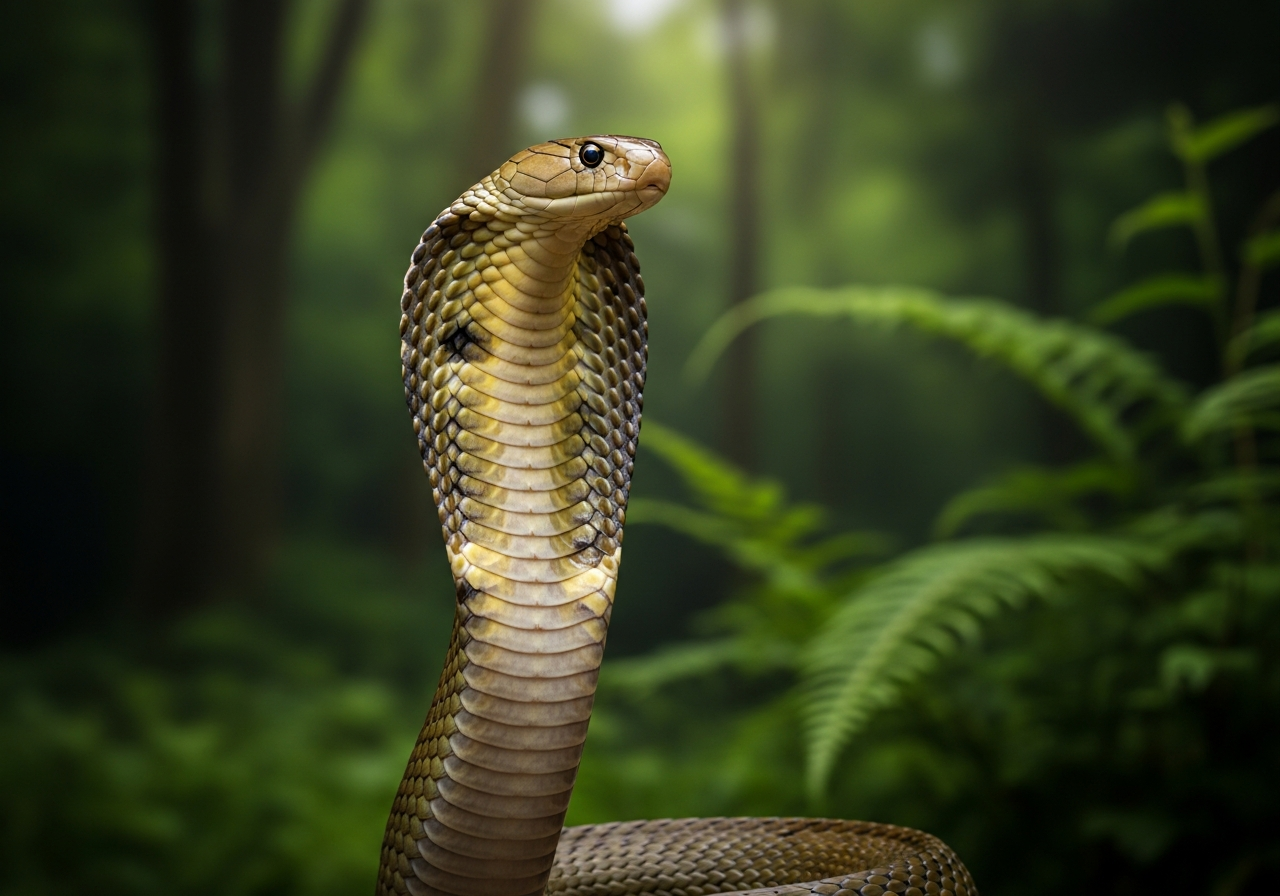
The king cobra (Ophiophagus hannah) is a reptile of the family Elapidae, in the order Squamata.
Quick answer
The king cobra is the longest venomous snake in the world, reaching up to 5.5 m (18 ft). Native to forests across South and Southeast Asia, it feeds almost entirely on other snakes. Its venom is potent enough to kill an elephant in large doses, yet it is shy and avoids people. King cobras are also the only snakes that build a nest for their eggs. They live around 20 years.
Top questions about the King Cobra
King Cobra facts at a glance
- Weight 9 kg
- Length 5.5 m
- Top speed 18 km/h
- Lifespan 20 years
| Scientific name | Ophiophagus hannah |
|---|---|
| Diet | Carnivore (mainly other snakes) |
| Habitat | Forests, mangroves, grasslands of Asia |
| Lifespan | ~20 years |
| Length | Up to 5.5 m (18 ft) |
| Venom | Potent neurotoxin |
| Conservation status | Vulnerable (IUCN) |
| Kingdom | Animalia |
|---|---|
| Phylum | Chordata |
| Class | Reptilia |
| Order | Squamata |
| Family | Elapidae |
| Genus | Ophiophagus |
Where it lives
The king cobra (Ophiophagus hannah) is native to The forests and jungles of India, southern China, and Southeast Asia. — recorded across Asia in this guide’s range summary.
For occurrence records, see GBIF species search and sources below.
How big is a king cobra?
An adult king cobra measures 5.5 m long — about 3.2× the height of an average adult person (1.73 m) — and weighs around 9.0 kg, about 13% of an average adult’s body weight (70 kg).
Length vs an average adult’s height (to scale)
What is a group of king cobras called?
Group name (collective noun)
A group of King Cobras is called a nest. It is also known as a den or a bed.
Baby name
A baby King Cobra is called a snakelet. It may also be called a hatchling.
Explore more animal collective nouns and baby animal names .
Behavior
The king cobra is intelligent and alert for a snake. When threatened it can raise up to a third of its body off the ground, spread its narrow hood, and emit a low growl-like hiss. Despite its fearsome reputation, it is generally shy and prefers to flee rather than confront people.
Diet and venom
Its scientific name, Ophiophagus, means "snake-eater," and the king cobra feeds mainly on other snakes, including venomous species. Its venom is a powerful neurotoxin delivered in large quantities; a single bite can deliver enough to be fatal to a human within hours if untreated.
Nesting
King cobras are the only snakes known to build a nest for their eggs. The female gathers leaves into a mound, lays 20 to 40 eggs inside, and guards the nest until the young are ready to hatch, an unusual level of parental care for a reptile.
Conservation
King cobras are listed as Vulnerable, threatened by deforestation, collection for skins and traditional medicine, and persecution out of fear. Protecting the forests of South and Southeast Asia is key to their survival.
Dig deeper into the King Cobra
- Are King Cobras Endangered?
Are king cobras endangered? Status Vulnerable, main threats, and what protection means.
- How King Cobra Venom Works
The king cobra is the longest venomous snake in the world, reaching up to 5.
- How Long Do King Cobras Live?
King Cobra lifespan is typically ~20 years. What shortens or extends life, life stages, and status (Vulnerable).
- King Cobra Bite Treatment
The king cobra is the longest venomous snake in the world, reaching up to 5.
- What Do King Cobras Eat?
What king cobras eat: Carnivore (mainly other snakes), foraging style, and seasonal shifts in Forests, mangroves, grasslands of Asia.
- King Cobra Habitat
The king cobra is the longest venomous snake in the world, reaching up to 5.
- King Cobra Nest
The king cobra is the longest venomous snake in the world, reaching up to 5.
- How Big Is A King Cobra?
King Cobra size and weight: typical about 9 kg, dimorphism, and growth.
- King Cobra Venom
The king cobra is the longest venomous snake in the world, reaching up to 5.
- King Cobra Vs Mongoose
The king cobra is the longest venomous snake in the world, reaching up to 5.
- King Cobra Vs Python
The king cobra is the longest venomous snake in the world, reaching up to 5.
- What Do King Cobras Eat?
What king cobras eat: Carnivore (mainly other snakes), foraging style, and seasonal shifts in Forests, mangroves, grasslands of Asia.
- Where Do King Cobras Live?
Where king cobras live: Forests, mangroves, grasslands of Asia, native range cues, and human overlap. Status Vulnerable.
Explore the King Cobra
Compare
Close relatives
- Black Mamba Same family
- Inland Taipan Same family
- Eastern Coral Snake Same family
- Coastal Taipan Same family
Collections
Range & geography
Did you know? King Cobra facts
- The king cobra is the world's longest venomous snake, reaching up to about 5.5 m.
- It can rear up to a third of its length and look a standing adult in the eye.
- King cobras mainly eat other snakes, including venomous ones.
- They are the only snakes known to build a nest for their eggs.
- A single bite delivers a large dose of neurotoxic venom.
- Despite this, king cobras are shy and usually avoid people.
Diet & feeding
King cobras feed predominantly on other snakes, including pythons and venomous species, and occasionally monitor lizards, locating prey by scent.
Adaptations
- A large venom yield of neurotoxins rapidly disables prey.
- The ability to rear high gives an intimidating defensive posture and striking reach.
- A specialised diet of snakes is supported by resistance to some snake venoms.
- Keen chemical sensing via the tongue and Jacobson's organ tracks snake prey.
Behaviour & ecology
- King cobras hunt other snakes, following scent trails to their prey.
- Females build and guard a nest of leaves for their eggs — unique among snakes.
- They flee from humans when possible, rearing and hissing only if cornered.
- They are mostly active by day in forest and near water.
Communication
- A low, resonant hiss (almost a growl) warns intruders.
- Rearing and hood-spreading are visual threat displays.
- Chemical cues via tongue-flicking dominate prey tracking.
Habitat & range
King cobras live in forests, mangroves, and farmland across South and Southeast Asia, often near streams and dense vegetation that shelter their snake prey.
Ecological role
As a top predator of other snakes, the king cobra helps regulate snake populations and sits high in the food web of Asian forest ecosystems.
Conservation status of the King Cobra
The king cobra (Ophiophagus hannah) is listed as Vulnerable on the IUCN Red List. Vulnerable (VU) means a species faces a high risk of extinction in the medium-term future. It is the lowest-risk of the three 'threatened' IUCN categories — one step below Endangered, which is itself below Critically Endangered — and is often an early warning that a population is in trouble.
The king cobra (Ophiophagus hannah) is assessed on the IUCN Red List. Look up on the IUCN Red List .
Frequently asked questions about the King Cobra
How long is a king cobra?
The king cobra is the longest venomous snake, averaging 3 to 4 m and reaching up to 5.5 m (18 ft) in exceptional individuals.
How dangerous is a king cobra's venom?
King cobra venom is a potent neurotoxin delivered in large amounts. An untreated bite can be fatal to a human within hours, though the snake is shy and bites on people are rare.
What do king cobras eat?
King cobras eat mainly other snakes, including venomous ones, along with the occasional lizard. Their name Ophiophagus literally means "snake-eater."
Do king cobras build nests?
Yes. King cobras are the only snakes that build a nest for their eggs. The female heaps up leaves, lays her eggs inside, and guards the nest until they are ready to hatch.
Are king cobras aggressive?
Not usually. King cobras are alert and will display a raised hood when cornered, but they are generally shy and prefer to escape rather than attack.
Are king cobras endangered?
King cobras are listed as Vulnerable by the IUCN, mainly due to habitat loss and collection. Their forest homes across Asia are shrinking.
What is a group of king cobras called?
A group of King Cobras is called a nest. It is also known as a den or a bed.
What is a baby king cobra called?
A baby King Cobra is called a snakelet. It may also be called a hatchling.
Sources & references
This guide is compiled and reviewed against established zoological and conservation references. Key sources for the King Cobra:
-
IUCN Red List of Threatened Species
Conservation status (Vulnerable) reflects the IUCN Red List category for Ophiophagus hannah.
-
iNaturalist — observations & photos
Search citizen-science observations and community IDs for Ophiophagus hannah. Useful for range checks and recent sightings — not a substitute for formal Red List status.
-
GBIF — occurrence data
Global Biodiversity Information Facility species search for Ophiophagus hannah. Explore published occurrence records used in range research.
- Stuart, B. et al. (2012). Ophiophagus hannah. IUCN Red List of Threatened Species.
Status (Vulnerable) and threats.
- The Reptile Database (reptile-database.org).
Taxonomy and distribution.
- Animal Diversity Web — Ophiophagus hannah. University of Michigan Museum of Zoology.
Life history, morphology, and range.
-
Global Animal Guide editorial standards
How we research, source, review, and update every guide for accuracy.