How Smart Are Animals? Intelligence Beyond Humans
Crows use tools, dolphins recognise themselves, elephants mourn their dead — what animal intelligence really means, how scientists measure it, and standout species.
Global Animal Guide · June 23, 2026
Quick answer
Animal intelligence is not one thing — it includes problem-solving, tool use, social learning, memory, and self-awareness. Species excel in different ways: corvids and parrots solve puzzles, cetaceans cooperate in complex societies, elephants show long-term memory and grief-like behaviour, and octopuses learn through trial and error despite short lifespans. Comparing brains fairly means looking at behaviour in context, not human IQ tests.
What counts as intelligence?
Human IQ tests measure one narrow band of ability. In the wild, intelligence is whatever helps an animal survive and reproduce — finding food, avoiding predators, navigating, remembering routes, and reading social allies or rivals.
Researchers look for:
- Tool use and manufacture
- Problem-solving and innovation
- Social learning (copying others)
- Long-term memory
- Self-recognition (mirror tests, though debated)
- Cooperation and deception
A desert ant’s path integration is genius for its world even if it cannot open a jar.
That last point is the whole difficulty of the field. Every test is administered in some sensory world, and if it is not the animal’s own, the animal fails for reasons that have nothing to do with thinking. Ask an elephant to solve a puzzle with its eyes and it looks unremarkable; let it work with its trunk and its nose and it looks formidable. Early mirror tests on gorillas suggested they lacked self-recognition, until researchers noticed that in gorilla society a prolonged stare is a threat — the animals were avoiding eye contact, not failing to recognise themselves. A negative result in comparative cognition is usually a statement about the experiment.
Standout cognitive performers
Corvids (crows, ravens, jays) — Plan for future food caching, recognise human faces, solve multi-step puzzles, and use tools. New Caledonian crows craft hooked sticks from leaves.
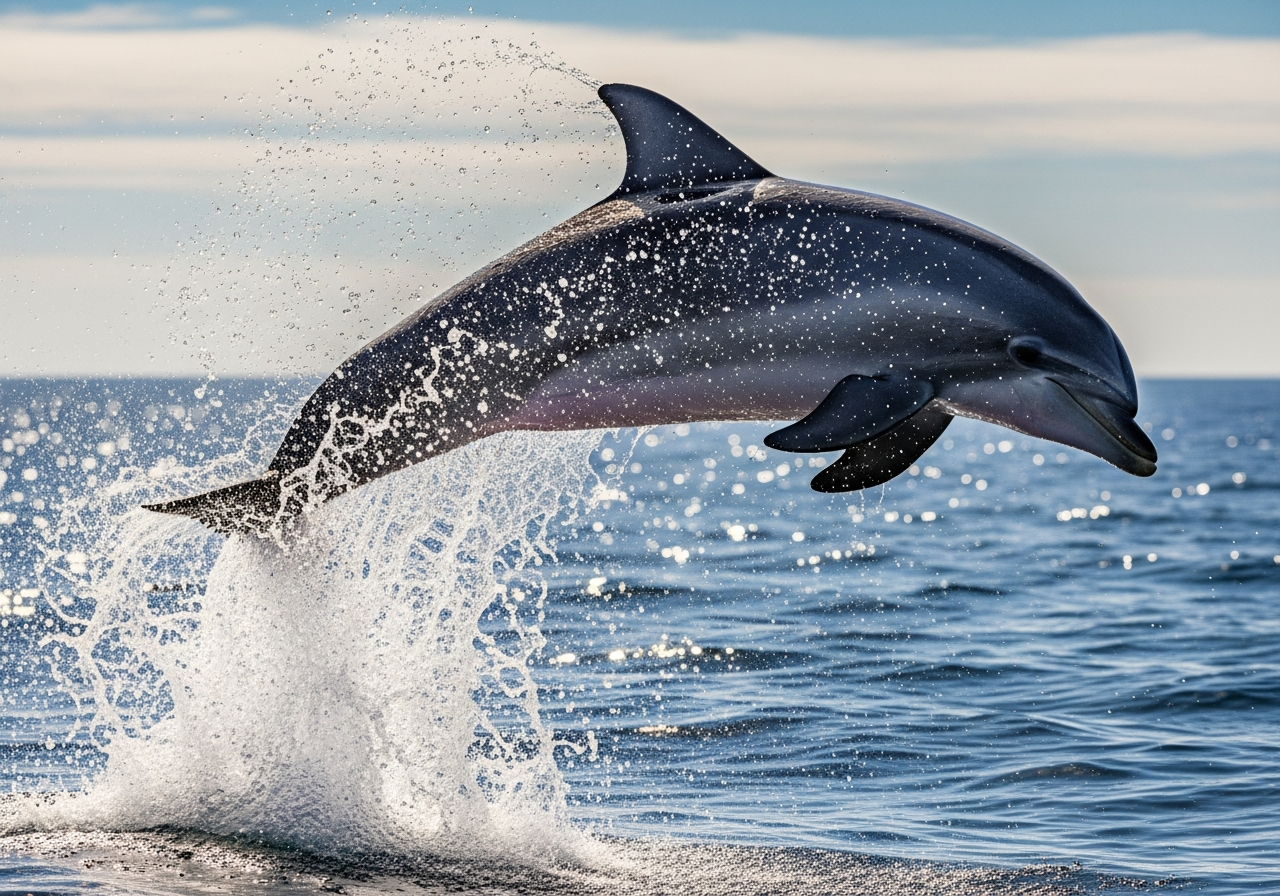
Cetaceans (dolphins, whales) — Live in fission-fusion societies with regional “cultures.” Bottlenose dolphins cooperate in hunting and may recognise themselves in mirrors. Sperm whales carry distinct vocal clan identities across generations.
Primates — Chimpanzees use tools, hunt cooperatively, and show empathy in controlled studies. Bonobos resolve conflict through social bonding. Orangutans delay gratification and plan routes through forest canopy.
Elephants — Remember water sources across droughts, cooperate to rescue calves, and respond strongly to dead companions — behaviours suggesting deep social cognition.
Parrots — African grey parrots grasp number concepts and combine labels in ways that resemble early language learning in children.
Octopuses — Solitary, short-lived, yet capable of opening jars, escaping enclosures, and learning by observation — remarkable for an invertebrate nervous system organised differently from ours.
Caching, planning, and the memory problem
The corvid work deserves unpacking, because it is where the strongest evidence for animal foresight comes from. A jay that hides thousands of food items across a landscape faces a brutal retrieval problem: it must recall not just where each cache is but what is in it and how long ago it was buried, since a worm rots and a nut does not. Scrub-jays in controlled studies recover perishable caches first and switch to durable ones once enough time has passed — evidence of a memory with a what, a where, and a when bound together, which is close to what we call episodic memory in ourselves.
They also behave as though they model other minds. A jay that has itself stolen from others will re-hide its own caches if another bird watched it bury them — but only if it was watched. The inference is uncomfortable and much argued over, and the conservative reading is that the bird has learned a rule about being observed rather than reasoning about what a rival knows. That argument is not settled, and it is worth noticing that the same argument runs for chimpanzees and, in a quieter way, for young children.
Dogs and domestic animals
Dogs excel at reading human pointing, gaze, and emotion — skills honed by thousands of years of co-evolution. Cats show object permanence and social learning but are harder to study in labs. Pigs outperform dogs on some spatial memory tasks. Horses read subtle human body language.
Domestication shaped intelligence toward human partnership as much as independent problem-solving.
The trade-off is real and measurable. Faced with an unsolvable puzzle box, a dog turns and looks at the nearest human within seconds; a hand-raised gray wolf keeps working at the box alone and often solves it. That is not the dog being stupid. It is the dog applying the strategy that has worked for its lineage for millennia — recruit the primate. Domestication did not simply blunt wild cognition; it redirected it towards a new and highly rewarding problem, which is us.
Why intelligence varies
Brain size alone misleads — birds achieve complex cognition with small, dense brains. Environment drives specialisation: bats navigate by echolocation; migratory birds map magnetic fields; bees communicate food locations through dance.
Two pressures come up again and again in explanations. One is social: keeping track of who is allied with whom, who owes whom, and who can be deceived is computationally expensive, and the most cognitively impressive animals are disproportionately those living in shifting groups — primates, cetaceans, corvids, elephants. The other is ecological: extractive foraging, where the food is embedded in something and must be worked out of it, rewards flexibility in a way that grazing never does. The sea otter hammering a shell and the capuchin cracking a nut with a stone are both solving that class of problem.
The octopus breaks both rules and is the most valuable case in the field for exactly that reason. It is solitary, lives a year or two, receives no teaching, and yet learns quickly — with most of its neurons distributed into its arms rather than centralised in a brain. If complex cognition can be built that differently, then whatever intelligence is, it is not one architecture. It is a set of problems that many architectures can be shaped to solve.
Ethics of studying animal minds
Recognising animal cognition supports stronger welfare laws and conservation — if elephants grieve and dolphins suffer in captivity, that carries moral weight. It also reminds us humans share the planet with other minds adapted to problems we can barely imagine.
The practical consequences are already visible. Cephalopods were brought under laboratory animal welfare protection in several jurisdictions on cognitive grounds, despite being invertebrates. Evidence on cetacean social complexity has driven the closure of orca programmes and shifted the argument about captivity generally. And the intellectual habit runs both ways: the more carefully we test, the more often the interesting finding is not that an animal is cleverer than expected, but that it is clever about something we never thought to ask about.
Sources
Related reading: Why do cats purr? · Why do dogs tilt their heads? · Animals that mate for life
Frequently asked questions
Which animal is the smartest?
There is no single winner — intelligence is multi-dimensional. Chimpanzees, dolphins, corvids, elephants, and octopuses are among the most studied for advanced cognition.
Do animals have consciousness?
Many scientists accept that mammals and birds likely experience emotions and awareness, though measuring subjective experience remains difficult.
Can animals use tools?
Yes — examples include chimpanzees using sticks for termites, crows bending wire to retrieve food, and otters using rocks to crack shells.
Do dogs understand human words?
Border collies in research have learned hundreds of object names; most dogs read human gestures and tone better than any other species.