Bears of the World: All 8 Living Species
Meet every living bear species — polar, brown, American black, Asiatic black, sun, sloth, spectacled, and giant panda — with size, range, diet, and conservation status.
Global Animal Guide · July 10, 2026
Quick answer
There are eight living bear species in family Ursidae: polar bear, brown bear (including grizzly), American black bear, Asiatic black bear, sun bear, sloth bear, spectacled (Andean) bear, and giant panda. Most are omnivores; the polar bear is the most carnivorous. Several are Vulnerable or Endangered.
Last updated: July 2026.
Eight species of bear survive today, and between them they occupy Arctic sea ice, Andean cloud forest, Himalayan slopes, Southeast Asian rainforest, and the suburbs of North America. They descend from a single family, Ursidae, that split from other carnivorans tens of millions of years ago — and the striking thing about them is not how similar they are, but how far a fairly conservative body plan has been pushed in different directions.
Quick comparison
| Species | Range highlight | Diet note | IUCN (typical) |
|---|---|---|---|
| Polar bear | Arctic sea ice | Seals | Vulnerable |
| Brown bear | Eurasia, N. America | Omnivore | Least Concern (some pops threatened) |
| American black bear | North America | Omnivore | Least Concern |
| Asiatic black bear | Asia | Omnivore | Vulnerable |
| Sun bear | SE Asia | Omnivore / insects, fruit | Vulnerable |
| Sloth bear | Indian subcontinent | Termites, fruit | Vulnerable |
| Spectacled bear | Andes | Mostly plants | Vulnerable |
| Giant panda | China | Bamboo specialist | Vulnerable |
What makes a bear a bear
Every ursid shares a recognisable kit: a heavy, muscular body with a short tail, a long snout packed with scent-processing tissue, small eyes, rounded ears, and five non-retractable claws on each foot. Bears walk plantigrade — heel to toe, flat-footed, like humans — which sacrifices running speed for stability, climbing ability, and the capacity to rear up and use the forelimbs as arms. It is a design for strength and versatility rather than pursuit.
The teeth tell the more interesting story. Bears inherited the carnassial shear of the order Carnivora, but in every species except the polar bear those blades have been flattened into broad, bumpy crushing surfaces suited to grinding vegetation. The canines stayed long. The result is a mouth that can kill and also process fruit, roots, and grass — an omnivore’s compromise, held together by an unusually good nose.
That nose is the bear’s principal sense organ. The olfactory surface area and the brain region devoted to smell are both enlarged relative to most carnivorans, and bears routinely locate carrion or fruiting trees from kilometres away. Sight and hearing are adequate; smell is the map.
Seasonal fattening and the truth about denning
Temperate bears live on a boom-and-bust calendar. In late summer and autumn a brown bear or black bear enters hyperphagia — a period of near-continuous feeding that can add enormous fat reserves in weeks. That fat is not indulgence; it is the entire winter budget.
Denning bears are often called hibernators, and there is a genuine argument about the term. A hibernating ground squirrel drops its body temperature close to freezing and rouses periodically to urinate and defecate. A denning bear lets its temperature fall only a handful of degrees, drops its heart rate dramatically, and yet neither eats, drinks, urinates, nor defecates for months — recycling urea into protein rather than excreting it. It can also wake and walk out within moments if disturbed, which a truly torpid rodent cannot. Physiologists now generally accept bears as hibernators of a distinct, shallow-but-efficient kind. See hibernation explained.
Females give birth mid-den to tiny, blind, nearly hairless cubs, and nurse them on stored fat alone. Tropical bears — sun and sloth bears — do not den at all, because their food supply never disappears.
Four ways to be a bear
The carnivore. The polar bear is the outlier: a brown bear lineage that went to the ice and specialised on seal blubber. Its molars re-sharpened, its gut shortened, its fur turned translucent over black skin, and its feet grew wide with papillae for grip. It is the most meat-dependent bear and, because it hunts from sea ice, the one most directly exposed to a warming Arctic.
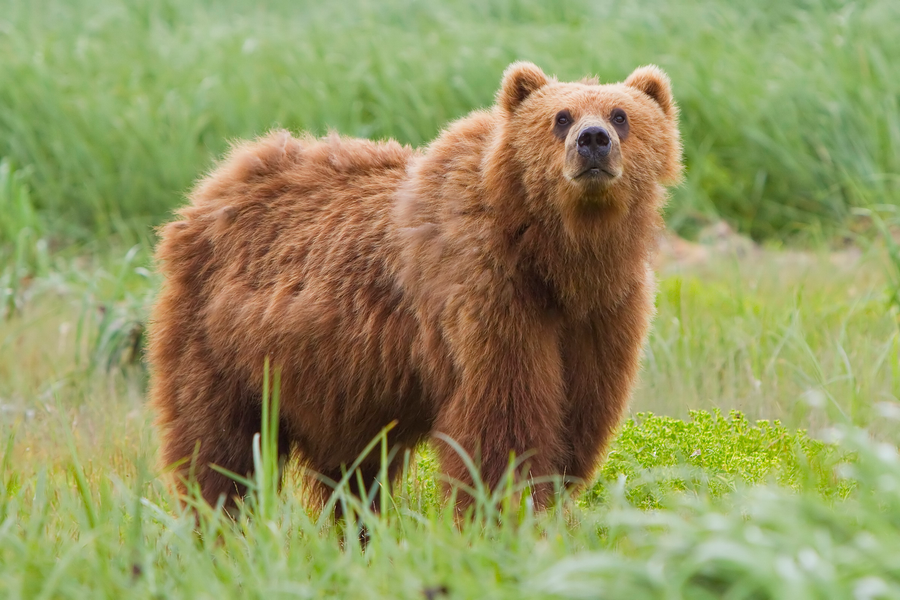
The generalist. Brown bears — including the grizzly bear and the huge coastal Kodiak population — and American black bears are opportunists. Diet varies with what is available: sedges in spring, salmon runs, berries, ungulate calves, insects, carrion. This flexibility is exactly why both remain Least Concern globally while more specialised bears struggle. The Asiatic black bear fills a comparable role across Asia but faces far heavier hunting pressure.
The insectivore. The sloth bear of the Indian subcontinent evolved a vacuum. It lost its upper incisors entirely, closes its nostrils at will, and blows dust out of a termite mound before sucking colony and all through the gap in its teeth — audibly, from many metres away. The sun bear, smallest of the eight, works Southeast Asian rainforest with a tongue that can extend remarkably far into bee nests and termite galleries, and claws built for climbing.
The herbivores. The spectacled bear, South America’s only bear, lives on bromeliads, cactus, and fruit in the Andes. The giant panda is the extreme case: a bear with a carnivore’s short, simple gut that eats almost nothing but bamboo, and compensates by eating for most of the day and digesting only a fraction of what it swallows. Its famous “thumb” is an enlarged wrist bone repurposed as an opposable pad for stripping stems.
Why bears keep ending up in conflict
Bears get into trouble for the same reason they are successful: an excellent nose attached to an animal strong enough to act on what it smells. Rubbish bins, orchards, beehives, and livestock are, from a bear’s point of view, unusually reliable food patches. A bear that finds one returns, and habituated bears are frequently destroyed — the origin of the phrase “a fed bear is a dead bear”.
The deeper pressures are habitat loss and fragmentation, poaching for gall bladders and paws, and, for the polar bear, shrinking sea ice that shortens the hunting season. Bears reproduce slowly — small litters, long maternal care, late maturity — so populations recover badly from losses. That is why six of the eight species carry a threatened or near-threatened classification even though bears as a whole look, to most people, like a conservation success. Compare notes on what makes an animal endangered.
Bears that are not bears
The name is applied loosely. Koalas are marsupials, not bears. The red panda is not a panda in the ursid sense — it belongs to its own family, closer to weasels and raccoons, and independently evolved a bamboo diet and a false thumb, one of the better cases of convergent evolution among mammals. Conversely, the giant panda’s ursid status was genuinely disputed for a century and settled by genetics: it is a true bear, the earliest branch of the living family.
Profiles on this site
Related reading
Sources
Frequently asked questions
How many bear species are there?
Eight living species.
Is a panda a bear?
Yes — the giant panda is a true bear (Ursidae), not a raccoon relative.
What is the largest bear?
Polar bears and large coastal brown bears (Kodiak) compete for heaviest; polar bears are usually longest.
Are koalas bears?
No — koalas are marsupials. 'Koala bear' is a misnomer.