What Is the Fastest Marine Animal?
Black marlin and sailfish reach about 100 km/h. Shortfin mako sharks are among the fastest sharks. Speed records in water are harder to verify than on land.
Global Animal Guide · June 28, 2026
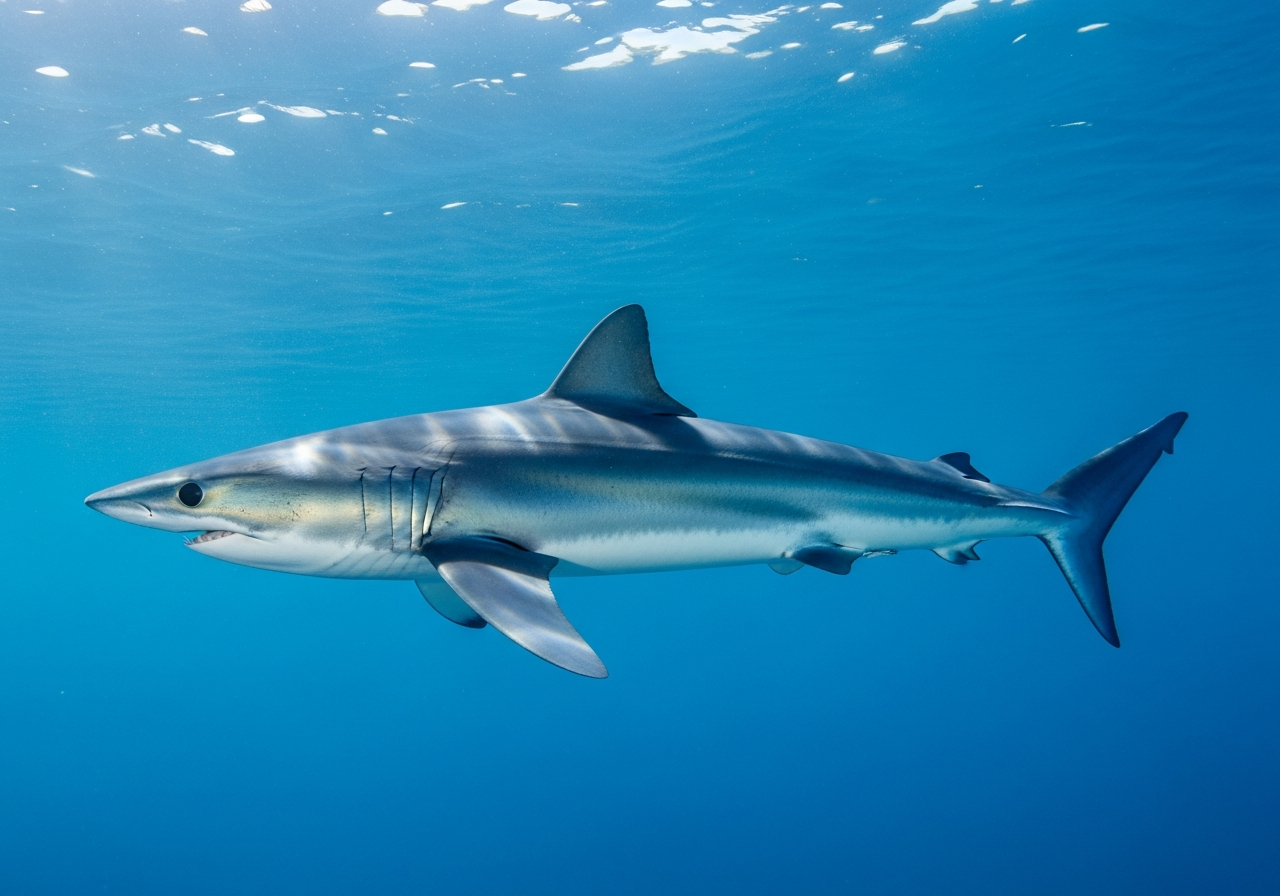
Image sourcing: see credits & licences
Quick answer
The black marlin and sailfish are the fastest marine animals, cited at roughly 100 km/h (62 mph) in short bursts — though precise measurement at sea is difficult.
Last updated: June 2026 — figures reflect widely cited scientific estimates.
The answer, and why it comes with an asterisk
Billfish — the black marlin and the sailfish — are conventionally named the fastest marine animals, with burst speeds often cited around 100 km/h (62 mph). That figure is worth treating with more caution than most animal records, because measuring speed at sea is genuinely difficult and several of the classic numbers come from methods no modern researcher would rely on. Among sharks, the shortfin-mako-shark is the clear champion, and the swordfish and bluefin-tuna are close behind the billfish.
What is not in doubt is the shape of the answer. The fastest animals in the sea are all large, warm-muscled, torpedo-bodied predators with crescent-shaped tails, and they all evolved that combination independently. When unrelated lineages converge on the same design, it usually means the physics has left them little choice.
Water is the reason every number is lower
The reason no fish approaches the speed of a diving peregrine-falcon is density. Seawater is hundreds of times denser than air, and drag rises steeply with speed — roughly with its square. Doubling speed therefore demands far more than double the power. A marine animal moving at 100 km/h is doing something closer, in energetic terms, to what a land animal would face running uphill through sand.
This single fact explains most marine speed anatomy. Fast fish are almost perfectly streamlined, with the widest point set well back and a smooth taper to a narrow tail base. Fins fold into grooves so nothing protrudes. Skin is either exceptionally smooth or, in sharks, covered in microscopic tooth-like denticles that manage the flow of water across the body rather than simply reducing friction.
At high speed a second problem appears: cavitation. Water pressure drops around a rapidly moving fin until bubbles form and collapse, which damages tissue and wastes energy. This appears to place a physical ceiling on how fast anything can swim, regardless of how much muscle it has. The fastest fish are probably bumping against a limit set by water itself rather than by their own biology.
Warm muscles in a cold sea
The billfish, tunas, and mako share a trait that most fish lack: regional endothermy. Using a countercurrent heat exchanger — a dense mesh of arteries and veins running alongside each other — they retain metabolic heat in the swimming muscles, eyes, and brain instead of losing it through the gills. Their core runs warmer than the surrounding water.
The payoff is power. Warm muscle contracts faster and recovers faster, so a shortfin-mako-shark can accelerate in cold water where a nurse-shark or most other fish would be sluggish. Warm eyes and brains also process visual information more quickly, which matters when closing on prey at speed. It is a striking case of convergence: mako sharks and bluefin tuna are only distantly related, yet both evolved essentially the same plumbing to solve the same problem.
The cost is a metabolism that never rests. These animals must swim continuously to ventilate their gills and must eat prodigiously to fund the heat they generate. They cannot idle, and they cannot afford a poor hunting season.
What the marlin’s bill is actually for
The long rostrum of a marlin or sailfish is often described as a speed aid, but the better-supported role is in feeding. Billfish slash sideways through tight bait schools, stunning and injuring fish that they then pick off individually. Sailfish frequently hunt cooperatively, herding a school into a compact ball at the surface before taking turns to strike through it — a behaviour that pays off precisely because a bill is far more effective against a packed target than a scattered one.
The famous sail is not primarily a speed structure either. It is generally raised during hunting and display and folded flat during fast swimming, which is the opposite of what a propulsive or stabilising fin would do.
Why the measurements are contested
Most classic marine speed figures came from fishing reels — timing how quickly a hooked fish stripped line. A hooked, panicking fish pulling against drag is not swimming as it would while hunting, and the arithmetic assumed the line ran straight from rod to fish, which it does not. Other numbers came from a single observation never repeated.
Modern accelerometer and satellite tags tell a more sober story. Tagged billfish and tunas record impressive bursts, but ones typically well short of the headline figures, and they spend the overwhelming majority of their lives cruising at modest speeds. The pattern mirrors the cheetah on land: the record describes a brief, exceptional capability, not a way of life.
The other contenders
Among mammals, the orca is the fastest large predator and combines speed with stamina and coordination that no fish can match — a hunting pod does not need to out-sprint prey when it can out-think it. The bottlenose-dolphin is quick and exceptionally manoeuvrable, and often rides pressure waves to travel cheaply. The great-white-shark delivers vertical ambush strikes fast enough to launch clear of the surface, though it is not a sustained sprinter.
The emperor-penguin deserves mention as the fastest swimming bird, and the salmon as an endurance specialist that will climb waterfalls rather than concede the route upriver. Speed is not the only currency: the blue-whale is unhurried but nearly untouchable, and the manta-ray trades sprinting entirely for efficient gliding.
Conservation note
Nearly every animal on this list is heavily fished. Billfish, bluefin tuna, and mako sharks are prized by both commercial and sport fisheries, and their biology works against them — they grow slowly, mature late, and produce relatively few young, so populations recover far more slowly than they are removed. Warming and deoxygenating water adds a further squeeze, compressing the temperature bands these warm-muscled hunters use. The fastest animals in the ocean are, unhelpfully for them, also among the most valuable.
Sources
Related reading: Animal profiles · Fastest animals on Earth · Support wildlife protection
Frequently asked questions
What Is the Fastest Marine Animal
The black marlin and sailfish are the fastest marine animals, cited at roughly 100 km/h (62 mph) in short bursts — though precise measurement at sea is difficult.
How do scientists measure this record?
Records come from peer-reviewed studies, GPS tracking, high-speed video, toxicology assays, and acoustic meters — field conditions always add variation.
Can the record holder change?
Yes — new measurements, species reclassification, or better technology can update rankings. Always check whether speed, venom, or size is measured differently.