What Is the Most Poisonous Frog in the World?
Golden poison frogs carry enough batrachotoxin to kill multiple adults. Poison dart frogs get toxins from diet in the wild; captive-bred frogs are harmless.
Global Animal Guide · June 28, 2026
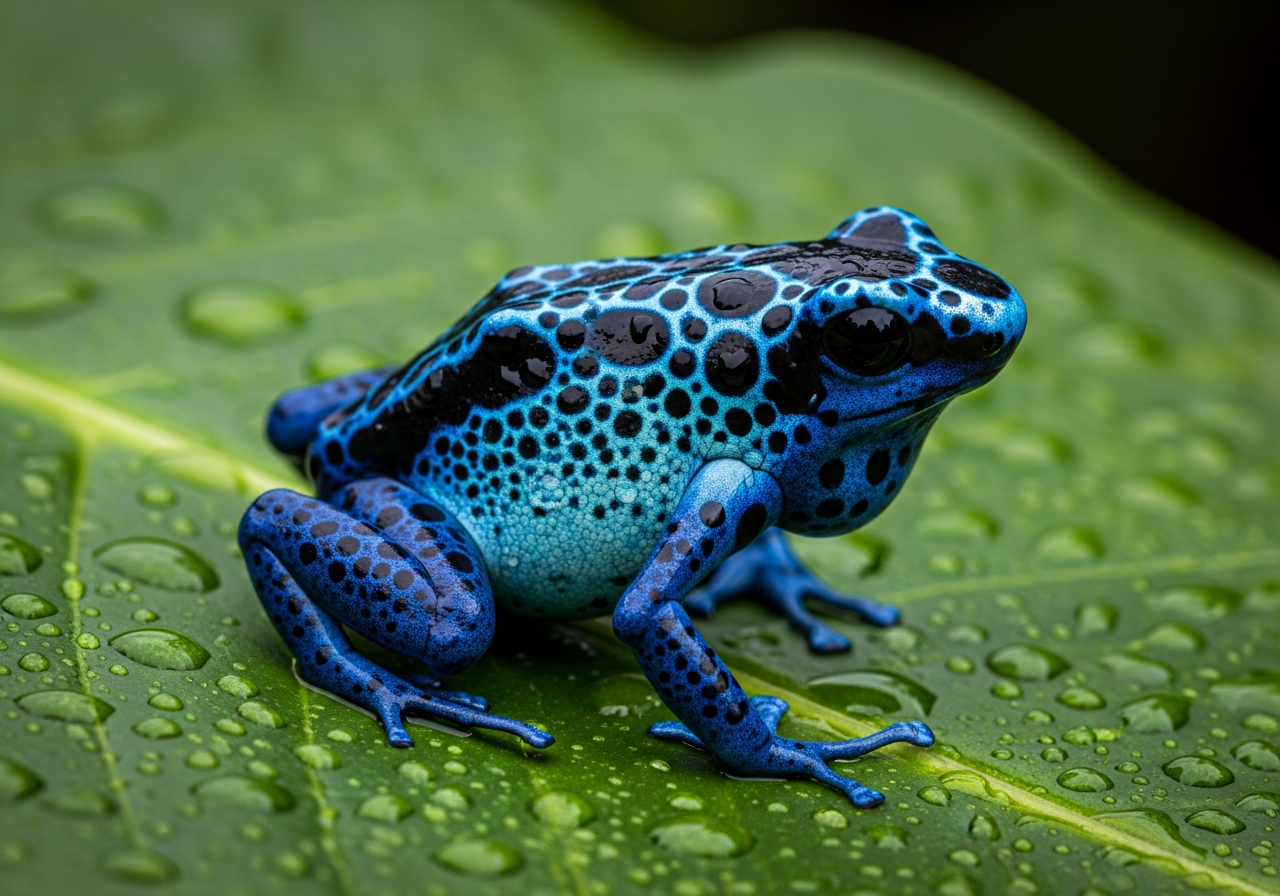
Image sourcing: see credits & licences
Quick answer
The golden poison frog (Phyllobates terribilis) is the most toxic — one wild frog carries enough batrachotoxin to kill several adult humans.
Last updated: June 2026 — figures reflect widely cited scientific estimates.
A frog the size of a paperclip that can kill several adults
The golden poison frog, Phyllobates terribilis, is the most poisonous frog known and one of the most toxic animals of any kind. An adult is perhaps five centimetres long and would sit comfortably on a bottle cap. A single wild individual carries enough batrachotoxin to kill several adult humans — a quantity measured in fractions of a milligram, distributed across skin glands the animal cannot even aim.
It advertises this without apology. The species is a uniform, almost fluorescent yellow, orange or mint green, and it forages in daylight on the forest floor of Colombia’s Pacific lowlands with no attempt at concealment. Nothing in its range meaningfully preys on it, and it behaves accordingly. Among poison dart frogs generally, this combination — extreme toxicity, bold colour, daytime activity — is the point rather than a coincidence.
What batrachotoxin actually does
Batrachotoxin is a steroidal alkaloid, and its mechanism explains why so little of it goes so far. It binds to voltage-gated sodium channels — the protein gates nerve and muscle cells use to fire — and jams them permanently open.
The consequence is not a shutdown but a runaway. Sodium floods in continuously, the cell can never reset its resting state, and nerves and muscles lose the ability to fire in a controlled way. The result is paralysis, arrhythmia and heart failure. Crucially, there is no antidote. The toxin does not degrade quickly, it is not neutralised by heat, and it acts on a target every animal with nerves depends on.
The frog’s own channels carry structural changes that stop the toxin from binding, which is the standard solution to the problem of self-poisoning. Broken skin is the main route of concern for humans — the toxin needs to get in, which is why handling with any cut is the real hazard.
The frogs do not make their own poison
This is the most important and least known fact about poison frogs: the toxin is not manufactured, it is stolen.
Wild golden poison frogs accumulate batrachotoxin from their diet, sequestering alkaloids that ultimately derive from small arthropods in the leaf litter — melyrid beetles are strongly implicated as a source — and concentrating them in skin glands. The frog is a filter and a warehouse, not a factory.
Remove the diet and the poison disappears. Captive-bred poison frogs raised on fruit flies and crickets are completely non-toxic and stay that way, which is why they are kept as pets and displayed in zoos where visitors can be told, accurately, that the frog in front of them is harmless. Wild-caught frogs gradually lose potency in captivity as their stores deplete without being topped up. This dietary sourcing is shared across the family — the golden mantella of Madagascar, an unrelated frog that arrived at a similar look and similar chemistry, does the same thing with its own local arthropods.
It also makes toxicity a moving target. Potency varies by population, by season and by locality, tracking whatever the local invertebrates offer. A frog from one valley may be dramatically more dangerous than the same species a few kilometres away.
Poison, not venom — and why the dart name misleads
A poison frog cannot inject anything. It has no fangs, no sting, no delivery system at all; the toxin sits in glands in the skin and only matters if something bites, licks or handles it. That makes it poisonous rather than venomous — the distinction is entirely about delivery, and it is worth reading up on if the terms blur together. See poison vs venom.
The “dart frog” name is also far broader than the reality. Of the couple of hundred species in the family, only three — all Phyllobates, with P. terribilis the most potent — are known to have been used by Indigenous Emberá and Noanamá people to tip blowgun darts. For the golden poison frog the process required no preparation: a dart wiped across the frog’s back stayed effective for a long period. The vast majority of species called dart frogs were never used for anything of the sort, and many are only mildly toxic. The famous red-eyed tree frog, despite the colour scheme people associate with danger, is not poisonous at all — its flash colouration is a startle tactic.
Bright colour as an honest signal
Aposematism only works if the warning is broadly reliable. A predator has to survive one bad experience and learn from it, and the signal has to be worth learning. Poison frogs make that easy: high-contrast, unmistakable, unchanging patterns that a bird can generalise from a single encounter.
The system is exploited by mimics — harmless or weakly defended species that copy the pattern and free-ride on the lesson. It also has cheats and honest signallers side by side, which is why colour alone is a poor guide to toxicity in the field. The tomato frog is vividly red and produces a sticky, irritating secretion rather than a lethal one. The cane toad is drab and carries bufotoxins in parotoid glands potent enough to kill dogs and native predators across Australia. The eastern newt and its relatives carry tetrodotoxin — the same class of toxin found in pufferfish — and some populations are locked in an evolutionary arms race with garter snakes that have evolved resistance, driving newt toxicity ever higher. Meanwhile the glass frog has gone the other way entirely and bet on transparency.
Why the most toxic frog is also a fragile one
The golden poison frog occupies a small range of humid lowland rainforest in a single region of Colombia, and it is threatened — habitat loss to logging and agriculture, plus collection pressure, against a naturally restricted distribution. Having the most powerful chemical defence on Earth is no protection against the forest being cleared.
There is a medical footnote worth keeping. Frog skin alkaloids have been a serious subject of pharmacological research, precisely because compounds that act so specifically on sodium channels are useful tools for understanding pain signalling. Losing the frogs would mean losing the chemistry — and the chemistry itself depends on the whole system, because a frog without its forest and its beetles is just a small yellow amphibian with nothing in its glands.
Sources
Related reading: Animal profiles · Fastest animals on Earth · Support wildlife protection
Frequently asked questions
What Is the Most Poisonous Frog in the World
The golden poison frog (Phyllobates terribilis) is the most toxic — one wild frog carries enough batrachotoxin to kill several adult humans.
How do scientists measure this record?
Records come from peer-reviewed studies, GPS tracking, high-speed video, toxicology assays, and acoustic meters — field conditions always add variation.
Can the record holder change?
Yes — new measurements, species reclassification, or better technology can update rankings. Always check whether speed, venom, or size is measured differently.