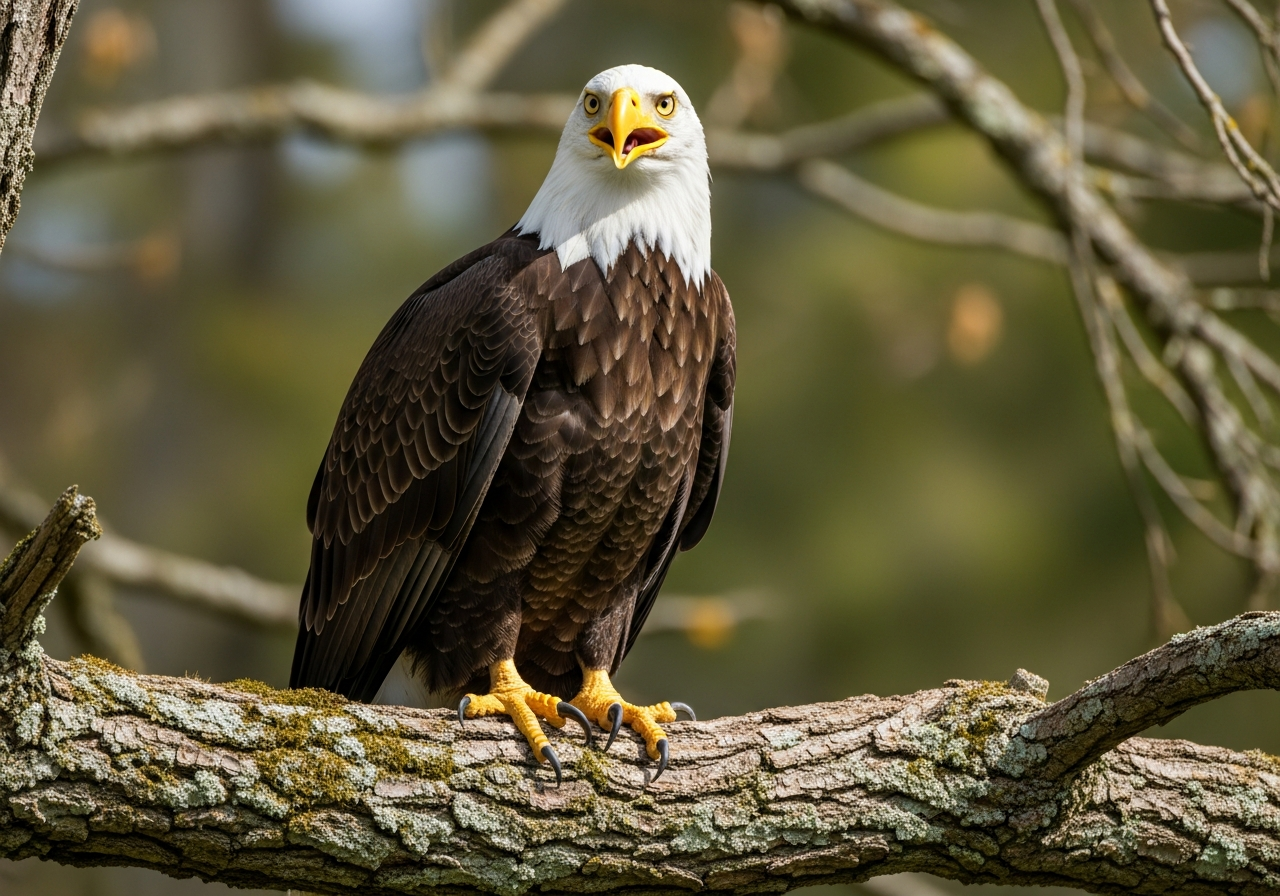
The bald eagle (Haliaeetus leucocephalus) is a bird of the family Accipitridae, in the order Accipitriformes.
Quick answer
The bald eagle is a large bird of prey native to North America, recognizable by its white head and tail against a dark brown body. It is not actually bald; "bald" comes from an old word meaning white-headed. Bald eagles mainly eat fish, build the largest tree nests of any North American bird, and can live 20 to 30 years in the wild.
Top questions about the Bald Eagle
Also available in Español (Águila calva)
Bald Eagle facts at a glance
- Weight 6.3 kg
- Length 2.3 m
- Top speed 120 km/h
- Lifespan 25 years
| Scientific name | Haliaeetus leucocephalus |
|---|---|
| Diet | Carnivore (mainly fish) |
| Habitat | Forests near lakes, rivers, and coasts |
| Lifespan | 20–30 years in the wild |
| Wingspan | 1.8–2.3 m (6–7.5 ft) |
| Top speed | 120 km/h (75 mph) in a dive |
| Conservation status | Least Concern (IUCN) |
| Kingdom | Animalia |
|---|---|
| Phylum | Chordata |
| Class | Aves |
| Order | Accipitriformes |
| Family | Accipitridae |
| Genus | Haliaeetus |
Where it lives
The bald eagle (Haliaeetus leucocephalus) is native to Near lakes, rivers, and coasts across Canada, the United States, and northern Mexico. — recorded across North America in this guide’s range summary.
For occurrence records, see GBIF species search and sources below.
How big is a bald eagle?
An adult bald eagle measures 2.3 m long — about 1.3× the height of an average adult person (1.73 m) — and weighs around 6.3 kg, about 9% of an average adult’s body weight (70 kg).
Length vs an average adult’s height (to scale)
What is a group of bald eagles called?
Group name (collective noun)
A group of Bald Eagles is called a convocation.
Baby name
A baby Bald Eagle is called an eaglet. It may also be called a chick.
Explore more animal collective nouns and baby animal names .
Behavior and nesting
Bald eagles mate for life and return to the same nest each year, adding material until it becomes the largest tree nest of any North American bird, sometimes weighing over a tonne. They are powerful fliers that can soar for hours on rising air, and they are known to steal fish from ospreys and other birds rather than always catching their own.
Diet and hunting
Fish make up most of a bald eagle's diet. It hunts by swooping low over water and snatching prey from the surface with its talons. Eagles also eat waterbirds, small mammals, and carrion, and will gather in large numbers at salmon runs and other seasonal food sources.
Habitat and range
Bald eagles live only in North America, from Alaska and Canada down to northern Mexico, almost always near open water with abundant fish and tall trees for nesting. Populations are densest along coasts, large rivers, and lakes.
Conservation
Bald eagles were once endangered in the contiguous United States, devastated by the pesticide DDT, which thinned their eggshells. After DDT was banned and strong protections were put in place, the species recovered dramatically and was removed from the U.S. endangered species list in 2007. It is now listed as Least Concern.
Dig deeper into the Bald Eagle
- Are Bald Eagles Dangerous?
Are bald eagles dangerous? Realistic risk, when incidents rise, and safety basics.
- How Fast Is A Bald Eagle?
Bald Eagle top speed is about 120 km/h (75 mph) in a dive. Sprint vs endurance and what limits pace.
- How Long Do Bald Eagles Live?
Bald Eagle lifespan is typically 20–30 years in the wild. What shortens or extends life, life stages, and status (Least Concern).
- What Do Bald Eagles Eat?
What bald eagles eat: Carnivore (mainly fish), foraging style, and seasonal shifts in Forests near lakes, rivers, and coasts.
- Where Do Bald Eagles Live?
Where bald eagles live: Forests near lakes, rivers, and coasts, native range cues, and human overlap. Status Least Concern.
Explore the Bald Eagle
Compare
Close relatives
- Northern Goshawk Same family
- Northern Harrier Same family
- Golden Eagle Same family
- Red-tailed Hawk Same family
Collections
Range & geography
Did you know? Bald Eagle facts
- The bald eagle is the national bird and symbol of the United States.
- Its eyesight is several times sharper than a human's, spotting prey from far away.
- Bald eagles build the largest tree nests of any North American bird.
- They are not bald — the name comes from an old meaning of 'white-headed'.
- After near-collapse from the pesticide DDT, the species has strongly recovered.
- Bald eagles often steal fish from ospreys and other birds.
Diet & feeding
Bald eagles eat mainly fish, supplemented by waterfowl, small mammals, and carrion, and frequently steal prey from ospreys and other birds.
Adaptations
- Exceptionally sharp vision detects fish and prey from great height and distance.
- Powerful talons and a hooked beak grip and tear fish and other prey.
- Broad wings enable efficient soaring on thermals while hunting.
- Rough foot pads (spicules) help grip slippery fish.
Behaviour & ecology
- Bald eagles hunt fish near water but also scavenge and pirate prey from other birds.
- Pairs build and reuse massive stick nests, adding to them each year.
- They gather in numbers at seasonal food sources such as salmon runs.
- Mated pairs perform dramatic aerial courtship displays.
Communication
- Bald eagles give high, chirping calls weaker than their fierce appearance suggests.
- Aerial displays and posturing signal courtship and territory.
- Calls and body language coordinate pairs and warn rivals.
Habitat & range
Bald eagles live near lakes, rivers, coasts, and wetlands across North America, needing open water for fishing and tall trees for nesting.
Ecological role
As a top avian predator and scavenger, the bald eagle helps regulate fish and waterbird populations and is a recovery success story and conservation symbol.
Conservation status of the Bald Eagle
The bald eagle (Haliaeetus leucocephalus) is listed as Least Concern on the IUCN Red List. Least Concern (LC) is the IUCN's lowest-risk category, assigned to widespread, abundant species that have been evaluated and found not to be threatened. It does not mean a species faces no pressures — only that it is not currently at risk of extinction.
The bald eagle (Haliaeetus leucocephalus) is assessed on the IUCN Red List. Look up on the IUCN Red List .
Frequently asked questions about the Bald Eagle
Are bald eagles actually bald?
No. Bald eagles have a full covering of white feathers on their heads. The name comes from an older meaning of "bald" that meant white-headed or marked with white, not hairless.
What do bald eagles eat?
Bald eagles eat mainly fish, which they snatch from the water with their talons. They also take waterbirds, small mammals, and carrion, and will steal prey from other birds.
How fast can a bald eagle fly?
Bald eagles cruise at around 50 km/h (30 mph) but can reach about 120 km/h (75 mph) when diving toward prey.
How long do bald eagles live?
In the wild, bald eagles typically live 20 to 30 years. In captivity, protected from hazards, they can live even longer.
Are bald eagles endangered?
Not anymore. After near collapse from DDT poisoning, bald eagle populations recovered and the species is now listed as Least Concern, though it remains protected by law in the United States.
How big is a bald eagle's nest?
Bald eagles build the largest tree nests of any North American bird. Reused and expanded over years, a nest can reach 2.5 m (8 ft) across and weigh more than a tonne.
What is a group of bald eagles called?
A group of Bald Eagles is called a convocation.
What is a baby bald eagle called?
A baby Bald Eagle is called an eaglet. It may also be called a chick.
Sources & references
This guide is compiled and reviewed against established zoological and conservation references. Key sources for the Bald Eagle:
-
IUCN Red List of Threatened Species
Conservation status (Least Concern) reflects the IUCN Red List category for Haliaeetus leucocephalus.
-
iNaturalist — observations & photos
Search citizen-science observations and community IDs for Haliaeetus leucocephalus. Useful for range checks and recent sightings — not a substitute for formal Red List status.
-
GBIF — occurrence data
Global Biodiversity Information Facility species search for Haliaeetus leucocephalus. Explore published occurrence records used in range research.
-
eBird — bird observations
Cornell Lab eBird target search for Bald Eagle. Check recent checklists and seasonal abundance where birders report this species.
- BirdLife International (2021). Haliaeetus leucocephalus. IUCN Red List of Threatened Species.
Status (Least Concern) and recovery.
- Billerman, S. M. et al. (eds.). Birds of the World. Cornell Lab of Ornithology.
Behaviour, nesting, and diet.
- Animal Diversity Web — Haliaeetus leucocephalus. University of Michigan Museum of Zoology.
Life history, morphology, and range.
-
Global Animal Guide editorial standards
How we research, source, review, and update every guide for accuracy.