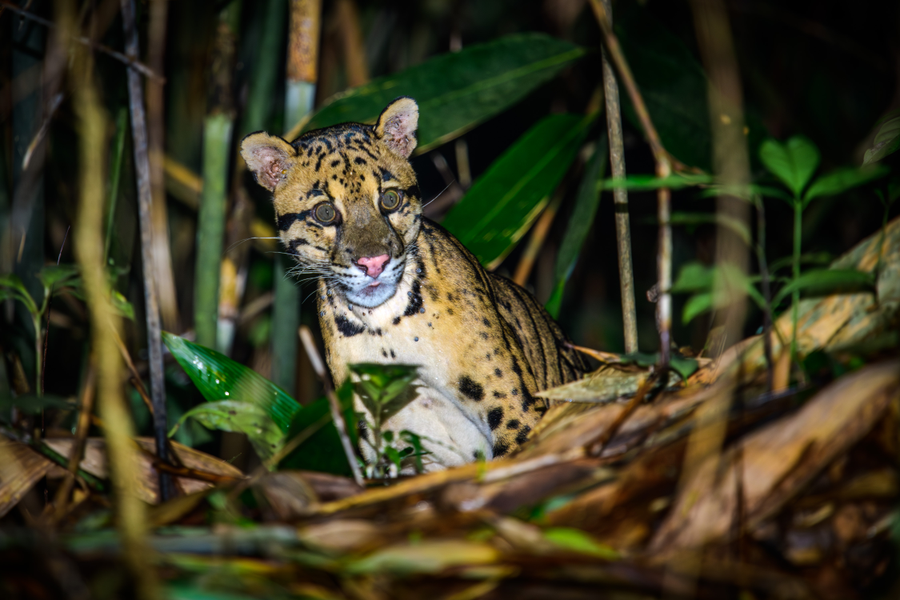
Quick answer
IUCN lists the mainland clouded leopard (Neofelis nebulosa) as Vulnerable (2021): about 3,700–5,580 mature animals. The Sunda clouded leopard (Neofelis diardi) is a separate species, also Vulnerable, on Borneo and Sumatra. They are not African leopards. Figures checked 13 August 2026.
Are clouded leopards Endangered or just Vulnerable?
Vulnerable, as two species. The 2021 mainland assessment found more than 30% decline over three generations — not the 50% that would force Endangered. Sharp drops in Vietnam, Laos, Cambodia and Myanmar can hide behind assumed stability in India or Thailand. “Listed in our guides as Vulnerable” without the two-species split was the thin version of this page.
What is driving the decline?
Snaring, the pelt trade, and rainforest converted to oil palm and farms. Prey depletion follows the snares. Ranking those threats changes by country — a Thai protected forest is not a Vietnamese snare line.
Is 3,700–5,580 an all-clear?
No. The lower bound can sit below widely cited wild-tiger totals. Camera-trap coverage is patchy. Isolated forest blocks can empty while the global label says Vulnerable.
What actually helps?
Standing forest and fewer snares. WARN’s habitat appeal describes proposed forest protection — not a tiger appeal. WARN does not run clouded-leopard camps.
Is the Sunda cat the same species?
No. N. diardi lives on Borneo and Sumatra. Mainland N. nebulosa runs from the Himalayan foothills through mainland Southeast Asia. A Sabah camera trap does not protect Nepal.
Why is Vulnerable not an all-clear?
Because snare lines still empty forest faster than a 30% threshold can describe. Long canines and cloud-shaped spots are not a recovery plan.
Sources
Clouded Leopard FAQs
Are clouded leopards endangered?
IUCN lists the mainland clouded leopard (Neofelis nebulosa) as Vulnerable (2021): about 3,700–5,580 mature animals, down more than 30% over three generations. The Sunda clouded leopard (Neofelis diardi) is a separate Vulnerable species on Borneo and Sumatra. They are not Panthera leopards. Figures checked 13 August 2026.
How many clouded leopards are left?
Mainland: 3,700–5,580 mature (2021). Sunda: on the order of 4,500 mature (2015). Those are planning ranges, not a weekly census. The lower mainland bound can sit below widely cited wild-tiger totals. A zoo cat is not a Sabah count.
Are they the same as leopards or snow leopards?
No. Clouded leopards are Neofelis — a different genus. Leopards are Panthera pardus; snow leopards are Panthera uncia. Mixing them produces the false story that a Kruger postcard protects Borneo. Do not map either to a tiger appeal.
What actually helps clouded leopards?
Keep rainforest standing, cut snaring and the pelt trade, and fund in-range habitat work. World Animal Rescue Network describes plans for habitat-protection partnerships. WARN does not run clouded-leopard camps.
Who this page is for.This page explains IUCN-style status. Skip it if you need an emergency wildlife-rescue number.