Image sourcing: see credits & licences
The snow leopard (Panthera uncia) is a mammal of the cat family, Felidae, in the order Carnivora.
Quick answer
The snow leopard is a rare big cat native to the high mountains of Central and South Asia, including the Himalayas. Superbly adapted to cold, rugged terrain, it has thick fur, a long tail for balance, and can leap up to 15 m (50 ft). Wild snow leopards typically live 10 to 12 years.
Top questions about the Snow Leopard
Snow Leopard facts at a glance
- Weight 55 kg
- Length 1.3 m
- Top speed 65 km/h
- Lifespan 12 years
| Scientific name | Panthera uncia |
|---|---|
| Diet | Carnivore |
| Habitat | High mountains and alpine zones |
| Lifespan | 10–12 years in the wild |
| Weight | 22–55 kg (49–121 lb) |
| Top speed | Up to 65 km/h (40 mph) |
| Conservation status | Vulnerable (IUCN) |
| Kingdom | Animalia |
|---|---|
| Phylum | Chordata |
| Class | Mammalia |
| Order | Carnivora |
| Family | Felidae |
| Genus | Panthera |
Where it lives
The snow leopard (Panthera uncia) is native to The high mountain ranges of Central and South Asia, including the Himalayas. — recorded across Asia in this guide’s range summary.
For occurrence records, see GBIF species search and sources below.
How big is a snow leopard?
An adult snow leopard measures 1.3 m long — about 75% of the height of an average adult person (1.73 m) — and weighs around 55 kg, about 79% of an average adult’s body weight (70 kg).
Length vs an average adult’s height (to scale)
What is a group of snow leopards called?
Group name (collective noun)
A group of Snow Leopards is called a prowl. It is also known as a leap.
Baby name
A baby Snow Leopard is called a cub.
Explore more animal collective nouns and baby animal names .
Built for the cold and the heights
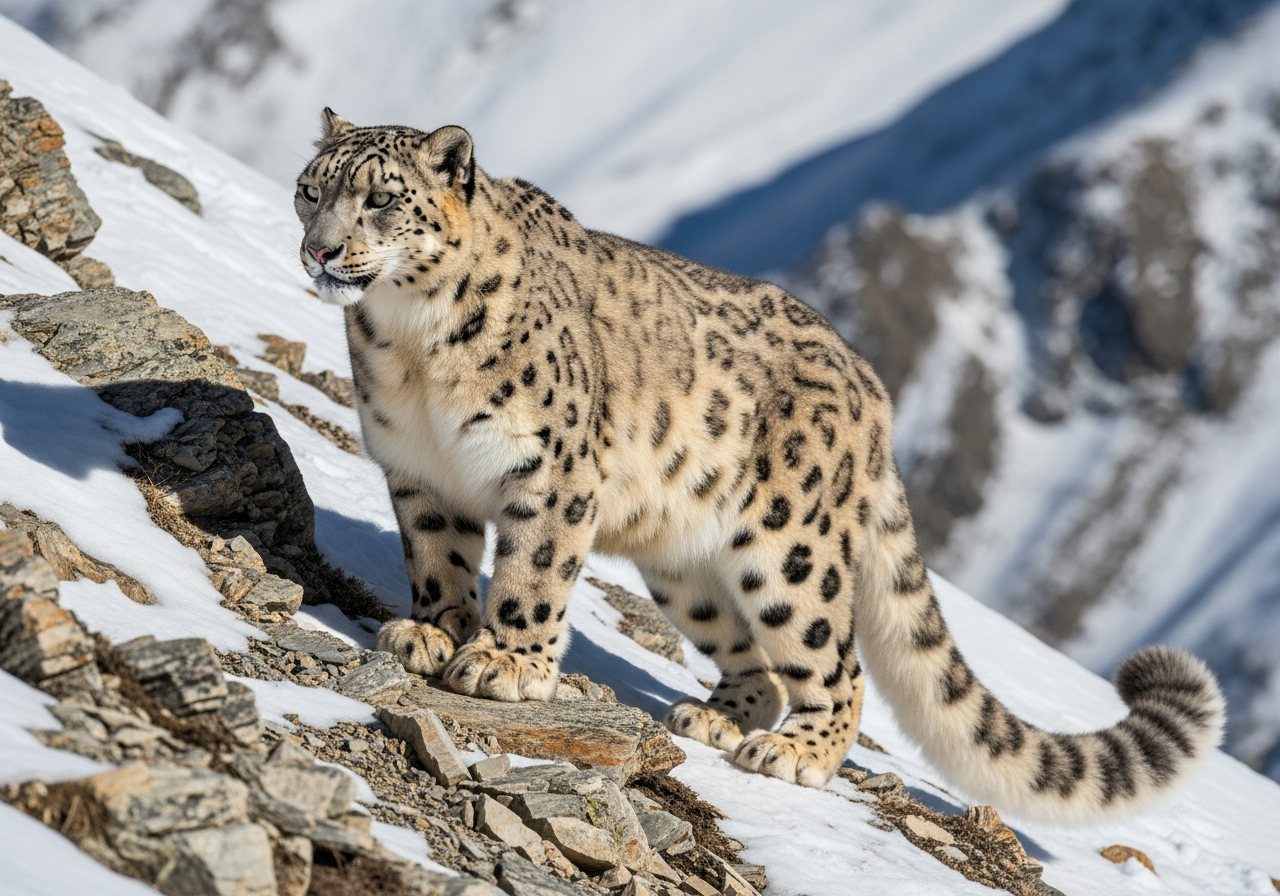
Snow leopards are perfectly adapted to harsh mountain life. Thick fur and a dense undercoat keep them warm, wide furry paws act like snowshoes, and an extremely long, thick tail helps them balance on steep terrain and wraps around the body like a blanket when resting. They can leap up to six times their body length.
A solitary hunter
Snow leopards are solitary and secretive, so rarely seen that they are nicknamed the ghost of the mountains. They ambush prey such as blue sheep and ibex on steep slopes, using the terrain to launch surprise attacks, and a single large kill can feed a snow leopard for days.
Habitat and range
Snow leopards live across the high mountain ranges of Central and South Asia, including the Himalayas, the Tian Shan, and the Altai. They roam vast territories at high altitude, following prey up and down the mountains with the seasons. Unlike other big cats, snow leopards cannot roar.
Conservation
Snow leopards are listed as Vulnerable, threatened by poaching for their fur and bones, retaliatory killing by herders, declining prey, and habitat loss. Because they range across many countries, their protection depends on cross-border cooperation and work with local mountain communities.
Dig deeper into the Snow Leopard
- Are Snow Leopards Endangered?
IUCN lists snow leopards as Vulnerable (downlisted 2017), not saved. About 2,710–3,386 mature animals across 12 high-Asian countries.
- How Long Do Snow Leopards Live?
Wild snow leopards often live about 10–12 years; prey loss and retaliatory killing cut the average. IUCN Vulnerable, not saved.
- Snow Leopard: Key Facts
Snow leopards (Panthera uncia) are IUCN Vulnerable after a 2017 criteria downlist, not a rebound. About 2,710–3,386 mature animals; not African leopards.
- What Do Snow Leopards Eat?
Snow leopards hunt mountain ungulates — bharal, ibex, argali — not savanna impala. Livestock kills are conflict, not a menu.
- Where Do Snow Leopards Live?
Snow leopards live only in 12 high-Asian countries — Himalaya to Altai — not African savanna. Typical elevations 3,000–5,500 m.
Explore the Snow Leopard
Collections
Range & geography
Did you know? Snow Leopard facts
- Snow leopards live high in the mountains of Central and South Asia, up to 5,500 m.
- Their enormous tail — nearly as long as the body — aids balance and acts as a scarf.
- Snow leopards cannot roar; they communicate with a soft 'chuff' and other calls.
- They can leap up to 15 m, among the longest jumps of any cat.
- Pale, spotted fur makes them almost invisible against rock and snow.
- They are elusive and rarely seen, earning the nickname 'ghost of the mountains'.
Diet & feeding
Snow leopards prey mainly on mountain ungulates such as blue sheep and ibex, supplemented by marmots, hares, and game birds, and will take domestic livestock where wild prey is scarce.
Adaptations
- Dense, pale fur and a thick undercoat insulate against extreme high-altitude cold. (Nowak 1999)
- Large, fur-covered paws act as snowshoes and protect against frozen ground.
- An enlarged nasal cavity warms thin, cold mountain air before it reaches the lungs.
- A long, heavy tail provides balance on steep terrain and wraps the body for warmth.
Behaviour & ecology
- Snow leopards are solitary and cover huge home ranges across rugged terrain.
- They ambush prey from above, using cliffs and broken ground for cover.
- Marking sites with scrapes and scent maintain spacing between individuals.
- They are most active at dawn and dusk in their cold, sparse habitat.
Communication
- A non-aggressive 'chuff' (prusten) is used in friendly close contact.
- Scent-marking and scrapes on prominent rocks advertise presence over large ranges.
- Moans and yowls feature during the breeding season.
Habitat & range
Snow leopards inhabit the alpine and subalpine zones of the high mountains of Central and South Asia — including the Himalayas and Tibetan Plateau — favouring steep, broken terrain above the tree line.
Ecological role
As the apex predator of high-mountain ecosystems, the snow leopard regulates wild sheep and goat populations and is a flagship species for fragile alpine habitats.
Conservation status of the Snow Leopard
The snow leopard (Panthera uncia) is listed as Vulnerable on the IUCN Red List. Vulnerable (VU) means a species faces a high risk of extinction in the medium-term future. It is the lowest-risk of the three 'threatened' IUCN categories — one step below Endangered, which is itself below Critically Endangered — and is often an early warning that a population is in trouble.
Main threats to the snow leopard
- Prey depletion
- Retaliatory killing over livestock
- Poaching for the illegal wildlife trade
- Habitat degradation
Snow Leopard (Panthera uncia) was most recently assessed for the IUCN Red List in 2017. View the full IUCN assessment .
Frequently asked questions about the Snow Leopard
Where do snow leopards live?
Snow leopards live in the high mountains of Central and South Asia, including the Himalayas, the Tian Shan, and the Altai ranges, usually at high altitude on steep, rugged terrain.
What do snow leopards eat?
Snow leopards are carnivores that mainly hunt mountain prey such as blue sheep and ibex, along with smaller animals like marmots and hares. A single large kill can sustain them for several days.
How far can a snow leopard jump?
Snow leopards are remarkable jumpers and can leap up to about 15 m (50 ft) across gaps in steep terrain, helped by their powerful hind legs and long balancing tail.
Can snow leopards roar?
No. Unlike lions, tigers, and other big cats, snow leopards cannot roar. They communicate with sounds such as growls, hisses, mews, and a non-aggressive puffing call known as a chuff.
Why are snow leopards endangered?
Snow leopards are listed as Vulnerable, threatened by poaching for their fur and bones, retaliatory killing by herders protecting livestock, loss of prey, and habitat degradation across their mountain range.
What is a group of snow leopards called?
A group of Snow Leopards is called a prowl. It is also known as a leap.
What is a baby snow leopard called?
A baby Snow Leopard is called a cub.
Sources & references
This guide is compiled and reviewed against established zoological and conservation references. Key sources for the Snow Leopard:
-
IUCN Red List of Threatened Species
Conservation status (Vulnerable) reflects the IUCN Red List category for Panthera uncia, most recently assessed in 2017.
-
iNaturalist — observations & photos
Search citizen-science observations and community IDs for Panthera uncia. Useful for range checks and recent sightings — not a substitute for formal Red List status.
-
GBIF — occurrence data
Global Biodiversity Information Facility species search for Panthera uncia. Explore published occurrence records used in range research.
- McCarthy, T. et al. (2017). Panthera uncia. IUCN Red List of Threatened Species.
Status (Vulnerable) and threats.
- Nowak, R. M. (1999). Walker's Mammals of the World (6th ed.). Johns Hopkins University Press.
Morphology and adaptations.
- Animal Diversity Web — Panthera uncia. University of Michigan Museum of Zoology.
Life history, morphology, and range.
-
Global Animal Guide editorial standards
How we research, source, review, and update every guide for accuracy.