Quick answer
European eels reproduce only once, at the very end of their lives. After roughly 5 to 20 or more years growing in the rivers, lakes and coasts of Europe and North Africa, adults turn into silver eels, stop feeding and swim thousands of kilometres to the Sargasso Sea in the western Atlantic, where they are believed to spawn and then die. Their transparent, leaf-shaped larvae drift back towards Europe on ocean currents and change into glass eels, elvers and finally yellow eels. Nobody has yet watched European eels spawn in the wild.
The eel life cycle, step by step
- 1
Egg and leptocephalus larva
Eggs hatch in the Sargasso Sea into leptocephali: flat, transparent, leaf-shaped larvae that look nothing like adult eels.
- 2
Ocean drift
The larvae are carried north-east by the Gulf Stream and North Atlantic Drift. Estimates of how long the crossing takes range from under a year to two or three years.
- 3
Glass eel
Near the European continental shelf the larvae reshape into small, see-through eels called glass eels, which reach coasts and estuaries mainly in winter and spring.
- 4
Elver
As they move into estuaries and start to swim upstream, glass eels darken and become elvers.
- 5
Yellow eel
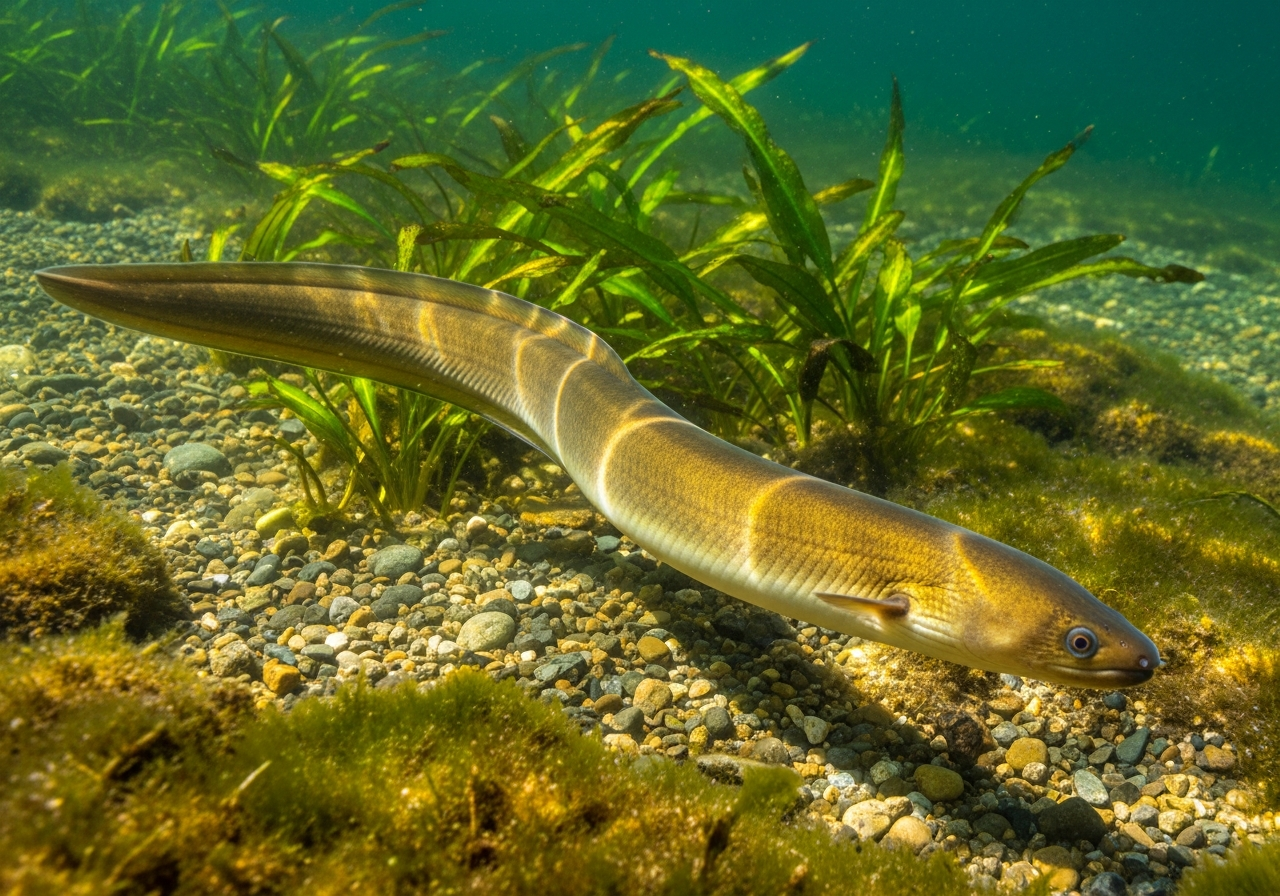
The long growth stage, spent in rivers, lakes, ponds and coastal lagoons. It usually lasts 5 to 20 years or more; females generally grow larger and stay longer than males.
- 6
Silver eel
Maturation begins: the eyes enlarge, the belly turns silvery, the gut shrinks and feeding stops. Silver eels head downstream, often on dark, rainy autumn nights when rivers run high.
- 7
Spawning migration
Adults swim several thousand kilometres across the Atlantic to the Sargasso Sea, spawn once and die. No European eel is known to return from the breeding grounds.
Why eel reproduction stayed a mystery
Eels in European rivers never carry ripe eggs or milt, because they only mature once they leave for the sea. Aristotle concluded that eels arose from mud, and in 1876 a young Sigmund Freud dissected hundreds of eels in Trieste without finding testes. The breakthrough came from the Danish biologist Johannes Schmidt, whose Atlantic surveys in the early twentieth century found ever-smaller larvae further west, pointing to the Sargasso Sea as the breeding area.
Schmidt's conclusion rested on larvae, not on adults. In 2022 researchers reported the first direct evidence: satellite tags on silver eels released from the Azores followed them into the Sargasso Sea. Spawning itself has still not been observed.
Can eels be bred in captivity?
Not at a commercial scale. Laboratories have hatched and reared European eel larvae, but closing the full life cycle remains experimental. Eel farms therefore stock ponds with wild-caught glass eels, so every farmed eel begins as a wild fish. International trade is controlled because of this: the European eel is listed on CITES Appendix II.
Why breeding matters for conservation
The IUCN lists the European eel as Critically Endangered. Because each eel breeds only once, every adult that fails to reach the sea is lost to the next generation. Dams, weirs and hydropower turbines block or kill migrating eels; glass eel fishing and illegal trafficking remove young fish; and pollution, disease and a swim-bladder parasite weaken the adults that do set off.
EU rules adopted in 2007 require national eel management plans intended to let at least 40% of the adult silver eel biomass reach the sea, relative to estimates without human impact. Practical measures include eel passes around barriers, screens on water intakes and seasonal fishing limits. The European eel profile covers the species' size, diet and range in more detail.
Sources
- Pike, C., Crook, V. & Gollock, M. (2020). Anguilla anguilla. The IUCN Red List of Threatened Species 2020: e.T60344A152845178.
- Wright, R. M. et al. (2022). First direct evidence of adult European eels migrating to their breeding place in the Sargasso Sea. Scientific Reports 12.
- Schmidt, J. (1923). The breeding places of the eel. Philosophical Transactions of the Royal Society B 211: 179–208.
- Council Regulation (EC) No 1100/2007 establishing measures for the recovery of the stock of European eel.
- European eel — Wikipedia
How eels reproduce: FAQs
How do eels reproduce?
European eels breed once in their lifetime. Mature silver eels leave European and North African rivers, swim to the Sargasso Sea in the western Atlantic, spawn there and die. The larvae drift back to Europe and grow up in fresh and coastal waters.
Where do European eels breed?
In the Sargasso Sea, a region of the western North Atlantic. Johannes Schmidt traced ever-smaller larvae there in the early 1900s, and in 2022 satellite-tagged adults were tracked to the area for the first time.
Do eels die after spawning?
Yes. European eels are thought to spawn once and die. Silver eels stop feeding before the journey and rely on stored fat to reach the breeding area.
How long does it take a European eel to mature?
Usually 5 to 20 years or more in fresh or coastal water, depending on temperature, food and sex. Females tend to mature later and larger than males.
Has anyone seen eels spawn?
Not European eels in the wild. The breeding area is inferred from where the smallest larvae are found, and from tracking adults that head there.
Can European eels be bred in captivity?
Not at commercial scale. Rearing larvae in laboratories is still experimental, so eel farms depend on young glass eels caught in the wild, which is one reason their trade is regulated.
Who this page is for.Read the european eel profile if you want the full biology; this page answers one question.