Image sourcing: see credits & licences
The ocean sunfish (Mola mola) is a ray-finned fish of the family Molidae, in the order Tetraodontiformes.
Quick answer
The ocean sunfish, or mola, is the heaviest bony fish in the world, reaching up to about 2,000 kg and 3 m across in the largest specimens. Found in temperate and tropical oceans worldwide, it is a harmless drifter that swims slowly at up to 5 km/h and feeds mostly on jellyfish. Molas are famous for basking flat at the surface, live around 8 to 10 years, and are classed as Vulnerable.
Top questions about the Ocean Sunfish
Also available in Español (Pez luna)
Ocean Sunfish facts at a glance
- Weight 1000 kg
- Length 3 m
- Top speed 5 km/h
- Lifespan 10 years
| Scientific name | Mola mola |
|---|---|
| Diet | Carnivore — jellyfish, salps, and small fish |
| Habitat | Temperate and tropical oceans worldwide |
| Lifespan | 8–10 years in the wild |
| Weight | 250–2,000 kg (550–4,400 lb); record specimens heaviest bony fish |
| Top speed | Up to 5 km/h (3 mph); slow swimmer |
| Conservation status | Vulnerable (IUCN) |
| Kingdom | Animalia |
|---|---|
| Phylum | Chordata |
| Class | Actinopterygii |
| Order | Tetraodontiformes |
| Family | Molidae |
| Genus | Mola |
Where it lives
The ocean sunfish (Mola mola) is native to All temperate and tropical oceans — pelagic species occasionally seen basking at surface worldwide. — recorded across Africa, Asia, Europe, North America, Oceania, Oceans, South America in this guide’s range summary.
For occurrence records, see GBIF species search and sources below.
How big is a ocean sunfish?
An adult ocean sunfish measures 3 m long — about 1.7× the height of an average adult person (1.73 m) — and weighs around 1000 kg, about 14× an average adult’s body weight (70 kg).
Length vs an average adult’s height (to scale)
What is a group of ocean sunfish called?
Group name (collective noun)
A group of Ocean Sunfish is called a school.
Baby name
A baby Ocean Sunfish is called a larva.
Explore more animal collective nouns and baby animal names .
The heaviest bony fish
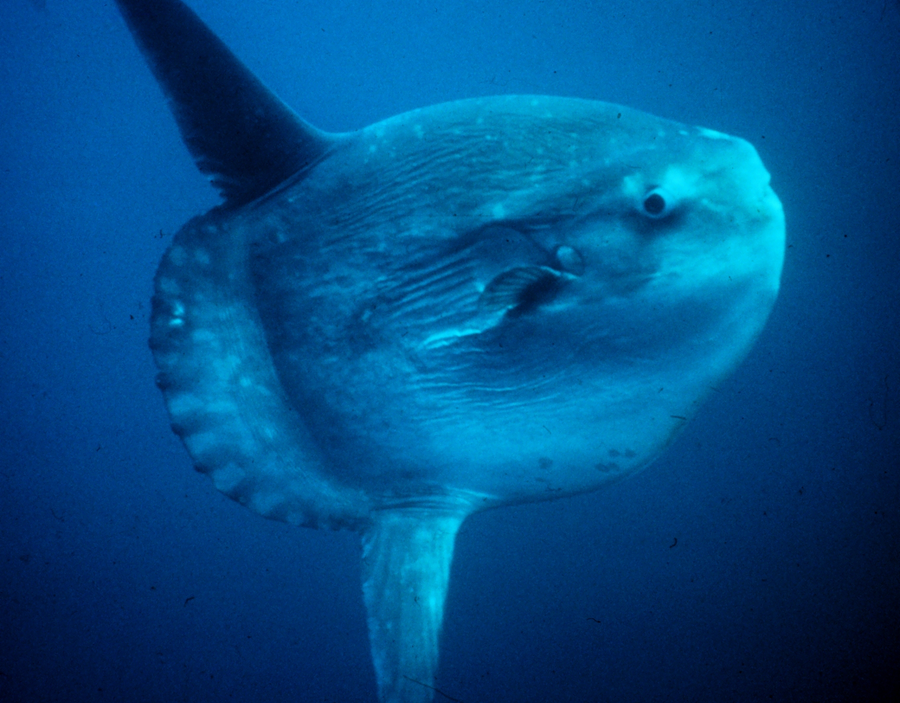
The ocean sunfish holds the record as the heaviest bony fish on Earth, with the largest individuals weighing up to about 2,000 kg (4,400 lb) and measuring around 3 m from fin tip to fin tip. Its body looks like a giant swimming head that ends abruptly, because it never develops a normal tail. In place of a tail it has a rounded rudder called a clavus, formed from the back of the body.
A slow, gentle swimmer
Despite its bulk, the sunfish is a harmless, placid animal that poses no danger to people. It swims slowly, reaching only about 5 km/h (3 mph), by sculling its tall dorsal and anal fins from side to side rather than beating a tail. Molas often let currents carry them and glide gently through open water in search of food; they never run, because they are fish and move only by swimming.
Feeding on jellyfish
The ocean sunfish feeds mainly on jellyfish and other gelatinous drifters such as salps and comb jellies, supplemented by small fish, squid, and crustaceans. Because this prey is mostly water and low in energy, a mola must eat huge quantities to sustain its size. It uses beak-like fused teeth to bite off chunks and a throat lined with spiny projections to break the slippery food apart.
Basking and parasites
Sunfish are often seen lying flat on their sides at the ocean surface, seemingly sunbathing. This basking behaviour helps them re-warm after deep dives into cold water and lets seabirds and cleaner fish pick parasites from their skin. Molas carry an exceptional parasite load, and they will even leap clear of the water, perhaps to dislodge unwanted hitchhikers.
Reproduction and record fertility
Female ocean sunfish are among the most fecund of all vertebrates, capable of carrying hundreds of millions of tiny eggs at once. The larvae hatch as spiny, spherical specks barely a few millimetres long, then grow through one of the largest size increases of any animal. Only a minute fraction survive the journey to adulthood.
Conservation and threats
The ocean sunfish is listed as Vulnerable by the IUCN. Large numbers are caught accidentally as bycatch in gillnet and longline fisheries, where their slow, surface-bound habits make them easy to snag. Floating plastic bags, which resemble jellyfish, are also mistaken for prey, adding to the pressures on this ocean giant.
Dig deeper into the Ocean Sunfish
- Are Ocean Sunfish Endangered?
Are ocean sunfish endangered? Status Vulnerable, main threats, and what protection means.
- How Long Do Ocean Sunfish Live?
Ocean Sunfish lifespan is typically 8–10 years in the wild. What shortens or extends life, life stages, and status (Vulnerable).
- Ocean Sunfish: Key Facts
Ocean sunfish can weigh over 2,000 kg with a flattened disc body and tiny mouth, living about 10 years and swimming slowly at 5 km/h.
- What Do Ocean Sunfish Eat?
What ocean sunfish eat: Carnivore — jellyfish, salps, and small fish, foraging style, and seasonal shifts in Temperate and tropical oceans worldwide.
- Where Do Ocean Sunfish Live?
Where ocean sunfish live: Temperate and tropical oceans worldwide, native range cues, and human overlap. Status Vulnerable.
Explore the Ocean Sunfish
Compare
Close relatives
- Pufferfish Same order
- Great White Shark Same class
- Rainbow Trout Same class
- Thresher Shark Same class
Collections
Did you know? Ocean Sunfish facts
- Ocean sunfish can weigh over 2,000 kg with a flattened disc body and tiny mouth.
- Harmless to humans — they eat gelatinous plankton.
- They float sideways at the surface soaking up sun after cold dives.
- Conservation: Vulnerable.
Diet & feeding
Ocean Sunfish feeds primarily as a jellyfish and salps.
Adaptations
- The body is a giant tail fin with fused vertebrae — no true tail.
- Sunfish carry heavy parasite burdens — seabirds pick them off at surface.
Behaviour & ecology
- The body is a giant tail fin with fused vertebrae — no true tail.
- Sunfish carry heavy parasite burdens — seabirds pick them off at surface.
Communication
- Lateral-line and visual cues coordinate schooling, courtship, or territorial behaviour.
- Some species produce low-frequency sounds or drumming for spawning or defence.
Habitat & range
Temperate and tropical oceans worldwide
Ecological role
Ocean Sunfish occupies a defined trophic level in aquatic food webs, linking plankton or smaller fish to larger predators.
Conservation status of the Ocean Sunfish
The ocean sunfish (Mola mola) is listed as Vulnerable on the IUCN Red List. Vulnerable (VU) means a species faces a high risk of extinction in the medium-term future. It is the lowest-risk of the three 'threatened' IUCN categories — one step below Endangered, which is itself below Critically Endangered — and is often an early warning that a population is in trouble.
Main threats to the ocean sunfish
- Bycatch in fisheries
- Plastic ingestion
- Boat strikes
- Targeted fisheries in some regions
Ocean Sunfish (Mola mola) was most recently assessed for the IUCN Red List in 2015. View the full IUCN assessment .
Frequently asked questions about the Ocean Sunfish
How big is an ocean sunfish?
The ocean sunfish is the heaviest bony fish in the world, with the largest specimens weighing up to about 2,000 kg (4,400 lb) and reaching around 3 m across. Typical adults are smaller, in the range of a few hundred kilograms.
Are ocean sunfish dangerous to humans?
No. Ocean sunfish are harmless, gentle animals with no interest in people and no ability to harm them. They swim slowly and feed on jellyfish, so divers can watch them at close range safely.
What do ocean sunfish eat?
Ocean sunfish feed mainly on jellyfish and other gelatinous animals such as salps, along with some small fish, squid, and crustaceans. Because this prey is low in energy, they must eat large amounts to maintain their enormous size.
Why do sunfish lie on their side at the surface?
Sunfish bask flat at the surface to re-warm their bodies after diving into cold, deep water. Basking also lets seabirds and cleaner fish remove the many parasites that collect on their skin.
How fast can an ocean sunfish swim?
Ocean sunfish are slow swimmers, reaching only about 5 km/h (3 mph). They move by waving their tall dorsal and anal fins from side to side and often drift with the current.
Are ocean sunfish endangered?
Ocean sunfish are listed as Vulnerable by the IUCN. Their main threat is accidental capture as bycatch in fishing nets and longlines, and they can also die from swallowing floating plastic mistaken for jellyfish.
What is a group of ocean sunfish called?
A group of Ocean Sunfish is called a school.
What is a baby ocean sunfish called?
A baby Ocean Sunfish is called a larva.
Sources & references
This guide is compiled and reviewed against established zoological and conservation references. Key sources for the Ocean Sunfish:
-
IUCN Red List of Threatened Species
Conservation status (Vulnerable) reflects the IUCN Red List category for Mola mola, most recently assessed in 2015.
-
iNaturalist — observations & photos
Search citizen-science observations and community IDs for Mola mola. Useful for range checks and recent sightings — not a substitute for formal Red List status.
-
GBIF — occurrence data
Global Biodiversity Information Facility species search for Mola mola. Explore published occurrence records used in range research.
- IUCN Red List — Mola mola.
Conservation status (Vulnerable) and population trends.
- Animal Diversity Web — Mola mola. University of Michigan Museum of Zoology.
Life history, morphology, and range.
-
Global Animal Guide editorial standards
How we research, source, review, and update every guide for accuracy.