Image sourcing: see credits & licences
The Philippine tarsier (Carlito syrichta) is a mammal of the family Tarsiidae, in the order Primates.
Quick answer
The Philippine tarsier is a tiny nocturnal primate found only in the forests of the southern Philippines. Weighing just 80 to 160 g and small enough to fit in a human hand, it has enormous eyes, each larger than its brain, and can leap more than 40 times its own body length between branches. Tarsiers are strictly carnivorous, live around 10 to 12 years in the wild, and are classed as Near Threatened.
Top questions about the Philippine Tarsier
Also available in Español (Tarsero filipino)
Philippine Tarsier facts at a glance
- Weight 150 g
- Length 15 cm
- Top speed 24 km/h
- Lifespan 12 years
| Scientific name | Carlito syrichta |
|---|---|
| Diet | Carnivore — insects, lizards, and small vertebrates |
| Habitat | Lowland and montane forests of the Philippines |
| Lifespan | 10–12 years in the wild |
| Weight | 80–160 g (0.08–0.16 kg); fits in a human hand |
| Top speed | Leaps over 40 body lengths; up to 24 km/h in bursts |
| Conservation status | Near Threatened (IUCN) |
| Kingdom | Animalia |
|---|---|
| Phylum | Chordata |
| Class | Mammalia |
| Order | Primates |
| Family | Tarsiidae |
| Genus | Carlito |
Where it lives
The philippine tarsier (Carlito syrichta) is native to Philippine tarsier on Bohol, Samar, Leyte, and Mindanao in the Philippines — lowland and montane forest fragments. — recorded across Asia in this guide’s range summary.
For occurrence records, see GBIF species search and sources below.
How big is a philippine tarsier?
An adult philippine tarsier measures 15 cm long — about 9% of the height of an average adult person (1.73 m) — and weighs around 150 g, a small fraction of an average adult’s body weight (70 kg).
Length vs an average adult’s height (to scale)
What is a group of philippine tarsiers called?
Group name (collective noun)
A group of Philippine Tarsiers is called a troop.
Baby name
A baby Philippine Tarsier is called an infant.
Explore more animal collective nouns and baby animal names .
Enormous eyes and night vision
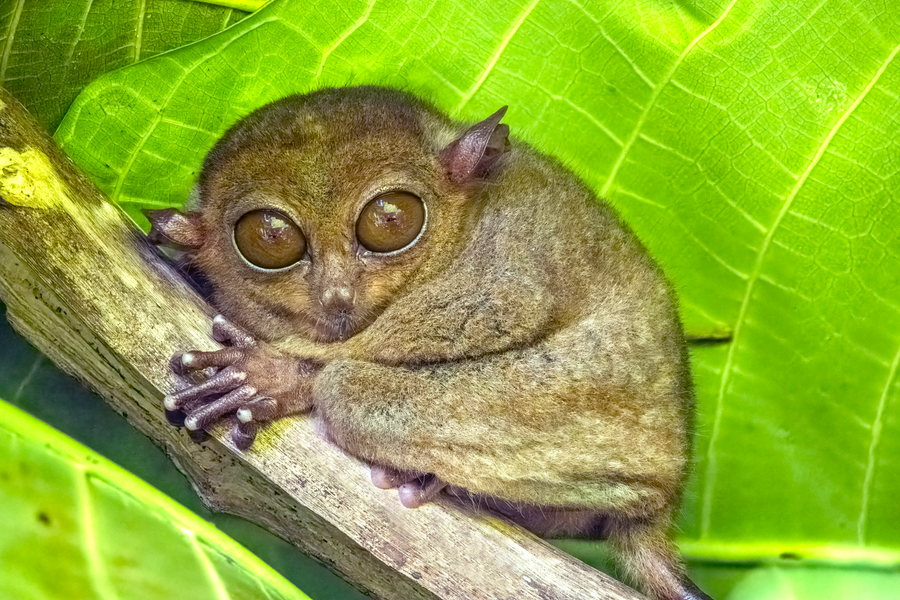
The tarsier's most striking feature is its pair of huge, fixed eyes, each roughly the size of its brain, which give it superb vision in near-total darkness. Because the eyes cannot move in their sockets, the tarsier instead rotates its head almost 180 degrees in each direction, like an owl, to scan for prey. Large membranous ears and sensitive hearing complete a body built entirely around hunting at night.
A leaping specialist
Tarsiers are extraordinary jumpers, with greatly elongated ankle bones (the tarsus that gives them their name) acting like springs. From a standing cling on a vertical trunk, a tarsier can launch itself more than 40 body lengths in a single leap, snatching insects out of the air or landing precisely on the next branch. In short bursts they move through the forest at speeds of up to 24 km/h (15 mph).
A purely carnivorous primate
Unusually for a primate, the tarsier eats no plant matter at all. Its diet is entirely animal: insects such as crickets, beetles, and moths, plus the occasional small lizard, bird, or even snake. It hunts by sitting still and listening, then pouncing with both hands to seize prey and deliver a killing bite.
Habitat and behaviour
The Philippine tarsier lives in the lowland and montane forests of islands such as Bohol, Samar, Leyte, and Mindanao, favouring dense secondary growth and tangled vegetation. It is nocturnal and largely solitary, resting by day clinging to a vertical stem in thick cover. Individuals mark territories with scent and keep in contact using high-pitched calls, some of them ultrasonic and inaudible to humans.
Conservation and threats
The Philippine tarsier is listed as Near Threatened by the IUCN, with numbers declining as its forest home is cleared. Habitat loss from logging and agriculture is the main pressure, compounded by capture for the pet trade and disturbance from tourism. Tarsiers are highly stress-prone in captivity, so protecting wild forest and well-managed sanctuaries are the most effective safeguards.
Lifespan and reproduction
In the wild tarsiers live around 10 to 12 years. Females give birth to a single, well-developed baby after a long gestation of about six months, and the newborn can cling to fur and even climb within days. Mothers sometimes carry infants in their mouths or park them on a branch while foraging nearby.
Dig deeper into the Philippine Tarsier
- How Long Do Philippine Tarsiers Live?
Philippine Tarsier lifespan is typically 10–12 years in the wild. What shortens or extends life, life stages, and status (Near Threatened).
- Tarsier Extreme Night Vision
The Philippine tarsier is a tiny primate with enormous eyes — each eyeball larger than its brain — fixed in the skull so it rotates its head 180 degrees.
- Tarsier Vertical Clinging And Leaping
The Philippine tarsier is a tiny primate with enormous eyes — each eyeball larger than its brain — fixed in the skull so it rotates its head 180 degrees.
- What Do Philippine Tarsiers Eat?
What Philippine tarsiers eat: Carnivore — insects, lizards, and small vertebrates, foraging style, and seasonal shifts in Lowland and montane forests of the Philippines.
- Where Do Philippine Tarsiers Live?
Where Philippine tarsiers live: Lowland and montane forests of the Philippines, native range cues, and human overlap. Status Near Threatened.
Explore the Philippine Tarsier
Close relatives
- Mountain Gorilla Same order
- Aye-aye Same order
- Japanese Macaque Same order
- Gorilla Same order
Range & geography
Did you know? Philippine Tarsier facts
- Tarsiers are tiny primates with enormous eyes fixed in the skull — each eye is bigger than the brain.
- No — they need live insect diets and darkness; most captive tarsiers die quickly.
- Over 40 times their body length between branches.
- Conservation: Near Threatened.
Diet & feeding
Philippine Tarsier feeds primarily as a insects, small vertebrates.
Adaptations
- Tarsiers cannot rotate their eyes and turn their head 180 degrees instead.
- Flash photography and handling in tourist sites harm sensitive tarsiers.
Behaviour & ecology
- Tarsiers cannot rotate their eyes and turn their head 180 degrees instead.
- Flash photography and handling in tourist sites harm sensitive tarsiers.
Communication
- Philippine Tarsier uses scent, posture, and vocal signals to mark territory and coordinate social behaviour.
- Communication intensity often peaks during breeding seasons and territorial disputes.
Habitat & range
Philippine forests
Ecological role
Philippine Tarsier plays a recognised ecological role in philippine forests.
Conservation status of the Philippine Tarsier
The philippine tarsier (Carlito syrichta) is listed as Near Threatened on the IUCN Red List. Near Threatened (NT) means a species does not yet qualify as threatened but is close to it, or likely to become so in the near future without ongoing conservation. It is a watch-list category just below Vulnerable.
The philippine tarsier (Carlito syrichta) is assessed on the IUCN Red List. Look up on the IUCN Red List .
Frequently asked questions about the Philippine Tarsier
How big is a Philippine tarsier?
The Philippine tarsier is one of the smallest primates, weighing just 80 to 160 g (0.08 to 0.16 kg) and measuring around 15 cm in body length. It is small enough to sit comfortably in the palm of a human hand.
Why do tarsiers have such big eyes?
Tarsiers are nocturnal and their huge eyes gather as much light as possible for hunting in near darkness. Each eye is about the size of the animal's brain, and because the eyes cannot move, the tarsier turns its head almost 180 degrees to look around.
What do tarsiers eat?
Tarsiers are strictly carnivorous, feeding on insects such as crickets, beetles, and moths. They also catch small vertebrates including lizards, birds, and even small snakes, making them the only entirely meat-eating primates.
How far can a tarsier jump?
A tarsier can leap more than 40 times its own body length in a single bound, thanks to its elongated ankle bones. This lets it cross wide gaps between trees and snatch flying insects in mid-air.
Are tarsiers endangered?
The Philippine tarsier is currently listed as Near Threatened by the IUCN. Its numbers are falling mainly because of forest clearance, along with capture for the pet trade and disturbance from tourism.
How long do tarsiers live?
In the wild, Philippine tarsiers live around 10 to 12 years. They are highly sensitive to stress, which makes them very difficult to keep alive in captivity.
What is a group of philippine tarsiers called?
A group of Philippine Tarsiers is called a troop.
What is a baby philippine tarsier called?
A baby Philippine Tarsier is called an infant.
Sources & references
This guide is compiled and reviewed against established zoological and conservation references. Key sources for the Philippine Tarsier:
-
IUCN Red List of Threatened Species
Conservation status (Near Threatened) reflects the IUCN Red List category for Carlito syrichta.
-
iNaturalist — observations & photos
Search citizen-science observations and community IDs for Carlito syrichta. Useful for range checks and recent sightings — not a substitute for formal Red List status.
-
GBIF — occurrence data
Global Biodiversity Information Facility species search for Carlito syrichta. Explore published occurrence records used in range research.
- IUCN Red List — Carlito syrichta.
Conservation status (Near Threatened) and population trends.
- Animal Diversity Web — Carlito syrichta. University of Michigan Museum of Zoology.
Life history, morphology, and range.
-
Global Animal Guide editorial standards
How we research, source, review, and update every guide for accuracy.