Image sourcing: see credits & licences
The red panda (Ailurus fulgens) is a mammal of the family Ailuridae, in the order Carnivora.
Quick answer
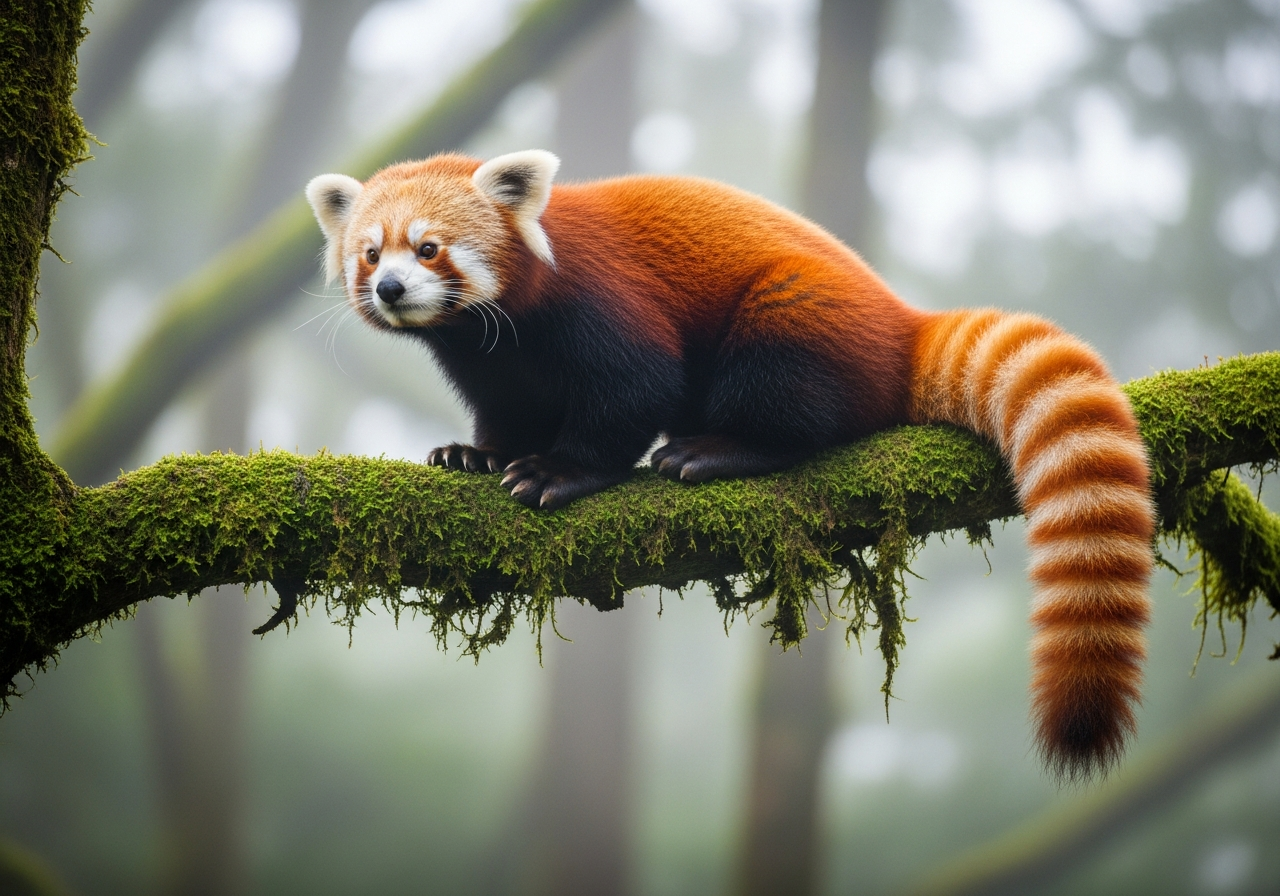
The red panda is a small, tree-dwelling mammal native to the eastern Himalayas and southwestern China, with rust-red fur, a ringed bushy tail, and a face like a raccoon. About the size of a house cat, it feeds mainly on bamboo and is the only living member of its own family. Red pandas typically live 8 to 14 years and are listed as Endangered.
Top questions about the Red Panda
Also available in Español (Panda rojo)
Red Panda facts at a glance
- Weight 6 kg
- Length 1.1 m
- Top speed 38 km/h
- Lifespan 14 years
| Scientific name | Ailurus fulgens |
|---|---|
| Diet | Omnivore (mostly bamboo) |
| Habitat | Temperate Himalayan forest |
| Lifespan | 8–14 years |
| Weight | 3–6 kg (7–13 lb) |
| Top speed | Up to 38 km/h (24 mph) |
| Conservation status | Endangered (IUCN) |
| Kingdom | Animalia |
|---|---|
| Phylum | Chordata |
| Class | Mammalia |
| Order | Carnivora |
| Family | Ailuridae |
| Genus | Ailurus |
Where it lives
The red panda (Ailurus fulgens) is native to Temperate bamboo forests of the eastern Himalayas and southwestern China. — recorded across Asia in this guide’s range summary.
For occurrence records, see GBIF species search and sources below.
How big is a red panda?
An adult red panda measures 1.1 m long — about 64% of the height of an average adult person (1.73 m) — and weighs around 6.0 kg, about 9% of an average adult’s body weight (70 kg).
Length vs an average adult’s height (to scale)
What is a group of red pandas called?
Group name (collective noun)
A group of Red Pandas is called a pack.
Baby name
A baby Red Panda is called a cub.
Explore more animal collective nouns and baby animal names .
Not really a panda
Despite the name and a shared love of bamboo, the red panda is not closely related to the giant panda. It is the sole living species in its own family, Ailuridae, and is more closely related to raccoons, weasels, and skunks. It even has a 'false thumb', an extended wrist bone, for gripping bamboo.
Diet and lifestyle
Red pandas spend most of their lives in the trees, where their reddish coats blend with reddish moss and lichen. They are mainly active at dawn and dusk and eat huge amounts of bamboo to make up for how little nutrition they extract from it, supplementing it with fruit, berries, eggs, and insects.
Surviving the cold
Living in cool mountain forests, the red panda has dense fur even on the soles of its feet and wraps its long, bushy tail around itself like a blanket against the cold. When threatened, it can stand on its hind legs to look bigger and lash out with sharp claws.
Conservation
Red pandas are Endangered, with fewer than an estimated 10,000 left in the wild. Deforestation, fragmentation of their bamboo forests, poaching for fur, and the illegal pet trade are the main threats. Protected reserves and community forestry programs are vital to their future.
Not a true panda
Despite its name and bamboo diet, the red panda is not closely related to the giant panda. It is the only living member of its own family, Ailuridae, and is roughly the size of a large house cat with a long, bushy, ringed tail.
Lifestyle
Red pandas are mostly solitary and active around dawn and dusk. They are skilled climbers that spend much of their time in trees, using their tails for balance and warmth, and like giant pandas they have a false thumb for gripping bamboo.
The other panda follows its own evolutionary path
Red pandas are not small giant pandas. They belong to Ailuridae and have adaptations for climbing, balancing and handling bamboo. Mountain forests provide food and shelter, so fragmentation can affect more than the area available on a map. Connectivity and forest quality matter too. Their appealing appearance should never be interpreted as evidence that they are suitable companion animals.
Dig deeper into the Red Panda
- Are Red Pandas Endangered?
Red pandas are IUCN Endangered: fewer than 10,000, declining ~50% over three generations. Not giant pandas. Not bears.
- How Long Do Red Pandas Live?
Wild red pandas often live about 8–14 years; logging, dogs and cub mortality cut the average. IUCN Endangered.
- Red Panda: Key Facts
Red pandas are IUCN Endangered: fewer than 10,000, declining ~50% over three generations. Ailuridae, not giant pandas, not a Chengdu story.
- What Do Red Pandas Eat?
Red pandas eat almost entirely bamboo, plus fruit and insects. They are Ailuridae, not bears. Never feed wild red pandas.
- Where Do Red Pandas Live?
Red pandas live in temperate Himalayan and southwestern Chinese forest — Nepal, India, Bhutan, Myanmar, China. Not giant pandas.
Explore the Red Panda
Collections
Range & geography
Did you know? Red Panda facts
- The red panda is not closely related to the giant panda — it is in its own family, Ailuridae.
- Like the giant panda, it has a 'false thumb' for gripping bamboo.
- Red pandas use their long, bushy tail as a blanket in cold mountain forests.
- They are mostly active at dawn, dusk, and night.
- The species is endangered, threatened by habitat loss and poaching.
- Red pandas were known to science before giant pandas and share the name 'panda'.
Diet & feeding
The diet is dominated by bamboo leaves and shoots, supplemented seasonally by fruit, berries, acorns, eggs, and small animals.
Adaptations
- A 'false thumb' (modified wrist bone) helps grip bamboo and climb.
- Thick fur, including furred foot soles, insulates against cold and grips branches.
- A long, ringed tail aids balance in trees and provides warmth at rest.
- Reddish coat and dark underside camouflage the panda among moss and red lichen.
Behaviour & ecology
- Red pandas are largely solitary, arboreal, and most active in cooler hours.
- They spend much of the day resting in trees and feed mainly on bamboo.
- Scent-marking maintains spacing between individuals' home ranges.
- Mothers raise cubs in tree nests, with young dependent for several months.
Communication
- Red pandas use scent from glands and a 'twitter' or 'huff-quack' vocalisation.
- Tail and body postures signal alarm and threat.
- Chemical marking communicates identity and reproductive state.
Habitat & range
Red pandas inhabit temperate broadleaf and conifer forests with bamboo understorey across the eastern Himalayas and southwestern China, at moderate to high elevations.
Ecological role
As a bamboo specialist and seed-disperser, the red panda is an indicator of healthy montane forest and a flagship for Himalayan conservation.
Conservation status of the Red Panda
The red panda (Ailurus fulgens) is listed as Endangered on the IUCN Red List. Endangered (EN) means a species faces a very high risk of extinction in the wild. Populations are usually declining sharply due to habitat loss, hunting, disease, or climate pressure. It sits one level below Critically Endangered on the IUCN Red List.
Main threats to the red panda
- Deforestation and habitat fragmentation
- Poaching and illegal trade for pelts
- Livestock grazing and herding pressure
- Dog-borne disease and predation
Red Panda (Ailurus fulgens) was most recently assessed for the IUCN Red List in 2015. View the full IUCN assessment .
Frequently asked questions about the Red Panda
Are red pandas endangered?
Yes. The red panda is listed as Endangered, with habitat loss and poaching driving population declines across its Himalayan range.
What do red pandas eat?
Red pandas eat mainly bamboo, but also fruit, acorns, eggs, and small animals, supplementing the low nutrition of bamboo with a varied diet.
Are red pandas related to giant pandas?
No, only distantly. Despite sharing a bamboo diet and a name, the red panda belongs to its own family and is more closely related to raccoons and weasels than to the giant panda.
How big is a red panda?
A red panda is roughly the size of a large house cat, weighing 3 to 6 kg (7 to 13 lb), though its long bushy tail makes it look bigger.
Where do red pandas live?
Red pandas live in the cool temperate forests of the eastern Himalayas and southwestern China, across countries including Nepal, India, Bhutan, Myanmar, and China.
Why are red pandas endangered?
Red pandas are Endangered due to deforestation, habitat fragmentation, poaching for their fur, and the illegal pet trade, which have reduced their numbers to an estimated 10,000 or fewer in the wild.
Is a red panda a bear?
No. Red pandas belong to their own family, Ailuridae. Giant pandas belong to the bear family, Ursidae. Their shared name and reliance on bamboo can obscure that distinction; scientific classification clarifies which traits reflect ancestry and which reflect similar ways of living.
What is a group of red pandas called?
A group of Red Pandas is called a pack.
What is a baby red panda called?
A baby Red Panda is called a cub.
Sources & references
This guide is compiled and reviewed against established zoological and conservation references. Key sources for the Red Panda:
-
IUCN Red List of Threatened Species
Conservation status (Endangered) reflects the IUCN Red List category for Ailurus fulgens, most recently assessed in 2015.
-
iNaturalist — observations & photos
Search citizen-science observations and community IDs for Ailurus fulgens. Useful for range checks and recent sightings — not a substitute for formal Red List status.
-
GBIF — occurrence data
Global Biodiversity Information Facility species search for Ailurus fulgens. Explore published occurrence records used in range research.
- Glatston, A. et al. (2015). Ailurus fulgens. IUCN Red List of Threatened Species.
Status (Endangered) and threats.
- Animal Diversity Web — Ailurus fulgens. University of Michigan Museum of Zoology.
Life history, morphology, and range.
- Nowak, R. M. (1999). Walker's Mammals of the World (6th ed.). Johns Hopkins University Press.
Morphology and biology.
-
Global Animal Guide editorial standards
How we research, source, review, and update every guide for accuracy.