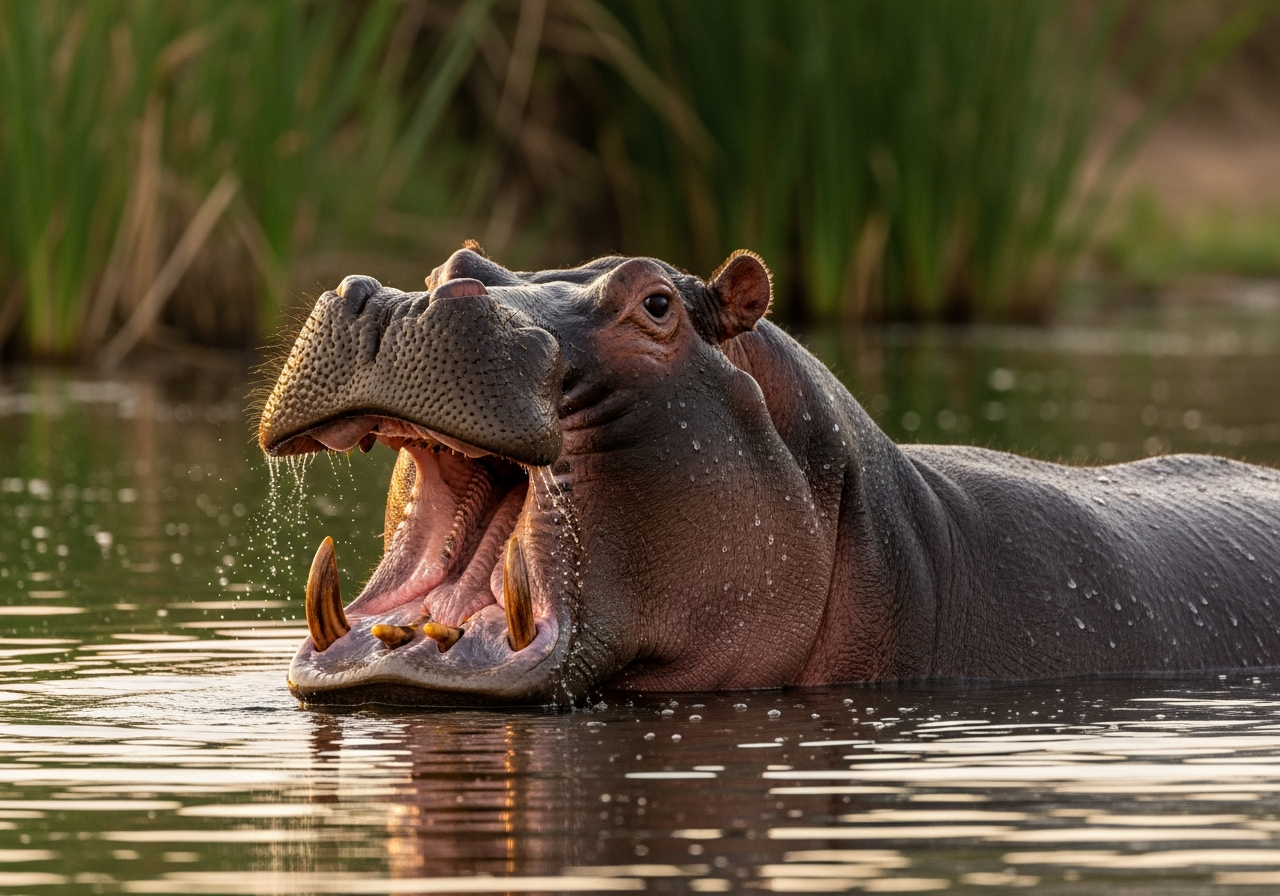
The hippopotamus (Hippopotamus amphibius) is a mammal of the hippopotamus family, Hippopotamidae, in the order Artiodactyla.
Quick answer
The hippopotamus is a massive semi-aquatic mammal native to sub-Saharan Africa, weighing up to 1,500 kg (3,300 lb). Despite a plant-based diet, hippos are highly territorial and are considered one of the most dangerous large animals to humans in Africa. Wild hippos live around 40 to 50 years.
Top questions about the Hippopotamus
Hippopotamus facts at a glance
- Weight 1500 kg
- Length 4 m
- Top speed 30 km/h
- Lifespan 45 years
| Scientific name | Hippopotamus amphibius |
|---|---|
| Diet | Herbivore |
| Habitat | Rivers, lakes, and wetlands |
| Lifespan | 40–50 years in the wild |
| Weight | 1,000–1,500 kg (2,200–3,300 lb) |
| Top speed | 30 km/h (19 mph) on land |
| Conservation status | Vulnerable (IUCN) |
| Kingdom | Animalia |
|---|---|
| Phylum | Chordata |
| Class | Mammalia |
| Order | Artiodactyla |
| Family | Hippopotamidae |
| Genus | Hippopotamus |
Where it lives
The hippopotamus (Hippopotamus amphibius) is native to Rivers, lakes, and wetlands across sub-Saharan Africa. — recorded across Africa in this guide’s range summary.
For occurrence records, see GBIF species search and sources below.
How big is a hippopotamus?
An adult hippopotamus measures 4 m long — about 2.3× the height of an average adult person (1.73 m) — and weighs around 1500 kg, about 21× an average adult’s body weight (70 kg).
Length vs an average adult’s height (to scale)
What is a group of hippopotamuses called?
Group name (collective noun)
A group of Hippopotamuses is called a bloat. It is also known as a pod.
Baby name
A baby Hippopotamus is called a calf.
Explore more animal collective nouns and baby animal names .
Life in and out of water
Hippos spend up to 16 hours a day in water to keep their huge bodies cool and protected from the sun. They cannot truly swim; instead they walk or push off along the riverbed and can hold their breath for around five minutes. Their skin secretes a reddish substance, sometimes called blood sweat, that acts as a natural sunscreen and antibiotic.
Diet and territory
Hippos leave the water at night to graze on grass, eating around 35 kg (80 lb) in a session. Despite their herbivorous diet, bulls are fiercely territorial in water and will defend their stretch of river aggressively, using their enormous jaws and tusk-like canine teeth.
Why hippos are so dangerous
Hippos are responsible for an estimated several hundred human deaths in Africa each year, more than lions or crocodiles. They are unpredictable, surprisingly fast on land, and will capsize boats and attack anything they see as a threat to their territory or young.
Conservation
Hippos are listed as Vulnerable, with populations under pressure from habitat loss as rivers and wetlands are drained or diverted, and from illegal hunting for their meat and ivory canine teeth. Protected reserves and stable water sources are key to their future.
Dig deeper into the Hippopotamus
- Are Hippopotamuses Endangered?
Are hippopotamuses endangered? Status Vulnerable, main threats, and what protection means.
- Are Hippopotamuses Dangerous?
Are hippopotamuses dangerous? Realistic risk, when incidents rise, and safety basics.
- What Do Hippopotamuses Eat?
What hippopotamuses eat: Herbivore, foraging style, and seasonal shifts in Rivers, lakes, and wetlands.
- Hippo Mother Calves
The hippopotamus is a massive semi-aquatic mammal native to sub-Saharan Africa, weighing up to 1,500 kg (3,300 lb).
- Hippo Population
The hippopotamus is a massive semi-aquatic mammal native to sub-Saharan Africa, weighing up to 1,500 kg (3,300 lb).
- Hippo Sweat Sunscreen
The hippopotamus is a massive semi-aquatic mammal native to sub-Saharan Africa, weighing up to 1,500 kg (3,300 lb).
- Hippo Vs Rhino
The hippopotamus is a massive semi-aquatic mammal native to sub-Saharan Africa, weighing up to 1,500 kg (3,300 lb).
- Are Hippopotamuses Dangerous?
Are hippopotamuses dangerous? Realistic risk, when incidents rise, and safety basics.
- How Long Do Hippopotamuses Live?
Hippopotamus lifespan is typically 40–50 years in the wild. What shortens or extends life, life stages, and status (Vulnerable).
- Pygmy Hippo
The hippopotamus is a massive semi-aquatic mammal native to sub-Saharan Africa, weighing up to 1,500 kg (3,300 lb).
- What Do Hippopotamuses Eat?
What hippopotamuses eat: Herbivore, foraging style, and seasonal shifts in Rivers, lakes, and wetlands.
- Where Do Hippopotamuses Live?
Where hippopotamuses live: Rivers, lakes, and wetlands, native range cues, and human overlap. Status Vulnerable.
- Why Do Hippos Yawn?
The hippopotamus is a massive semi-aquatic mammal native to sub-Saharan Africa, weighing up to 1,500 kg (3,300 lb).
Explore the Hippopotamus
Compare
Close relatives
- Pygmy Hippopotamus Same family
- Giraffe Same order
- Blue Whale Same order
- Cow Same order
Collections
Range & geography
Did you know? Hippopotamus facts
- Hippos are among Africa's deadliest large animals to people, killing more humans than lions.
- Despite their bulk, hippos can run at around 30 km/h over short distances on land.
- Their closest living relatives are whales and dolphins, not pigs.
- Hippos secrete a reddish 'blood sweat' that acts as sunscreen and an antibiotic.
- They spend the day in water to stay cool, then graze on land at night.
- A hippo's bite force is around 1,800 PSI, able to bite a small boat in two.
- Hippos cannot truly swim — they move by pushing off the bottom and 'porpoising'.
Diet & feeding
Hippos are bulk grazers, feeding chiefly on short grasses during nightly excursions and eating relatively little for their size — around 40 kg a night — thanks to an energy-conserving lifestyle.
Adaptations
- Eyes, ears, and nostrils sit on top of the head, so a hippo can sense the world while submerged. (Eltringham 1999)
- Reddish skin secretions screen ultraviolet light and inhibit bacteria, protecting hairless skin.
- Enormous canine and incisor tusks grow continuously and are formidable weapons.
- Dense bones and the ability to walk along riverbeds suit a semi-aquatic life.
Behaviour & ecology
- Bulls hold and aggressively defend stretches of water against rivals. (Eltringham 1999)
- Hippos leave the water at night to graze on grass, often travelling several kilometres.
- Mothers are intensely protective, and many attacks involve a perceived threat to a calf.
- Gaping wide-mouth displays and dung-scattering advertise dominance and territory.
Communication
- Hippos produce loud 'wheeze-honks' and grunts that carry across and under water.
- They can vocalise both above and below the surface, an unusual amphibious ability.
- Dung-scattering with a flicking tail marks paths and territorial boundaries.
Habitat & range
The common hippo lives in and around rivers, lakes, and wetlands of sub-Saharan Africa, needing deep water to rest in by day and adjacent grassland to graze by night.
Ecological role
Hippos transfer nutrients from land into rivers through their dung, shaping aquatic food webs and channel structure, and their grazing and trampling help maintain open grazing 'lawns'.
Conservation status of the Hippopotamus
The hippopotamus (Hippopotamus amphibius) is listed as Vulnerable on the IUCN Red List. Vulnerable (VU) means a species faces a high risk of extinction in the medium-term future. It is the lowest-risk of the three 'threatened' IUCN categories — one step below Endangered, which is itself below Critically Endangered — and is often an early warning that a population is in trouble.
Main threats to the hippopotamus
- Habitat loss along rivers and lakes
- Hunting for meat and ivory-like canine teeth
- Human–hippo conflict
- Drought reducing dry-season water
Hippopotamus (Hippopotamus amphibius) was most recently assessed for the IUCN Red List in 2017. View the full IUCN assessment .
Frequently asked questions about the Hippopotamus
Are hippos dangerous?
Yes. Hippos are considered one of the most dangerous large animals in Africa, blamed for an estimated several hundred human deaths each year. They are highly territorial and will attack boats and people that come too close.
What do hippos eat?
Hippos are herbivores that feed mainly on grass. They leave the water at night to graze, eating around 35 kg (80 lb) of vegetation in a single feeding session.
Can hippos swim?
Not in the usual sense. Hippos are too dense to float easily, so instead of swimming they walk or push off along the bottom of rivers and lakes and can hold their breath for about five minutes.
How fast can a hippo run?
On land, a hippo can run up to about 30 km/h (19 mph) over short distances, fast enough to outpace a person despite its enormous bulk.
How much does a hippo weigh?
Adult hippos typically weigh between 1,000 and 1,500 kg (2,200 to 3,300 lb), with large males occasionally exceeding that, making them one of the heaviest land animals after elephants and rhinos.
What is a group of hippopotamuses called?
A group of Hippopotamuses is called a bloat. It is also known as a pod.
What is a baby hippopotamus called?
A baby Hippopotamus is called a calf.
Sources & references
This guide is compiled and reviewed against established zoological and conservation references. Key sources for the Hippopotamus:
-
IUCN Red List of Threatened Species
Conservation status (Vulnerable) reflects the IUCN Red List category for Hippopotamus amphibius, most recently assessed in 2017.
-
iNaturalist — observations & photos
Search citizen-science observations and community IDs for Hippopotamus amphibius. Useful for range checks and recent sightings — not a substitute for formal Red List status.
-
GBIF — occurrence data
Global Biodiversity Information Facility species search for Hippopotamus amphibius. Explore published occurrence records used in range research.
- Lewison, R. & Pluháček, J. (2017). Hippopotamus amphibius. The IUCN Red List of Threatened Species.
Status (Vulnerable) and threats.
- Eltringham, S. K. (1999). The Hippos: Natural History and Conservation. Academic Press.
Definitive natural-history reference.
- Nowak, R. M. (1999). Walker's Mammals of the World (6th ed.). Johns Hopkins University Press.
Morphology and biology.
- Animal Diversity Web — Hippopotamus amphibius. University of Michigan Museum of Zoology.
Behaviour and range.
-
Global Animal Guide editorial standards
How we research, source, review, and update every guide for accuracy.