Image sourcing: see credits & licences
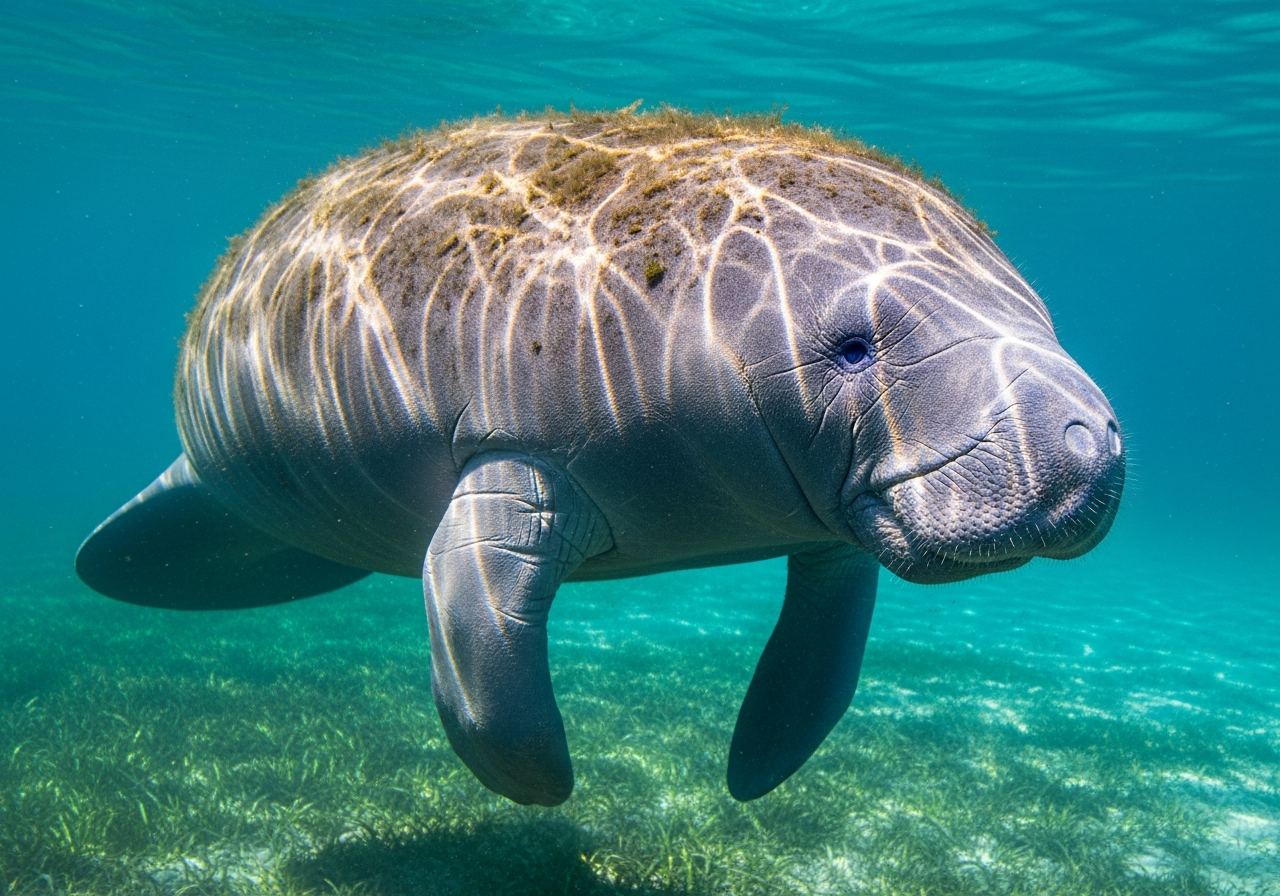
The manatee (Trichechus manatus) is a mammal of the family Trichechidae, in the order Sirenia.
Quick answer
Manatees are large, slow-moving aquatic mammals often called sea cows. The West Indian manatee grazes on seagrass and water plants in warm rivers, estuaries, and shallow coasts. Adults reach about 3 m (10 ft) and 500 kg (1,100 lb) and can live 40 years or more in the wild.
Top questions about the Manatee
Also available in Español (Manatí)
Manatee facts at a glance
- Weight 500 kg
- Length 3 m
- Top speed 24 km/h
- Lifespan 40 years
| Scientific name | Trichechus manatus |
|---|---|
| Diet | Herbivore (seagrass and water plants) |
| Habitat | Warm rivers, estuaries, and shallow coasts |
| Lifespan | 40+ years in the wild |
| Weight | 200–600 kg (440–1,300 lb) |
| Length | 2.7–4 m (9–13 ft) |
| Conservation status | Vulnerable (IUCN) |
| Kingdom | Animalia |
|---|---|
| Phylum | Chordata |
| Class | Mammalia |
| Order | Sirenia |
| Family | Trichechidae |
| Genus | Trichechus |
Where it lives
The manatee (Trichechus manatus) is native to Warm Atlantic coasts, rivers, and estuaries from the southeastern United States through the Caribbean to northern Brazil. — recorded across North America, South America, Oceans in this guide’s range summary.
For occurrence records, see GBIF species search and sources below.
How big is a manatee?
An adult manatee measures 3 m long — about 1.7× the height of an average adult person (1.73 m) — and weighs around 500 kg, about 7.1× an average adult’s body weight (70 kg).
Length vs an average adult’s height (to scale)
What is a group of manatees called?
Group name (collective noun)
A group of Manatees is called an aggregation.
Baby name
A baby Manatee is called a calf.
Explore more animal collective nouns and baby animal names .
Gentle plant-eating giants
Manatees are among the only fully aquatic herbivorous mammals. A single adult can eat a tenth of its body weight in seagrass and water plants every day, grazing for up to eight hours. They have no natural predators and spend their time slowly cruising warm shallows, surfacing every few minutes to breathe.
Built for warm water
Despite their bulk, manatees have very little body fat and a slow metabolism, so they cannot survive long in water below about 20°C (68°F). In winter, Florida manatees gather in the hundreds around warm natural springs and the outflows of power plants, where the water stays warm enough to keep them alive.
Surprisingly close to elephants
Manatees are not related to whales or seals. Their closest living relatives are elephants, with which they share traits such as continually replaced molar teeth and thick, sparse body hair. The group that includes manatees and the dugong is called the Sirenia, the likely origin of old sailors' mermaid legends.
Habitat and range
The West Indian manatee lives along the Atlantic coast from the southeastern United States through the Caribbean to northern Brazil. It moves freely between salt, brackish, and fresh water, following warm temperatures and the seagrass beds it depends on for food.
Conservation
Manatees are listed as Vulnerable by the IUCN. Their greatest threats are collisions with boats — many wild manatees carry scars from propellers — along with loss of seagrass, cold-water stress, and entanglement. Speed-limit zones, habitat protection, and rescue-and-release programs are central to their recovery.
Dig deeper into the Manatee
- Are Manatees Endangered?
Are manatees endangered? Status Vulnerable, main threats, and what protection means.
- How Long Do Manatees Live?
Manatee lifespan is typically 40+ years in the wild. What shortens or extends life, life stages, and status (Vulnerable).
- Manatee: Key Facts
Manatees are large, slow-moving aquatic mammals often called sea cows.
- What Do Manatees Eat?
What manatees eat: Herbivore (seagrass and water plants), foraging style, and seasonal shifts in Warm rivers, estuaries, and shallow coasts.
- Where Do Manatees Live?
Where manatees live: Warm rivers, estuaries, and shallow coasts, native range cues, and human overlap. Status Vulnerable.
Explore the Manatee
Collections
Did you know? Manatee facts
- Manatees are gentle, slow-moving marine mammals often called 'sea cows'.
- Their closest living relatives are elephants, not other marine mammals.
- They graze on seagrass and can eat a tenth of their body weight daily.
- Manatees continually replace their teeth, growing new ones from the back.
- They surface to breathe every few minutes and rest underwater between breaths.
- Boat strikes are a leading threat to manatee survival.
Diet & feeding
Manatees are herbivores grazing on seagrasses, freshwater plants, and algae, consuming large quantities daily to fuel their bulk on a low-energy diet.
Adaptations
- Continuously replaced 'marching molars' cope with abrasive aquatic plants.
- A large, slow metabolism and heavy bones suit a grazing, shallow-water life.
- Paddle-like flippers and a flattened tail provide gentle propulsion.
- Sensitive facial bristles (vibrissae) help locate and handle vegetation.
Behaviour & ecology
- Manatees are mostly solitary or form loose groups, spending much of the day feeding.
- They move into warm-water refuges, such as springs, in cold weather.
- They surface regularly to breathe, often resting just below the surface.
- Mothers nurse and guide a single calf for up to two years.
Communication
- Manatees produce squeaks and chirps to maintain contact, especially mother and calf.
- Sensitive whiskers gather tactile information about their surroundings.
- Touch and close-range sound dominate their gentle social life.
Habitat & range
Manatees inhabit warm coastal waters, estuaries, rivers, and springs of the Atlantic and Caribbean (and related species elsewhere), needing warm water and abundant aquatic vegetation.
Ecological role
As large aquatic grazers, manatees shape seagrass beds and freshwater vegetation, influencing the structure of the shallow-water habitats they occupy.
Conservation status of the Manatee
The manatee (Trichechus manatus) is listed as Vulnerable on the IUCN Red List. Vulnerable (VU) means a species faces a high risk of extinction in the medium-term future. It is the lowest-risk of the three 'threatened' IUCN categories — one step below Endangered, which is itself below Critically Endangered — and is often an early warning that a population is in trouble.
The manatee (Trichechus manatus) is assessed on the IUCN Red List. Look up on the IUCN Red List .
Frequently asked questions about the Manatee
Why are manatees called sea cows?
Because they are large, slow, and graze on underwater plants much as cows graze on grass. The nickname reflects their gentle, herbivorous lifestyle, not any relationship to cattle.
What do manatees eat?
Manatees are herbivores that feed almost entirely on seagrass, freshwater plants, and algae, eating up to a tenth of their body weight every day.
Are manatees dangerous?
No. Manatees are gentle, curious, and harmless to people. The danger runs the other way — boat strikes are one of the leading causes of manatee deaths.
What are manatees related to?
Their closest living relatives are elephants. Manatees belong to a group called the Sirenia, which also includes the dugong, and they likely inspired ancient mermaid myths.
How long do manatees live?
Manatees can live 40 years or more in the wild, and some individuals have passed 60. Many die younger from boat collisions and cold-water stress.
What is a group of manatees called?
A group of Manatees is called an aggregation.
What is a baby manatee called?
A baby Manatee is called a calf.
Sources & references
This guide is compiled and reviewed against established zoological and conservation references. Key sources for the Manatee:
-
IUCN Red List of Threatened Species
Conservation status (Vulnerable) reflects the IUCN Red List category for Trichechus manatus.
-
iNaturalist — observations & photos
Search citizen-science observations and community IDs for Trichechus manatus. Useful for range checks and recent sightings — not a substitute for formal Red List status.
-
GBIF — occurrence data
Global Biodiversity Information Facility species search for Trichechus manatus. Explore published occurrence records used in range research.
- Deutsch, C. J. et al. (2008). Trichechus manatus. IUCN Red List of Threatened Species.
Status (Vulnerable) and threats.
- Animal Diversity Web — Trichechus manatus. University of Michigan Museum of Zoology.
Life history, morphology, and range.
- Nowak, R. M. (1999). Walker's Mammals of the World (6th ed.). Johns Hopkins University Press.
Physiology and diet.
-
Global Animal Guide editorial standards
How we research, source, review, and update every guide for accuracy.