Image sourcing: see credits & licences
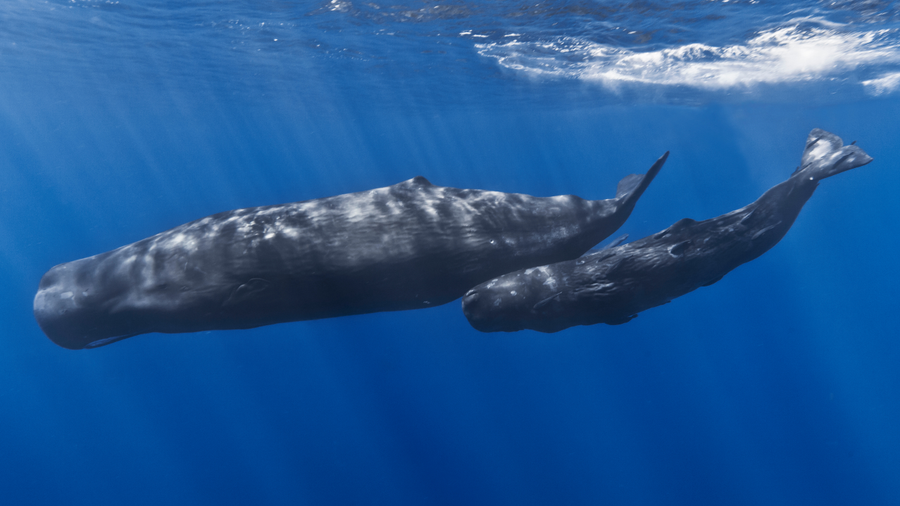
The sperm whale (Physeter macrocephalus) is a mammal of the family Physeteridae, in the order Artiodactyla.
Quick answer
The sperm whale is the largest toothed predator on Earth, with males reaching 16–20 m (52–66 ft) and over 50 tonnes. Famous for deep dives exceeding 2,000 m hunting giant squid, it has the largest brain of any animal and lives in social female-led pods across the world's oceans.
Top questions about the Sperm Whale
Also available in Español (Cachalote)
Sperm Whale facts at a glance
- Weight 40000 kg
- Length 16 m
- Top speed 35 km/h
- Lifespan 65 years
| Scientific name | Physeter macrocephalus |
|---|---|
| Diet | Carnivore — squid, deep-sea fish, and occasional sharks |
| Habitat | Deep offshore waters worldwide; males range into polar seas |
| Lifespan | 60–70 years |
| Weight | Males up to 57,000 kg; females 15,000 kg |
| Top speed | Up to 35 km/h (22 mph) swimming |
| Conservation status | Vulnerable (IUCN) |
| Kingdom | Animalia |
|---|---|
| Phylum | Chordata |
| Class | Mammalia |
| Order | Artiodactyla |
| Family | Physeteridae |
| Genus | Physeter |
Where it lives
The sperm whale (Physeter macrocephalus) is native to Deep offshore waters worldwide in all major oceans; males range into polar seas while females and young stay in warmer temperate and tropical waters. — recorded across Africa, Asia, Europe, North America, Oceania, Oceans, South America in this guide’s range summary.
For occurrence records, see GBIF species search and sources below.
How big is a sperm whale?
An adult sperm whale measures 16 m long — about 9.2× the height of an average adult person (1.73 m) — and weighs around 40000 kg, about 571× an average adult’s body weight (70 kg).
Length vs an average adult’s height (to scale)
What is a group of sperm whales called?
Group name (collective noun)
A group of Sperm Whales is called a pod.
Baby name
A baby Sperm Whale is called a calf.
Explore more animal collective nouns and baby animal names .
Extreme deep diving
Sperm whales hunt in darkness more than a kilometre down, holding breath for over an hour. Spermaceti organs in the huge head may aid echolocation or buoyancy control. Scars from giant squid tentacles are common on bulls.
Pod society and clicking
Females and young live in stable matrilineal pods, while mature males roam alone or in bachelor groups at higher latitudes. Coda clicks — patterned sequences — may function as clan identifiers across populations.
Historic whaling impact
Sperm whales were primary targets of industrial whaling for spermaceti oil and ambergris. Populations are recovering slowly in some oceans but remain Vulnerable. Moby-Dick immortalised the species in literature.
Modern threats
Ship strikes, entanglement in fishing gear, plastic ingestion, and underwater noise from sonar and shipping affect sperm whales today. Marine protected areas and shipping lane adjustments help, but deep-ocean monitoring remains difficult.
Dig deeper into the Sperm Whale
- Are Sperm Whales Endangered?
Are sperm whales endangered? Status Vulnerable, main threats, and what protection means.
- How Long Do Sperm Whales Live?
Sperm Whale lifespan is typically 60–70 years. What shortens or extends life, life stages, and status (Vulnerable).
- Sperm Whale: Key Facts
The sperm whale is the largest toothed predator on Earth, with males reaching 16–20 m (52–66 ft) and over 50 tonnes.
- What Do Sperm Whales Eat?
What sperm whales eat: Carnivore — squid, deep-sea fish, and occasional sharks, foraging style, and seasonal shifts in Deep offshore waters worldwide; males range into polar seas.
- Where Do Sperm Whales Live?
Where sperm whales live: Deep offshore waters worldwide; males range into polar seas, native range cues, and human overlap. Status Vulnerable.
Explore the Sperm Whale
Close relatives
- Giraffe Same order
- Pygmy Hippopotamus Same order
- Blue Whale Same order
- Cow Same order
Collections
Did you know? Sperm Whale facts
- The sperm whale is the largest toothed predator on Earth, with males reaching 16–20 m (52–66 ft) and over 50 tonnes.
- Over 2,000 m (6,500 ft), among the deepest dives of any mammal, lasting up to 90 minutes on a single breath.
- Whalers thought the spermaceti waxy substance in the head was sperm — it is actually an oil-filled organ of uncertain function, possibly for echolocation.
- Yes — giant and colossal squid are important prey, hunted in the deep scattering layer where light fades.
- About 7–8 kg — the largest brain of any animal, though brain size alone does not determine intelligence.
- Conservation: Vulnerable (IUCN).
Diet & feeding
Sperm Whale feeds primarily as a carnivore — squid, deep-sea fish, and occasional sharks. Sperm whales hunt in darkness more than a kilometre down, holding breath for over an hour. Spermaceti organs in the huge head may aid echolocation or buoyancy control. Scars from giant squid tentacles are common on bulls.
Adaptations
- Sperm whales hunt in darkness more than a kilometre down, holding breath for over an hour. Spermaceti organs in the huge head may aid echolocation or buoyancy control. Scars from giant squid tentacles are common on bulls.
- Females and young live in stable matrilineal pods, while mature males roam alone or in bachelor groups at higher latitudes. Coda clicks — patterned sequences — may function as clan identifiers across populations.
Behaviour & ecology
- Sperm whales hunt in darkness more than a kilometre down, holding breath for over an hour. Spermaceti organs in the huge head may aid echolocation or buoyancy control. Scars from giant squid tentacles are common on bulls.
- Females and young live in stable matrilineal pods, while mature males roam alone or in bachelor groups at higher latitudes. Coda clicks — patterned sequences — may function as clan identifiers across populations.
- Sperm whales were primary targets of industrial whaling for spermaceti oil and ambergris. Populations are recovering slowly in some oceans but remain Vulnerable. Moby-Dick immortalised the species in literature.
Communication
- Sperm Whale uses scent, posture, and vocal signals to mark territory and coordinate social behaviour.
- Communication intensity often peaks during breeding seasons and territorial disputes.
Habitat & range
Deep offshore waters worldwide; males range into polar seas
Ecological role
Sperm Whale acts as a predator that helps regulate prey populations and maintain balance in deep offshore waters worldwide; males range into polar seas.
Conservation status of the Sperm Whale
The sperm whale (Physeter macrocephalus) is listed as Vulnerable on the IUCN Red List. Vulnerable (VU) means a species faces a high risk of extinction in the medium-term future. It is the lowest-risk of the three 'threatened' IUCN categories — one step below Endangered, which is itself below Critically Endangered — and is often an early warning that a population is in trouble.
Main threats to the sperm whale
- Legacy of commercial whaling
- Ship strikes
- Entanglement in fishing gear
- Ocean noise and chemical pollution
Sperm Whale (Physeter macrocephalus) was most recently assessed for the IUCN Red List in 2008. View the full IUCN assessment .
Frequently asked questions about the Sperm Whale
How deep can sperm whales dive?
Over 2,000 m (6,500 ft), among the deepest dives of any mammal, lasting up to 90 minutes on a single breath.
Why is it called a sperm whale?
Whalers thought the spermaceti waxy substance in the head was sperm — it is actually an oil-filled organ of uncertain function, possibly for echolocation.
Do sperm whales eat giant squid?
Yes — giant and colossal squid are important prey, hunted in the deep scattering layer where light fades.
How big is a sperm whale's brain?
About 7–8 kg — the largest brain of any animal, though brain size alone does not determine intelligence.
Are sperm whales endangered?
Listed Vulnerable globally. Populations are recovering from whaling but face modern ocean hazards.
What is a group of sperm whales called?
A group of Sperm Whales is called a pod.
What is a baby sperm whale called?
A baby Sperm Whale is called a calf.
Sources & references
This guide is compiled and reviewed against established zoological and conservation references. Key sources for the Sperm Whale:
-
IUCN Red List of Threatened Species
Conservation status (Vulnerable) reflects the IUCN Red List category for Physeter macrocephalus, most recently assessed in 2008.
-
iNaturalist — observations & photos
Search citizen-science observations and community IDs for Physeter macrocephalus. Useful for range checks and recent sightings — not a substitute for formal Red List status.
-
GBIF — occurrence data
Global Biodiversity Information Facility species search for Physeter macrocephalus. Explore published occurrence records used in range research.
- IUCN Red List — Physeter macrocephalus.
Conservation status (Vulnerable) and population trends.
- Animal Diversity Web — Physeter macrocephalus. University of Michigan Museum of Zoology.
Life history, morphology, and range.
- Wikipedia — Sperm Whale.
General taxonomy and overview (cross-check primary sources).
-
Global Animal Guide editorial standards
How we research, source, review, and update every guide for accuracy.