What Is a Fish? Definition, Types & Examples
Fish are aquatic vertebrates with gills and fins — but 'fish' is not one neat clade. Bony fish, cartilaginous fish, and jawless fish explained simply.
Global Animal Guide · July 10, 2026
Quick answer
In everyday language, fish are aquatic vertebrates that breathe with gills and swim with fins. Biologically, 'fish' is a grade, not a single clade that excludes tetrapods — because land vertebrates evolved from fish ancestors. Living groups include jawless fish (lampreys, hagfish), cartilaginous fish (sharks, rays), and bony fish (the vast majority).
Last updated: July 2026.
A fish is an aquatic vertebrate that breathes with gills and swims with fins — a definition that works perfectly for everyday use and quietly falls apart the moment you take evolution seriously. The problem is that land vertebrates evolved from fish, so any group containing all fish also contains you. Biologists call “fish” a grade rather than a clade: a description of a body plan and a way of life, not a single branch of the tree. With that caveat noted, it remains one of the most useful words in zoology, covering more than 30,000 described species — more than all other vertebrates combined.
Three big living groups
Jawless fish — Lampreys and hagfish
Cartilaginous fish — Sharks, rays, skates, chimaeras
Bony fish — Ray-finned fish (tuna, goldfish, seahorses) and lobe-finned relatives
Why “fish” is not a proper evolutionary group
Consider the awkward arithmetic. A coelacanth is a lobe-finned fish. So is the Australian lungfish. But the lungfish is more closely related to a cow than it is to a salmon, because tetrapods — amphibians, reptiles, birds, mammals — emerged from within the lobe-finned lineage. To make “fish” a real clade, you would have to include every land vertebrate inside it.
Biologists live with this by being explicit about which they mean. In an ecological or fisheries context, “fish” is a perfectly serviceable shorthand. In a phylogenetic argument, they name the actual clade: Chondrichthyes, Actinopterygii, Sarcopterygii. Neither usage is wrong; they answer different questions. The same tension explains why whales are not fish — the blue whale is a mammal whose ancestors walked on land and returned to the sea, converging on a fish-like shape because physics gives streamlined swimmers few options.
Jawless fish: the oldest body plan still running
Lampreys and hagfish are the last survivors of a once-dominant world of vertebrates without jaws. They have no paired fins, no scales, and a skeleton of cartilage. Lampreys feed with a rasping oral disc, some species attaching to other fish and drinking blood and body fluids; hagfish are deep-sea scavengers that burrow into carcasses and eat from the inside.
The hagfish’s slime is worth understanding as a defence mechanism. Threatened, it releases a protein-and-mucin secretion that expands into litres of fibrous gel in a fraction of a second, clogging a predator’s gills. The counter-problem is obvious — the hagfish must not suffocate in its own slime — and it solves it by tying itself into a knot and sliding the knot down its body to scrape itself clean.
Cartilaginous fish: sharks, rays, and the buoyancy problem
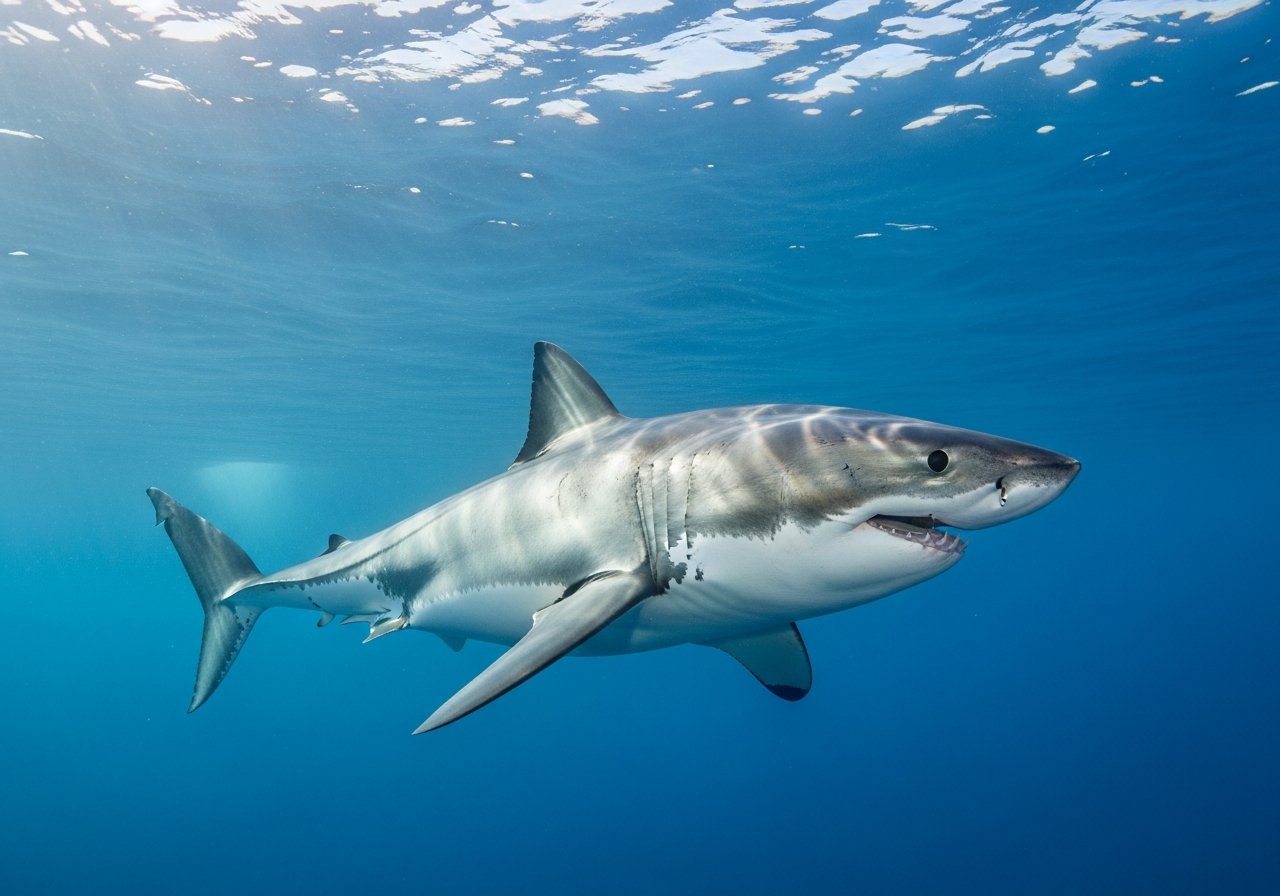
Sharks, rays, skates, and chimaeras build their skeletons from cartilage stiffened with mineral, not true bone. Cartilage is lighter and more flexible than bone, but they lack the gas-filled swim bladder that bony fish use to hover, which forces a different solution: an enormous oil-rich liver that provides static lift, plus pectoral fins that generate dynamic lift like aircraft wings. That is why many sharks must keep moving, and why a great white shark sinks if it stops.
Their skin is covered in dermal denticles — tooth-like scales with the same enamel-and-dentine structure as their teeth, arranged to reduce drag and turbulence. Their teeth sit in a conveyor belt of replacements rather than sockets, so a lost tooth is replaced within days. Reproduction is strikingly varied for a single group: some lay egg cases, many give live birth, and the sand tiger shark practises intrauterine cannibalism, the strongest embryo eating its siblings before birth. Rays like the manta ray took the same chassis and flattened it, swapping tail-driven swimming for winged flight through open water.
Bony fish: the group that won
Ray-finned fish account for the overwhelming majority of fish species and nearly every fish most people ever see, from the goldfish to the bluefin tuna. Their key innovation was the swim bladder, a gas-filled sac whose volume they adjust to achieve neutral buoyancy at a given depth. Hovering suddenly costs nothing, which frees the fins from lift duty and lets them specialise for precise, low-speed manoeuvring — the reason a reef fish can hold station in a current and reverse on the spot while a shark cannot.
That freedom explains the group’s absurd morphological range. The seahorse swims upright with a fluttering dorsal fin and grips weed with a prehensile tail. The anglerfish converted a dorsal fin spine into an illuminated lure. The electric eel turned muscle tissue into stacked biological batteries. The ocean sunfish abandoned a tail fin altogether. Lobe-finned fish — the coelacanth and lungfishes — are the sparse survivors of the branch that produced everything with legs.
Gills, and the exceptions that breathe air
Gills work by countercurrent exchange: water flows across the gill filaments in the opposite direction to the blood inside them, so blood always meets water slightly richer in oxygen than itself. The gradient never reverses along the whole length of contact, which is why fish extract a far higher share of available oxygen than lungs manage from air. It has to be efficient, because water holds a small fraction of the oxygen air does and is far heavier to move.
Where that is not enough, fish cheat. Lungfish breathe air and can survive drought sealed in mud cocoons for months. The catfish family includes species that absorb oxygen through the gut. Fast open-ocean swimmers like tuna gave up the ability to pump water and simply hold their mouths open, letting forward motion ventilate the gills — ram ventilation, efficient at speed and fatal at a standstill.
Cold-blooded, mostly
Nearly all fish are ectotherms whose body temperature tracks the water around them, which is thermally very stable but caps the power output of muscle in cold seas. A handful of predators broke that rule with countercurrent heat exchangers — dense networks of arteries and veins that trap metabolic heat before it reaches the gills and is lost to the water.
The shortfin mako, the great white, and bluefin tuna all keep their swimming muscle, eyes, or brain well above ambient temperature. Warm muscle contracts faster, so these species hunt effectively in cold water that leaves their prey sluggish. The cost is a much higher food requirement — regional endothermy only pays for animals that hunt actively enough to fund it.
Related reading
Sources
Frequently asked questions
Are sharks fish?
Yes — cartilaginous fish (class Chondrichthyes).
Are whales fish?
No — whales are mammals that returned to the sea.
How many fish species are there?
Over 30,000 described species — more than all other vertebrates combined.
Do all fish lay eggs?
No — many sharks and some bony fish give live birth.