Vertebrates Explained: Animals With Backbones
Vertebrates are animals with a backbone — fish, amphibians, reptiles, birds, and mammals. Definition, characteristics, classification, and how they differ from invertebrates.
Global Animal Guide · July 10, 2026
Quick answer
Vertebrates are animals with a vertebral column (backbone) made of bone or cartilage. They include fish, amphibians, reptiles, birds, and mammals — fewer than 5% of animal species, but most of the large animals people recognise. All vertebrates are chordates with a dorsal nerve cord; most have a closed circulatory system, paired sense organs, and organ-level body organisation.
Last updated: July 2026 — figures reflect widely cited zoological estimates.
What is a vertebrate?
The word comes from Latin vertebratus — “joint of the spine.” A vertebrate belongs to the subphylum Vertebrata (within phylum Chordata). Defining features include:
- A vertebral column (or, in a few lineages, a persistent notochord) protecting a hollow dorsal nerve cord
- A cranium (skull) housing a brain in most groups
- Organ-system body organisation
- Usually a closed circulatory system with a heart
Embryos of chordates share a notochord, pharyngeal slits, and a post-anal tail — vertebrates elaborate that plan into backboned animals.
The backbone itself is easy to misunderstand. It is not one bone but a chain of separate vertebrae, and that segmentation is the whole point: a rigid rod would stop an animal bending, while a chain of linked units gives stiffness against compression and flexibility in bending. It is the reason a cheetah can flex its spine like a spring at full sprint and a snapping turtle can fuse the same structure into an immovable shell. The column runs down the animal’s back, encasing the nerve cord in a bony tunnel — armour for the most fragile and least replaceable tissue in the body.
Skulls, jaws, and why vertebrates got big
Two innovations did most of the work in vertebrate history. The first was the cranium, a braincase that let sense organs concentrate at the front end. Paired eyes, ears, and nostrils clustered around a large brain turned a filter-feeding worm-shape into an animal that could hunt.
The second was the jaw, and it arrived later. The earliest vertebrates were jawless, sucking and rasping rather than biting; today only lampreys and hagfish survive from that grade. Jaws evolved from the front pair of gill-supporting arches, which is why jaw and gill structures share the same embryonic origins. Once vertebrates could seize and process prey larger than their own mouths, the ceiling on body size lifted — a lineage of predators rather than sievers. Everything from the bite of a great white shark to the crushing molars of a hippopotamus is a variation on that one anatomical borrowing.
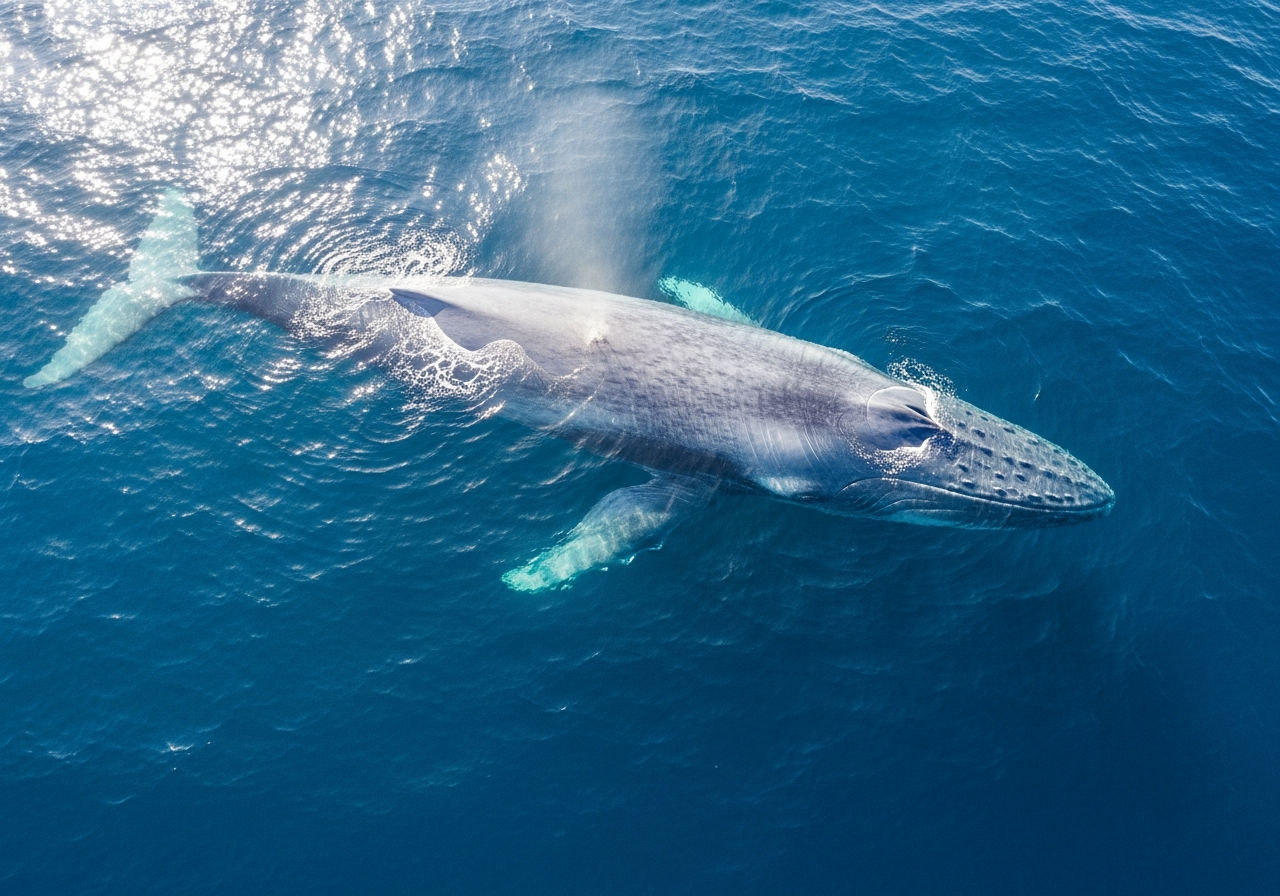
Size follows from the skeleton too. An internal skeleton grows with the animal, adding material to bones that stay in place. An external skeleton must be shed and regrown at every size increase, a dangerous, energetically brutal process that gets worse the bigger you are. That asymmetry is a large part of why the biggest animals on land and in the sea — the blue whale, the African elephant, the ostrich — are all vertebrates, while the largest invertebrates are aquatic, where water carries the weight.
The five living vertebrate groups
| Group | Skeleton / covering | Breathing | Examples |
|---|---|---|---|
| Fish | Bone or cartilage; scales common | Gills (most) | Shark, tuna, seahorse |
| Amphibians | Bone; moist skin | Lungs + skin | Frog, salamander, caecilian |
| Reptiles | Bone; scales / scutes | Lungs | Snake, crocodile, turtle |
| Birds | Bone; feathers | Lungs + air sacs | Eagle, penguin, hummingbird |
| Mammals | Bone; hair / fur | Lungs | Lion, whale, human, bat |
Birds evolved from theropod dinosaurs and are nested within reptiles in modern phylogeny — school textbooks still list them separately for clarity.
Where the tidy five-group scheme breaks
The table above is a teaching convenience, and it leaks in several places worth knowing about.
“Fish” is not a single group. It is a grade — everything aquatic that isn’t a tetrapod. A coelacanth or an Australian lungfish is more closely related to you than to a goldfish, because lobe-finned fish are the lineage that crawled onto land. Any group that contains all fish must also contain amphibians, reptiles, birds, and mammals.
Not all vertebrates have bones. Sharks, rays, and chimaeras build their skeletons from cartilage — lighter than bone and, in a whale shark or a manta ray, a genuine advantage for staying afloat without a swim bladder. Cartilage is the ancestral condition, not a simplification; these fish did not lose bone so much as never fully adopt it. Hagfish go further still, retaining a notochord and only rudimentary vertebral elements as adults, which is why their membership of Vertebrata is debated at all.
Reptiles, as usually taught, are not a real group either. Crocodiles are closer kin to birds than to lizards. Modern phylogeny resolves this by placing birds inside the reptiles — so a saltwater crocodile, a peregrine falcon, and a green iguana all belong to one branch, while feathers and scales turn out to be the same tissue type expressed differently.
Vertebrates vs invertebrates
| Trait | Vertebrates | Invertebrates |
|---|---|---|
| Backbone | Present | Absent |
| Share of species | ~3–5% | ~95–97% |
| Circulatory system | Closed | Often open |
| Nervous system | Centralised brain + spinal cord | Variable (nets to ganglia) |
| Size extremes | Blue whale to tiny frogs | Giant squid to microscopic animals |
See our full guide: invertebrates explained.
The species-count line in that table is the one people find hardest to believe. Vertebrates are a rounding error in the animal kingdom — beetles alone outnumber every backboned species several times over. What vertebrates have is not diversity but size, visibility, and individual complexity. They are the animals large enough to notice, long-lived enough to name, and behaviourally rich enough to hold our attention, which is why they dominate zoos, documentaries, and conservation budgets far out of proportion to their share of life.
One body plan, endlessly re-tooled
The most striking thing about vertebrates is how little the underlying blueprint changes. The same bones appear again and again, stretched or shrunk for entirely different jobs. The bones in a bat’s wing, an orca’s flipper, a horse’s leg, and your own hand correspond one to one — same elements, same arrangement, radically different function. This is homology, and it is among the clearest fossil-free evidence of common ancestry available.
Vertebrate evolution reworks existing parts rather than inventing new ones, because natural selection can only modify what a developing embryo already builds. The giraffe’s neck contains seven vertebrae, exactly as many as a mouse or a mole — each one merely enormous. Bones that supported gills became jaws; bones from the back of the reptilian jaw migrated into the mammalian middle ear and now transmit sound. Nothing here was designed from scratch; everything was repurposed.
Why vertebrates matter
Vertebrates dominate many food webs as apex predators, large herbivores, and pollinators (bats, some birds). They are also the focus of most conservation campaigns — partly because people relate to them, and partly because many are threatened by habitat loss, overfishing, and climate change.
Their ecological weight exceeds their numbers because body size determines influence. Large vertebrates move nutrients across landscapes, engineer habitats, and hold herbivore populations in check. Remove the gray wolf from a system and browsing pressure reshapes the vegetation; remove the sea otter and urchins strip the kelp. Few invertebrates exert that kind of top-down leverage as individuals, though collectively — as pollinators and decomposers — they matter more than any vertebrate.
Size cuts the other way for survival. Large, slow-breeding, wide-ranging animals recover badly from population crashes, which is why vertebrates are so heavily represented among threatened species. A vaquita or a javan rhino cannot outbreed a threat the way an insect can.
Understanding vertebrate biology helps answer everyday questions: why sharks need to keep swimming, how frogs breathe through skin, why birds migrate, and how mammals regulate body heat.
Related reading
- Invertebrates explained
- Arthropods explained
- Warm-blooded vs cold-blooded
- What is a mammal?
- Blue whale profile
Sources
Frequently asked questions
What are vertebrates?
Vertebrates are animals with a backbone (vertebral column). Living groups are fish, amphibians, reptiles, birds, and mammals.
How many vertebrate species are there?
Roughly 70,000 described vertebrate species — a small fraction of all animals, most of which are invertebrates.
Are humans vertebrates?
Yes. Humans are mammals, and all mammals are vertebrates.
What is the largest vertebrate?
The blue whale — up to about 30 m (100 ft) long and over 150 tonnes.
Do all vertebrates have bones?
No. Sharks and rays have cartilaginous skeletons; hagfish retain a notochord without true vertebrae as adults.