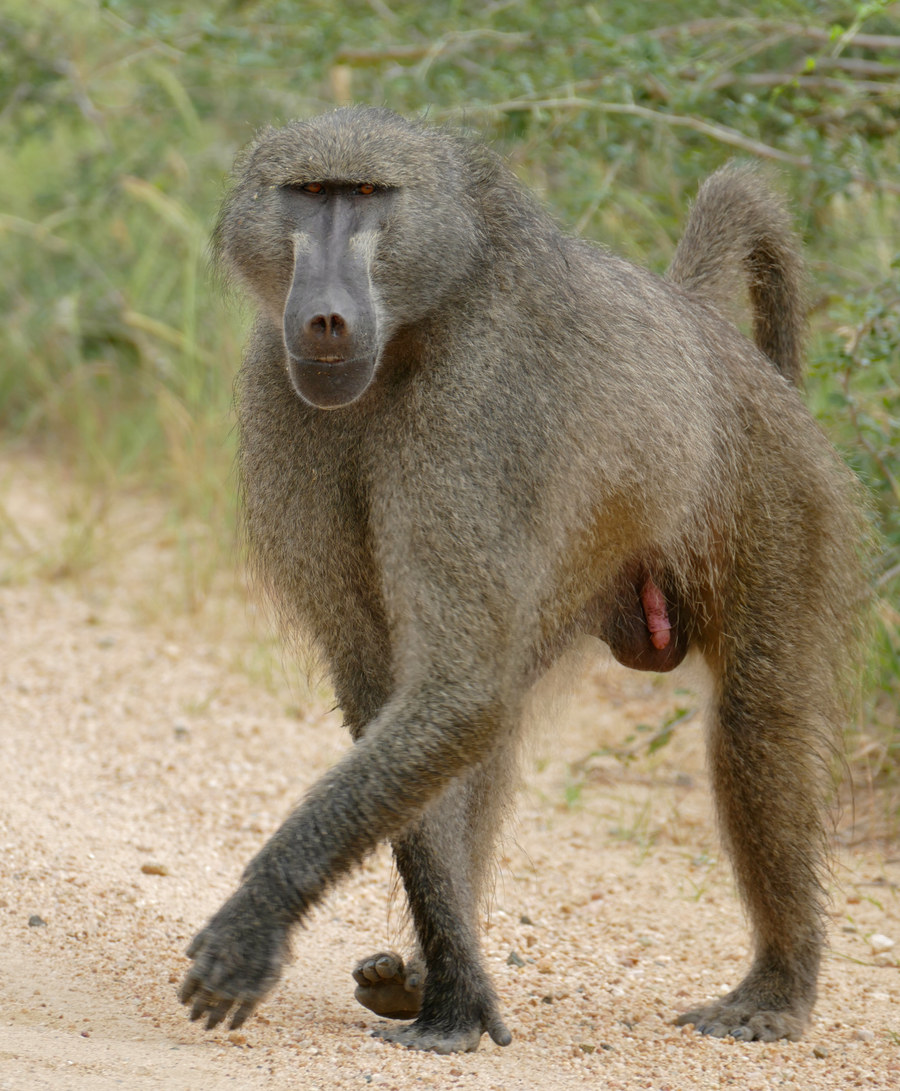
The olive baboon (Papio anubis) is a mammal of the family Cercopithecidae, in the order Primates.
Quick answer
The olive baboon is a large, ground-dwelling monkey found across the savannas, woodlands, and rocky hills of equatorial Africa. Highly intelligent and adaptable, it lives in big social troops, eats almost anything, and can run at up to 45 km/h (28 mph). Males can weigh around 30 kg, roughly twice the size of females. Olive baboons live 25 to 30 years in the wild and are listed as Least Concern.
Top questions about the Olive Baboon
Also available in Español (Babuino oliva)
Olive Baboon facts at a glance
- Weight 30 kg
- Length 1.1 m
- Top speed 45 km/h
- Lifespan 30 years
| Scientific name | Papio anubis |
|---|---|
| Diet | Omnivore — grasses, seeds, insects, small mammals, and crops |
| Habitat | Savannas, woodlands, and rocky hills of equatorial Africa |
| Lifespan | 25–30 years in the wild (longer in captivity) |
| Weight | 15–30 kg (33–66 lb); males twice female size |
| Top speed | Up to 45 km/h (28 mph) |
| Conservation status | Least Concern (IUCN) |
| Kingdom | Animalia |
|---|---|
| Phylum | Chordata |
| Class | Mammalia |
| Order | Primates |
| Family | Cercopithecidae |
| Genus | Papio |
Where it lives
The olive baboon (Papio anubis) is native to Olive baboon across equatorial Africa from Mali and Ethiopia to Tanzania and northern South Africa in savanna and woodland. — recorded across Africa in this guide’s range summary.
For occurrence records, see GBIF species search and sources below.
How big is a olive baboon?
An adult olive baboon measures 1.1 m long — about 64% of the height of an average adult person (1.73 m) — and weighs around 30 kg, about 43% of an average adult’s body weight (70 kg).
Length vs an average adult’s height (to scale)
What is a group of olive baboons called?
Group name (collective noun)
A group of Olive Baboons is called a troop.
Baby name
A baby Olive Baboon is called an infant.
Explore more animal collective nouns and baby animal names .
Diet and foraging
Baboons are opportunistic omnivores that eat grasses, seeds, fruit, roots, insects, and small mammals, and they will readily raid crops and rubbish where people live nearby. Their varied appetite and clever foraging are a big part of why they thrive in so many habitats. They use their hands with great dexterity to dig up roots, strip seeds, and turn over stones for insects. Cheek pouches let them stuff food away quickly and chew it later in a safer spot.
Intelligence and communication
Olive baboons are among the more intelligent monkeys, capable of learning, planning, and forming intricate social strategies. They communicate through a rich repertoire of grunts, screams, and barks, along with facial expressions and postures that signal threat, submission, or reassurance. A yawning male flashing his long canine teeth is issuing a clear warning to rivals. Their sharp memories help them track the shifting alliances and rivalries that run through troop life.
Appearance and build
The olive baboon takes its name from the greenish-grey sheen of its coat, and it has a dog-like muzzle, powerful jaws, and a sloping body around 1.1 metres long. Males are far larger than females, weighing up to about 30 kg, roughly twice a female's size, and carry a mane of longer hair over the shoulders. Both sexes have formidable canine teeth that can rival a leopard's in length. Their strong limbs and calloused sitting pads suit a life spent largely on the ground.
Habitat and adaptability
Olive baboons range widely across equatorial Africa, occupying savannas, open woodlands, and rocky hills from Mali to Ethiopia and south into Tanzania. They are one of the most adaptable primates, thriving everywhere from semi-desert to moist forest edges and increasingly around farms and towns. Access to water and to safe sleeping sites, usually tall trees or cliffs, shapes where a troop can settle. This flexibility is a key reason the species remains so widespread and numerous.
Breeding and young
Female baboons signal their fertility with conspicuous swellings, and dominant males compete for the chance to mate, though females also form lasting "friendships" with particular males. A single infant is born after a gestation of about six months and clings to its mother's belly before later riding jockey-style on her back. Youngsters learn the troop's social rules through play and close observation over several years. In the wild olive baboons can live 25 to 30 years, and longer in captivity.
Dig deeper into the Olive Baboon
- Olive Baboon: Key Facts
The olive baboon is a large African monkey living in troops of up to 150 across savannas and increasingly at human edges.
- How Fast Is An Olive Baboon?
Olive Baboon top speed is up to about 45 km/h (28 mph). Sprint vs endurance and what limits pace.
- How Long Do Olive Baboons Live?
Olive Baboon lifespan is typically 25–30 years in the wild (longer in captivity). What shortens or extends life, life stages, and status (Least Concern).
- What Do Olive Baboons Eat?
What olive baboons eat: Omnivore — grasses, seeds, insects, small mammals, and crops, foraging style, and seasonal shifts in Savannas, woodlands, and rocky hills of equatorial Africa.
- Where Do Olive Baboons Live?
Where olive baboons live: Savannas, woodlands, and rocky hills of equatorial Africa, native range cues, and human overlap. Status Least Concern.
Explore the Olive Baboon
Close relatives
- Japanese Macaque Same family
- Mandrill Same family
- Proboscis Monkey Same family
- Guereza Colobus Same family
Range & geography
Did you know? Olive Baboon facts
- Olive baboons live in large troops across African savannas and increasingly in urban edges.
- They can bite if cornered or habituated to food — never feed wild baboons.
- They use tools opportunistically and navigate complex social rules.
- Conservation: Least Concern.
Diet & feeding
Olive Baboon feeds primarily as a omnivore — plants, insects, small animals.
Adaptations
- Dominance rank affects mating access and grooming alliances.
- Crop raiding near farms leads to retaliation and culling.
Behaviour & ecology
- Dominance rank affects mating access and grooming alliances.
- Crop raiding near farms leads to retaliation and culling.
Communication
- Olive Baboon uses scent, posture, and vocal signals to mark territory and coordinate social behaviour.
- Communication intensity often peaks during breeding seasons and territorial disputes.
Habitat & range
African savannas and woodlands
Ecological role
Olive Baboon plays a recognised ecological role in african savannas and woodlands.
Conservation status of the Olive Baboon
The olive baboon (Papio anubis) is listed as Least Concern on the IUCN Red List. Least Concern (LC) is the IUCN's lowest-risk category, assigned to widespread, abundant species that have been evaluated and found not to be threatened. It does not mean a species faces no pressures — only that it is not currently at risk of extinction.
The olive baboon (Papio anubis) is assessed on the IUCN Red List. Look up on the IUCN Red List .
Frequently asked questions about the Olive Baboon
What do olive baboons eat?
Olive baboons are omnivores that eat grasses, seeds, fruit, roots, insects, and small mammals. They are highly opportunistic and will also raid crops and rubbish near human settlements, which is a major part of their success as a species.
How big do olive baboons get?
Males can weigh up to about 30 kg (66 lb) and measure around 1.1 metres in body length, while females are roughly half that size. This strong size difference between the sexes is typical of baboons.
Are baboons dangerous?
Baboons are powerful animals with long canine teeth and can be aggressive, especially males defending a troop or habituated animals raiding for food. Serious attacks on people are uncommon, but baboons should be treated with respect and never fed, as this encourages bold and risky behaviour.
How long do baboons live?
Olive baboons typically live 25 to 30 years in the wild, and can live longer in captivity. Their long lifespan allows the complex social relationships and hierarchies of the troop to develop over many years.
How fast can a baboon run?
Olive baboons can run at up to 45 km/h (28 mph) on all fours. This speed, combined with their agility and ability to climb, helps them escape predators such as leopards and lions.
Do baboons live in groups?
Yes. Olive baboons live in large troops that can range from a dozen to more than a hundred members, organised around related females and a hierarchy of males. Troop life provides safety in numbers and a web of grooming-based social bonds.
What is a group of olive baboons called?
A group of Olive Baboons is called a troop.
What is a baby olive baboon called?
A baby Olive Baboon is called an infant.
Sources & references
This guide is compiled and reviewed against established zoological and conservation references. Key sources for the Olive Baboon:
-
IUCN Red List of Threatened Species
Conservation status (Least Concern) reflects the IUCN Red List category for Papio anubis.
-
iNaturalist — observations & photos
Search citizen-science observations and community IDs for Papio anubis. Useful for range checks and recent sightings — not a substitute for formal Red List status.
-
GBIF — occurrence data
Global Biodiversity Information Facility species search for Papio anubis. Explore published occurrence records used in range research.
- IUCN Red List — Papio anubis.
Conservation status (Least Concern) and population trends.
- Animal Diversity Web — Papio anubis. University of Michigan Museum of Zoology.
Life history, morphology, and range.
-
Global Animal Guide editorial standards
How we research, source, review, and update every guide for accuracy.