Image sourcing: see credits & licences
The mandrill (Mandrillus sphinx) is a mammal of the family Cercopithecidae, in the order Primates.
Quick answer
The mandrill is the world's most colourful primate, a large forest-floor monkey native to the rainforests of central Africa. Dominant males are unmistakable, with a scarlet-and-blue face and rump, and can weigh up to about 35 kg, far more than the smaller females. Mandrills are omnivores that live in some of the largest groups of any primate, reach 20 to 25 years in the wild, and are listed as Vulnerable.
Top questions about the Mandrill
Also available in Español (Mandril)
Mandrill facts at a glance
- Weight 35 kg
- Length 1 m
- Top speed 40 km/h
- Lifespan 25 years
| Scientific name | Mandrillus sphinx |
|---|---|
| Diet | Omnivore — fruit, seeds, leaves, insects, and small animals |
| Habitat | Rainforests and gallery forest of central Africa |
| Lifespan | 20–25 years in the wild |
| Weight | 19–35 kg (42–77 lb); males much larger than females |
| Top speed | Up to 40 km/h (25 mph) in forest sprints |
| Conservation status | Vulnerable (IUCN) |
| Kingdom | Animalia |
|---|---|
| Phylum | Chordata |
| Class | Mammalia |
| Order | Primates |
| Family | Cercopithecidae |
| Genus | Mandrillus |
Where it lives
The mandrill (Mandrillus sphinx) is native to Rainforests of Gabon, Cameroon, Congo, Equatorial Guinea, and southwestern Central African Republic. — recorded across Africa in this guide’s range summary.
For occurrence records, see GBIF species search and sources below.
How big is a mandrill?
An adult mandrill measures 1 m long — about 58% of the height of an average adult person (1.73 m) — and weighs around 35 kg, about 50% of an average adult’s body weight (70 kg).
Length vs an average adult’s height (to scale)
What is a group of mandrills called?
Group name (collective noun)
A group of Mandrills is called a troop.
Baby name
A baby Mandrill is called an infant.
Explore more animal collective nouns and baby animal names .
The most colourful primate
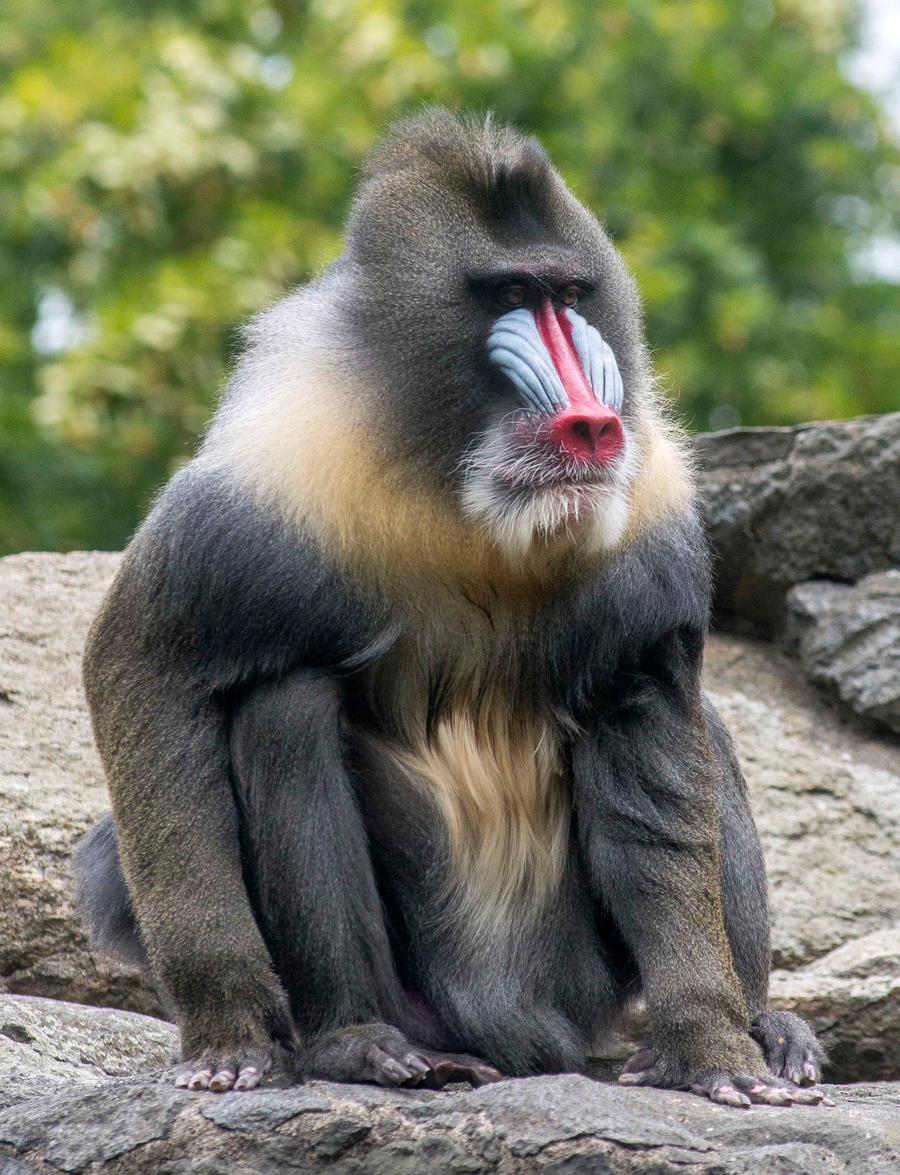
The mandrill is the most vividly coloured of all mammals, and the colour is strongest in dominant adult males. Their faces carry a bright red central stripe flanked by ridged blue cheeks, and the same scarlet and blue appear on the rump. These signals grow more intense with rank and testosterone, advertising a male's status to rivals and females across the dim forest floor.
Size and striking sexual dimorphism
Mandrills show some of the most extreme size differences between the sexes of any primate. Large males can weigh up to about 35 kg (77 lb) and are roughly three times the weight of females, which are typically around 12 to 15 kg. Males also carry long canine teeth, sometimes several centimetres long, which they bare in a wide "yawn" to intimidate rivals.
Diet and foraging
Mandrills are omnivores that forage mainly on the forest floor, using their strong hands and cheek pouches to gather food as they travel. Their diet is dominated by fruit and seeds, supplemented with leaves, roots, fungi, insects, and small animals such as frogs and lizards. They will dig through leaf litter and turn over stones to reach hidden invertebrates.
Life in huge groups
Mandrills form some of the largest stable groups of any primate, and central troops known as hordes can number in the hundreds. These groups are built around related females and their young, with males often living more peripherally and joining fully in the breeding season. In forest sprints a mandrill can move at up to 40 km/h (25 mph) when escaping danger or covering ground between feeding sites.
Habitat and range
The mandrill lives in the tropical rainforests and gallery forests of west-central Africa, chiefly in Cameroon, Gabon, Equatorial Guinea, and the Republic of the Congo. It is largely terrestrial, foraging by day across the forest floor, but climbs trees to sleep safely at night. Its range is bounded by major rivers that separate it from its close relative, the drill.
Conservation and threats
The mandrill is listed as Vulnerable by the IUCN, and its numbers are falling. The two biggest threats are hunting for bushmeat, made easier by their large, noisy groups, and the loss and fragmentation of rainforest to logging and agriculture. Because mandrills breed slowly and depend on large tracts of intact forest, protected reserves are important to their future.
Dig deeper into the Mandrill
- Are Mandrills Endangered?
Are mandrills endangered? Status Vulnerable, main threats, and what protection means.
- How Long Do Mandrills Live?
Mandrill lifespan is typically 20–25 years in the wild. What shortens or extends life, life stages, and status (Vulnerable).
- Mandrill: Key Facts
The mandrill is the largest monkey species, with males displaying vivid blue and red facial ridges and rumps.
- What Do Mandrills Eat?
What mandrills eat: Omnivore — fruit, seeds, leaves, insects, and small animals, foraging style, and seasonal shifts in Rainforests and gallery forest of central Africa.
- Where Do Mandrills Live?
Where mandrills live: Rainforests and gallery forest of central Africa, native range cues, and human overlap. Status Vulnerable.
Explore the Mandrill
Compare
Close relatives
- Japanese Macaque Same family
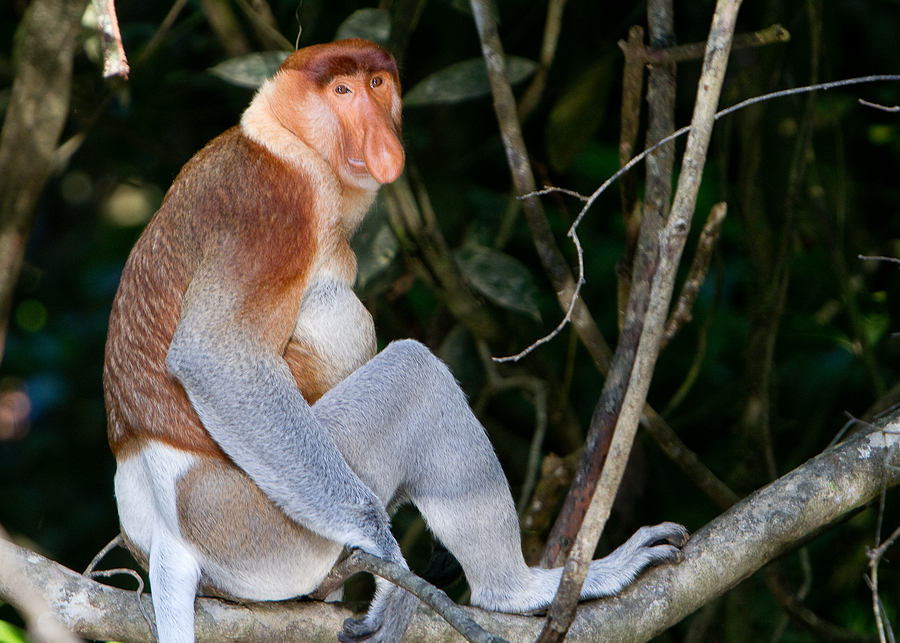
- Proboscis Monkey Same family
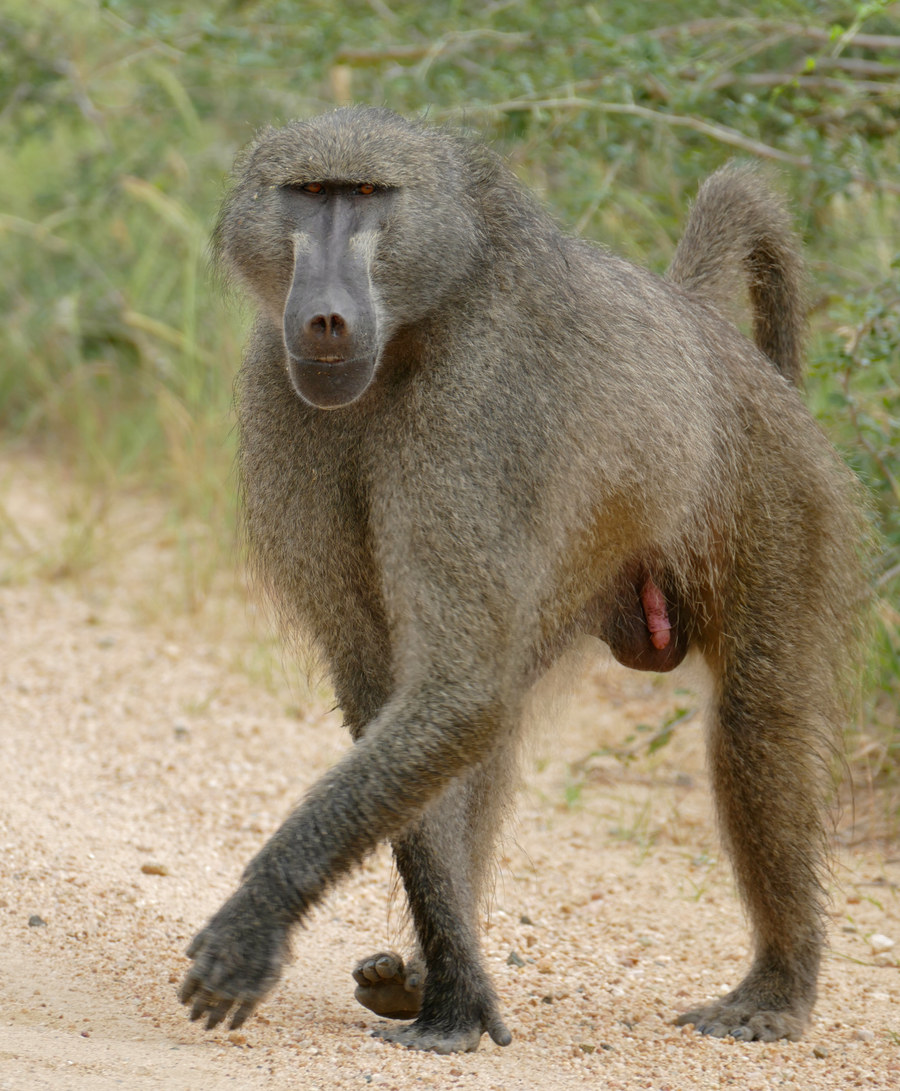
- Olive Baboon Same family
- Guereza Colobus Same family
Collections
Range & geography
Did you know? Mandrill facts
- Mandrills are large forest baboons with vivid blue and red facial ridges.
- Mandrills are more colourful forest specialists; olive baboons range more openly.
- Mandrills are among the largest — males can exceed 30 kg.
- Conservation: Vulnerable.
Diet & feeding
Mandrill feeds primarily as a fruit, seeds, insects, small animals. Bushmeat hunting and deforestation threaten remaining populations.
Adaptations
- Facial colour intensity signals dominance and health to rivals and females.
- Bushmeat hunting and deforestation threaten remaining populations.
Behaviour & ecology
- Facial colour intensity signals dominance and health to rivals and females.
- Bushmeat hunting and deforestation threaten remaining populations.
Communication
- Mandrill uses scent, posture, and vocal signals to mark territory and coordinate social behaviour.
- Communication intensity often peaks during breeding seasons and territorial disputes.
Habitat & range
Rainforests of central Africa
Ecological role
Mandrill plays a recognised ecological role in rainforests of central africa.
Conservation status of the Mandrill
The mandrill (Mandrillus sphinx) is listed as Vulnerable on the IUCN Red List. Vulnerable (VU) means a species faces a high risk of extinction in the medium-term future. It is the lowest-risk of the three 'threatened' IUCN categories — one step below Endangered, which is itself below Critically Endangered — and is often an early warning that a population is in trouble.
Main threats to the mandrill
- Bushmeat hunting
- Habitat loss from logging and agriculture
- Forest fragmentation
- Live capture for the pet trade
Mandrill (Mandrillus sphinx) was most recently assessed for the IUCN Red List in 2019. View the full IUCN assessment .
Frequently asked questions about the Mandrill
Why are mandrills so colourful?
Mandrills use their bright red and blue faces and rumps to signal status and health. The colours are most intense in dominant males, driven by testosterone, and help advertise rank to rivals and females on the shadowy forest floor.
How big do mandrills get?
Male mandrills can weigh up to about 35 kg (77 lb), while females are much smaller at roughly 12 to 15 kg. This makes the mandrill one of the largest and most sexually dimorphic of all monkeys.
What do mandrills eat?
Mandrills are omnivores whose diet is dominated by fruit and seeds. They also eat leaves, roots, fungi, insects, and small animals such as frogs and lizards, foraging mostly on the forest floor.
Are mandrills the same as baboons?
No, though they are closely related and were once grouped with baboons. Mandrills belong to their own genus, Mandrillus, and are distinguished by their vivid colouring and their rainforest, forest-floor lifestyle.
How large are mandrill groups?
Mandrills form some of the largest groups of any primate. Central troops, known as hordes, can contain several hundred individuals, built mainly around related females and their young.
Are mandrills endangered?
Mandrills are listed as Vulnerable by the IUCN, and their numbers are declining. The main threats are hunting for bushmeat and the loss of rainforest habitat to logging and farming.
What is a group of mandrills called?
A group of Mandrills is called a troop.
What is a baby mandrill called?
A baby Mandrill is called an infant.
Sources & references
This guide is compiled and reviewed against established zoological and conservation references. Key sources for the Mandrill:
-
IUCN Red List of Threatened Species
Conservation status (Vulnerable) reflects the IUCN Red List category for Mandrillus sphinx, most recently assessed in 2019.
-
iNaturalist — observations & photos
Search citizen-science observations and community IDs for Mandrillus sphinx. Useful for range checks and recent sightings — not a substitute for formal Red List status.
-
GBIF — occurrence data
Global Biodiversity Information Facility species search for Mandrillus sphinx. Explore published occurrence records used in range research.
- IUCN Red List — Mandrillus sphinx.
Conservation status (Vulnerable) and population trends.
- Animal Diversity Web — Mandrillus sphinx. University of Michigan Museum of Zoology.
Life history, morphology, and range.
-
Global Animal Guide editorial standards
How we research, source, review, and update every guide for accuracy.