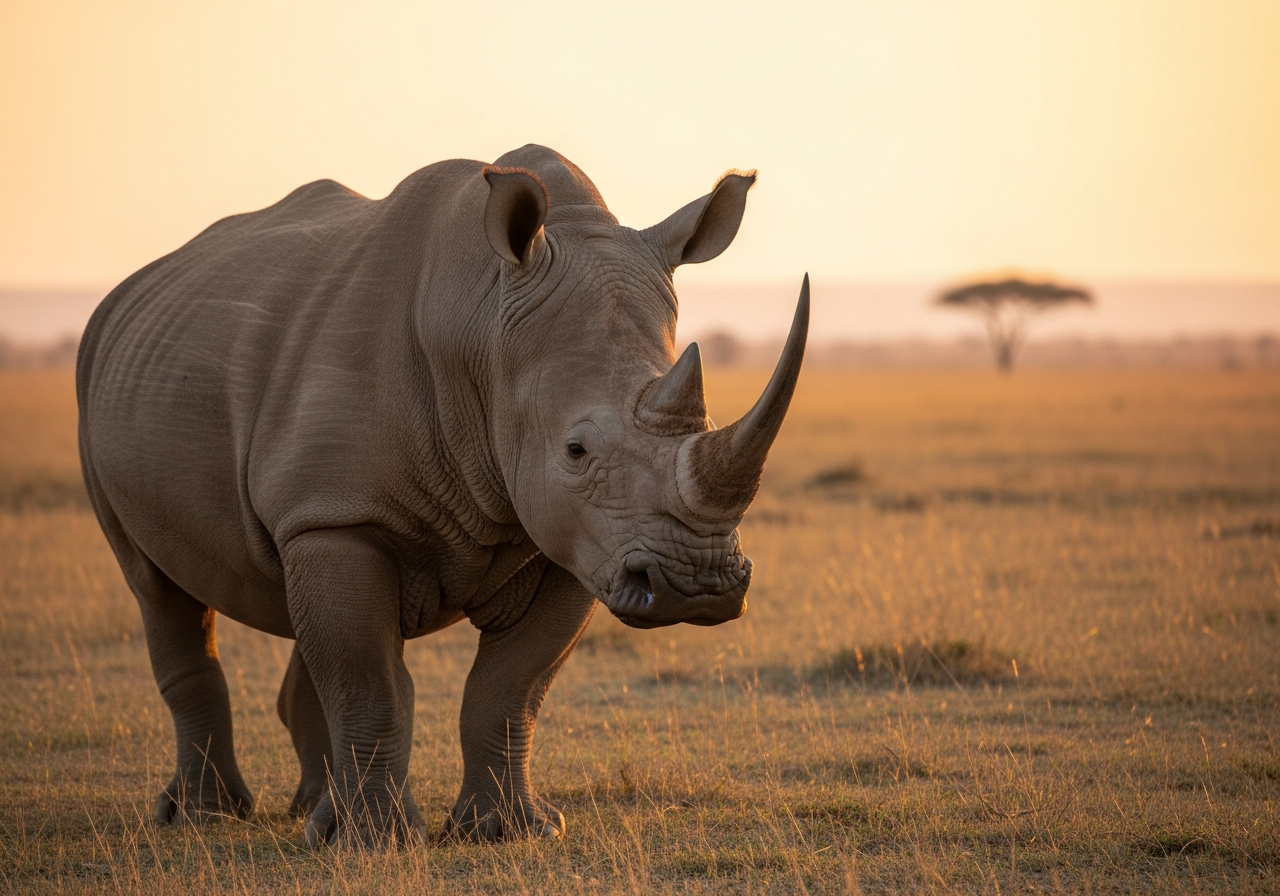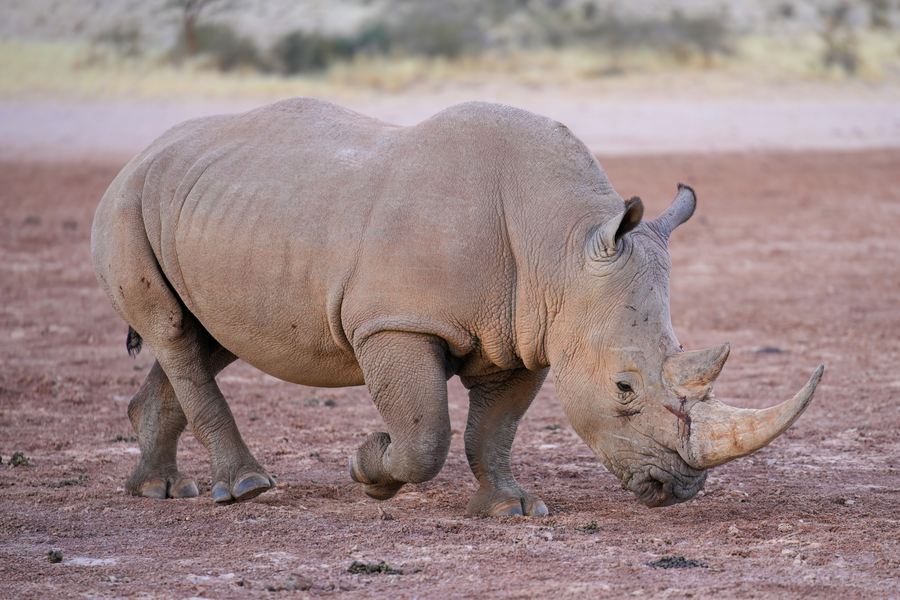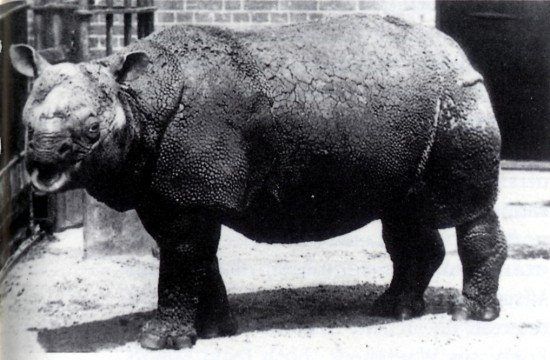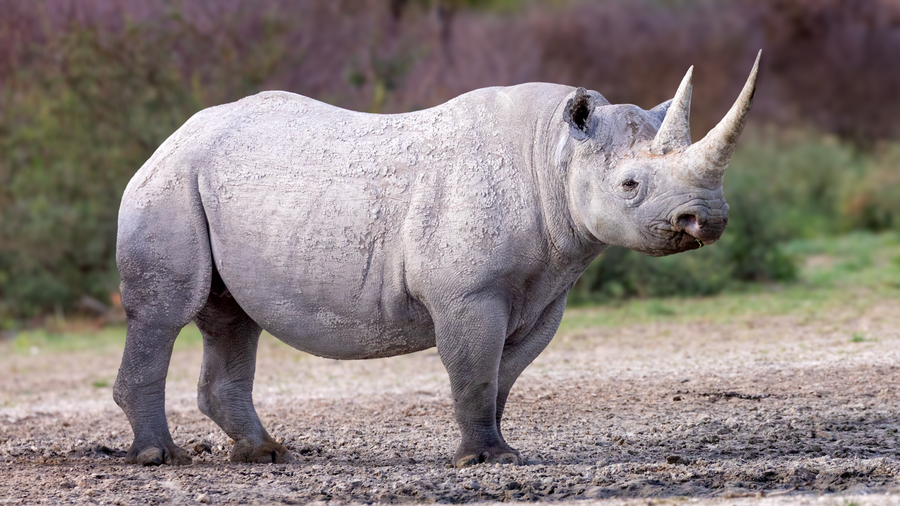
The black rhinoceros (Diceros bicornis) is a mammal of the rhinoceros family, Rhinocerotidae, in the order Perissodactyla.
Quick answer
The black rhinoceros is a large African rhino with a hooked upper lip for browsing shrubs, weighing 800–1,400 kg (1,750–3,100 lb) despite its name referring to soil colour, not hide. Critically endangered from poaching for horn, fewer than 6,500 remain across scattered eastern and southern African reserves.
Top questions about the Black Rhinoceros
Also available in Español (Rinoceronte negro)
Black Rhinoceros facts at a glance
- Weight 1100 kg
- Length 3.5 m
- Top speed 55 km/h
- Lifespan 45 years
| Scientific name | Diceros bicornis |
|---|---|
| Diet | Herbivore — leaves, branches, and woody browse |
| Habitat | Savannas, scrub, and dry woodland of eastern and southern Africa |
| Lifespan | 35–50 years in the wild |
| Weight | 800–1,400 kg (1,750–3,100 lb) |
| Top speed | Up to 55 km/h (34 mph) in charge |
| Conservation status | Critically Endangered (IUCN) |
| Kingdom | Animalia |
|---|---|
| Phylum | Chordata |
| Class | Mammalia |
| Order | Perissodactyla |
| Family | Rhinocerotidae |
| Genus | Diceros |
Where it lives
The black rhinoceros (Diceros bicornis) is native to Scattered protected populations in Kenya, Tanzania, Namibia, South Africa, Zimbabwe, and Zambia — absent from most of their historic range. — recorded across Africa in this guide’s range summary.
For occurrence records, see GBIF species search and sources below.
How big is a black rhinoceros?
An adult black rhinoceros measures 3.5 m long — about 2.0× the height of an average adult person (1.73 m) — and weighs around 1100 kg, about 16× an average adult’s body weight (70 kg).
Length vs an average adult’s height (to scale)
What is a group of black rhinoceroses called?
Group name (collective noun)
A group of Black Rhinoceroses is called a crash.
Baby name
A baby Black Rhinoceros is called a calf.
Explore more animal collective nouns and baby animal names .
Hooked lip browser
The prehensile pointed upper lip lets black rhinos strip leaves from thorny acacia and succulents that grass-eating white rhinos cannot exploit. They have poor eyesight but acute hearing and smell, charging threats they detect downwind.
Solitary temperament
Black rhinos are more solitary and aggressive than white rhinos, with bulls maintaining territories and cows accompanying calves. Mothers are fiercely protective — most human injuries involve surprised animals on foot.
Poaching catastrophe
Rhino horn — made of keratin like fingernails — is illegally traded for traditional medicine and status symbols, driving poaching despite international bans. Black rhino numbers crashed 96% between 1970 and 1990; recovery is slow but ongoing in well-guarded reserves.
Recovery efforts
Intensive anti-poaching, dehorning programmes, and translocations support populations in Namibia, Kenya, South Africa, and Tanzania. Critically Endangered globally, the species illustrates both the devastation of illegal wildlife trade and the impact of committed conservation funding.
Dig deeper into the Black Rhinoceros
- Are Black Rhinoceroses Endangered?
Black rhinos are Critically Endangered. Africa held 6,788 at end-2024 after a 96% crash in the late 20th century. Recovery is slow and conservation-dependent.
- Black Rhinoceros: Key Facts
The black rhinoceros is a large African rhino with a hooked upper lip for browsing shrubs, weighing 800–1,400 kg (1,750–3,100 lb) despite its name…
- How Long Do Black Rhinoceroses Live?
Wild black rhinos often live about 35–50 years; poaching truncates the average. Critically Endangered; IUCN 2020 increasing, still CR.
- What Do Black Rhinoceroses Eat?
Black rhinos are hooked-lip browsers of woody shrubs — not white-rhino grazers. Diceros bicornis, Critically Endangered. Never feed them.
- Where Do Black Rhinoceroses Live?
Black rhinos live in eastern and southern African savanna and scrub. Critically Endangered; 6,788 in Africa at end-2024. Not white rhinos.
Explore the Black Rhinoceros
Compare
Close relatives
- Indian Rhinoceros Same family
- Rhinoceros Same family
- White Rhinoceros Same family
- Sumatran Rhinoceros Same family
Collections
Range & geography
Did you know? Black Rhinoceros facts
- The black rhinoceros is a large African rhino with a hooked upper lip for browsing shrubs, weighing 800–1,400 kg (1,750–3,100 lb) despite its name referring to soil colour, not hide.
- Black rhinos are smaller, hook-lipped browsers holding their heads high. White rhinos are larger, square-lipped grazers of grass. 'Black' and 'white' are mistranslations of Dutch/Afrikaans words, not skin colour.
- Roughly 6,000–6,500 in the wild after decades of poaching — up from a low of about 2,400 in the 1990s thanks to protection.
- For their horns, sold illegally despite being made of keratin with no proven medicinal value. Demand in some Asian markets drives the trade.
- They charge when threatened and have poor eyesight, making close approaches on foot extremely risky. Respect park rules and ranger guidance.
- Conservation: Critically Endangered (IUCN).
Diet & feeding
Black Rhinoceros feeds primarily as a herbivore — leaves, branches, and woody browse. The prehensile pointed upper lip lets black rhinos strip leaves from thorny acacia and succulents that grass-eating white rhinos cannot exploit. They have poor eyesight but acute hearing and smell, charging threats they detect downwin
Adaptations
- The prehensile pointed upper lip lets black rhinos strip leaves from thorny acacia and succulents that grass-eating white rhinos cannot exploit. They have poor eyesight but acute hearing and smell, charging threats they detect downwind.
- Black rhinos are more solitary and aggressive than white rhinos, with bulls maintaining territories and cows accompanying calves. Mothers are fiercely protective — most human injuries involve surprised animals on foot.
Behaviour & ecology
- The prehensile pointed upper lip lets black rhinos strip leaves from thorny acacia and succulents that grass-eating white rhinos cannot exploit. They have poor eyesight but acute hearing and smell, charging threats they detect downwind.
- Black rhinos are more solitary and aggressive than white rhinos, with bulls maintaining territories and cows accompanying calves. Mothers are fiercely protective — most human injuries involve surprised animals on foot.
- Rhino horn — made of keratin like fingernails — is illegally traded for traditional medicine and status symbols, driving poaching despite international bans. Black rhino numbers crashed 96% between 1970 and 1990; recovery is slow but ongoing in well-guarded reserves.
Communication
- Black Rhinoceros uses scent, posture, and vocal signals to mark territory and coordinate social behaviour.
- Communication intensity often peaks during breeding seasons and territorial disputes.
Habitat & range
Savannas, scrub, and dry woodland of eastern and southern Africa
Ecological role
Black Rhinoceros shapes vegetation through grazing or browsing and serves as prey for larger predators where ranges overlap.
Conservation status of the Black Rhinoceros
The black rhinoceros (Diceros bicornis) is listed as Critically Endangered on the IUCN Red List. Critically Endangered (CR) is the highest-risk category the IUCN Red List assigns to a wild species before Extinct in the Wild. It means a species faces an extremely high probability of extinction — usually because its population has collapsed, its range has shrunk drastically, or very few mature individuals remain. Species at this level typically depend on active conservation to survive.
Main threats to the black rhinoceros
- Poaching for horn
- Illegal horn trade
- Small, fragmented populations
Black Rhinoceros (Diceros bicornis) was most recently assessed for the IUCN Red List in 2020. View the full IUCN assessment .
Frequently asked questions about the Black Rhinoceros
Black rhino vs white rhino?
Black rhinos are smaller, hook-lipped browsers holding their heads high. White rhinos are larger, square-lipped grazers of grass. 'Black' and 'white' are mistranslations of Dutch/Afrikaans words, not skin colour.
How many black rhinos are left?
Roughly 6,000–6,500 in the wild after decades of poaching — up from a low of about 2,400 in the 1990s thanks to protection.
Why are rhinos poached?
For their horns, sold illegally despite being made of keratin with no proven medicinal value. Demand in some Asian markets drives the trade.
Are black rhinos dangerous?
They charge when threatened and have poor eyesight, making close approaches on foot extremely risky. Respect park rules and ranger guidance.
Where do black rhinos live?
Scattered protected areas in Kenya, Tanzania, Namibia, South Africa, Zimbabwe, and Zambia — absent from most of their historic range.
What is a group of black rhinoceroses called?
A group of Black Rhinoceroses is called a crash.
What is a baby black rhinoceros called?
A baby Black Rhinoceros is called a calf.
Sources & references
This guide is compiled and reviewed against established zoological and conservation references. Key sources for the Black Rhinoceros:
-
IUCN Red List of Threatened Species
Conservation status (Critically Endangered) reflects the IUCN Red List category for Diceros bicornis, most recently assessed in 2020.
-
iNaturalist — observations & photos
Search citizen-science observations and community IDs for Diceros bicornis. Useful for range checks and recent sightings — not a substitute for formal Red List status.
-
GBIF — occurrence data
Global Biodiversity Information Facility species search for Diceros bicornis. Explore published occurrence records used in range research.
- IUCN Red List — Diceros bicornis.
Conservation status (Critically Endangered) and population trends.
- Animal Diversity Web — Diceros bicornis. University of Michigan Museum of Zoology.
Life history, morphology, and range.
- Wikipedia — Black Rhinoceros.
General taxonomy and overview (cross-check primary sources).
-
Global Animal Guide editorial standards
How we research, source, review, and update every guide for accuracy.