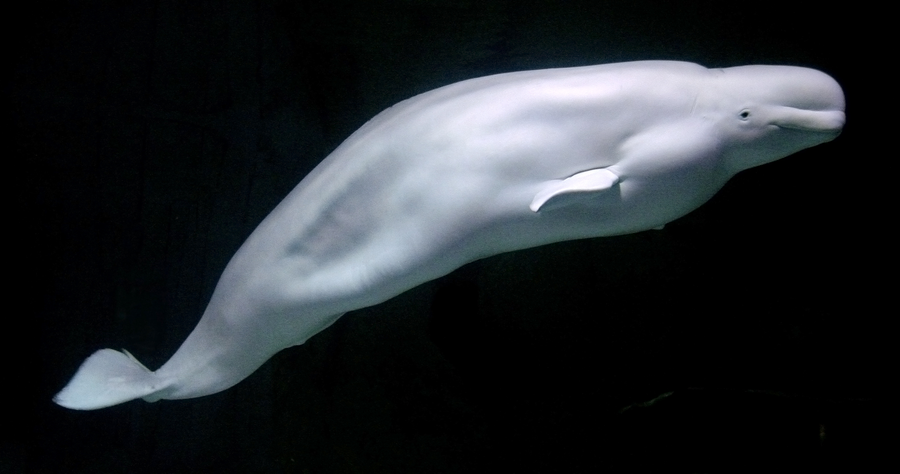
Photo: Javier Yaya Tur / CIUDAD DE LAS ARTES Y LAS CIENCIAS from Valencia, España · CC BY 2.0 · source · credits
The beluga whale (Delphinapterus leucas) is a mammal of the family Monodontidae, in the order Artiodactyla.
Quick answer
The beluga is a small, sociable white whale of the Arctic and sub-Arctic seas, easily recognised by its rounded forehead and lack of a dorsal fin. Adults grow to about 4.5 m and weigh between 700 and 1,400 kg, with males the larger sex. Belugas swim in tight-knit pods, feed on fish and invertebrates, and can live 35 to 50 years. The IUCN lists the species as Near Threatened.
Top questions about the Beluga Whale
Also available in Español (Beluga)
Beluga Whale facts at a glance
- Weight 1400 kg
- Length 4.5 m
- Top speed 22 km/h
- Lifespan 50 years
| Scientific name | Delphinapterus leucas |
|---|---|
| Diet | Carnivore — fish, crustaceans, worms, and cephalopods |
| Habitat | Arctic and sub-Arctic seas, estuaries, and pack ice |
| Lifespan | 35–50 years in the wild |
| Weight | 700–1,400 kg (1,540–3,090 lb); males larger |
| Top speed | Up to 22 km/h (14 mph); agile under ice |
| Conservation status | Near Threatened (IUCN) |
| Kingdom | Animalia |
|---|---|
| Phylum | Chordata |
| Class | Mammalia |
| Order | Artiodactyla |
| Family | Monodontidae |
| Genus | Delphinapterus |
Where it lives
The beluga whale (Delphinapterus leucas) is native to Arctic and sub-Arctic waters of Russia, Canada, Alaska, and Greenland — estuaries like Churchill and St. Lawrence River. — recorded across Asia, Europe, North America, Oceans in this guide’s range summary.
For occurrence records, see GBIF species search and sources below.
How big is a beluga whale?
An adult beluga whale measures 4.5 m long — about 2.6× the height of an average adult person (1.73 m) — and weighs around 1400 kg, about 20× an average adult’s body weight (70 kg).
Length vs an average adult’s height (to scale)
What is a group of beluga whales called?
Group name (collective noun)
A group of Beluga Whales is called a pod.
Baby name
A baby Beluga Whale is called a calf.
Explore more animal collective nouns and baby animal names .
Appearance and adaptations
Belugas are unmistakable: pure white as adults, with a bulbous 'melon' on the forehead and no dorsal fin. That flat back is an adaptation to life among sea ice, letting them swim close beneath the surface and break through thin ice to breathe. Unlike most whales, belugas have unfused neck vertebrae, so they can turn and nod their heads. A thick layer of blubber, up to 40 percent of body weight, insulates them in near-freezing water.
Habitat and seasonal movements
Belugas live in the cold coastal waters, estuaries, and pack ice of the Arctic and sub-Arctic. Many populations migrate with the ice, moving into river mouths and shallow bays in summer and retreating toward the open sea as winter ice advances. They are remarkably at home under ice, using sound and agility to find breathing holes across vast frozen expanses. Some populations gather in warm estuaries each summer to moult their outer skin.
Diet and feeding
Belugas are carnivores with a varied menu of fish such as cod and salmon, along with crustaceans, marine worms, and cephalopods like squid and octopus. They forage on the seabed as well as in open water, using their flexible necks and pursed lips to root out and suck up prey. An adult may eat many kilograms of food a day to fuel its warm-blooded body in icy seas. They often hunt cooperatively, herding schooling fish into tight balls.
Communication and intelligence
Nicknamed 'the canaries of the sea', belugas are among the most vocal of all whales, producing an extraordinary range of clicks, whistles, chirps, and squeals. They rely on echolocation to navigate and hunt in dark or ice-covered waters, reading the echoes of their own clicks. Belugas are highly intelligent and social, living in pods that can merge into gatherings of hundreds. They can even mimic sounds, and captive individuals have been recorded imitating human speech patterns.
Reproduction and life cycle
Females give birth to a single calf after a gestation of roughly 14 to 15 months, usually in warmer summer estuaries. Calves are born grey or brownish and only gradually turn white, reaching the adult colour at around five to nine years of age. A mother nurses her calf for up to two years, and the strong bond keeps young belugas close to the pod. With slow reproduction, belugas can live 35 to 50 years in the wild.
Conservation and threats
The beluga is listed as Near Threatened by the IUCN, though some local populations, such as those in Canada's Cook Inlet and St Lawrence estuary, are far more imperilled. Key threats include pollution, industrial noise that disrupts their sound-based world, shipping traffic, and the loss of sea ice to a warming climate. Historic hunting reduced several stocks, and subsistence hunting continues in parts of the Arctic. Reducing contaminants and underwater noise is central to protecting the species.
Dig deeper into the Beluga Whale
- Beluga Whale: Key Facts
The beluga whale is a white Arctic cetacean with a flexible neck and rich vocal repertoire — nicknamed 'canary of the sea'.
- How Big Is A Beluga Whale?
Beluga Whale size and weight: typical 700–1,400 kg (1,540–3,090 lb); males larger, dimorphism, and growth.
- How Long Do Beluga Whales Live?
Beluga Whale lifespan is typically 35–50 years in the wild. What shortens or extends life, life stages, and status (Near Threatened).
- What Do Beluga Whales Eat?
What beluga whales eat: Carnivore — fish, crustaceans, worms, and cephalopods, foraging style, and seasonal shifts in Arctic and sub-Arctic seas, estuaries, and pack ice.
- Where Do Beluga Whales Live?
Where beluga whales live: Arctic and sub-Arctic seas, estuaries, and pack ice, native range cues, and human overlap. Status Near Threatened.
Explore the Beluga Whale
Compare
Close relatives
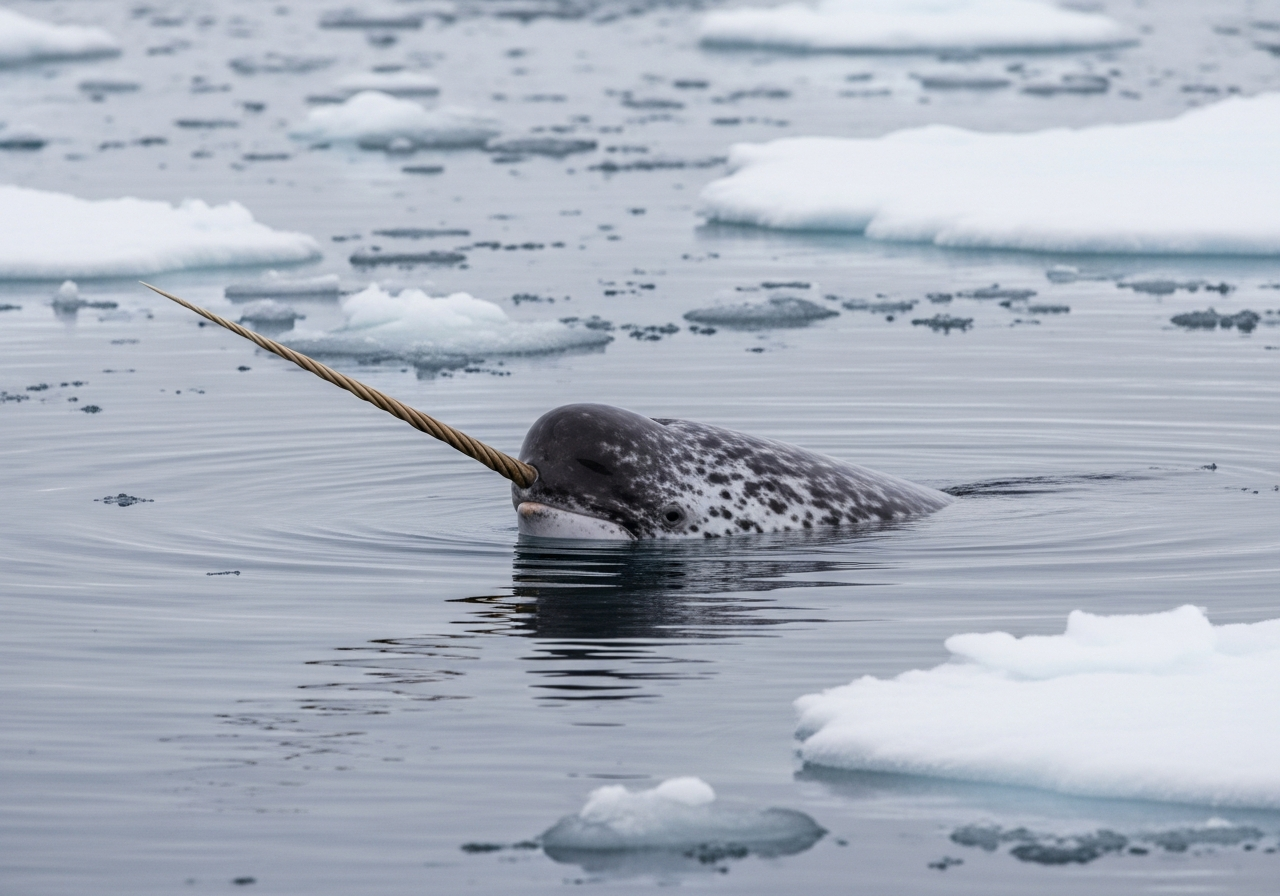
- Narwhal Same family
- Giraffe Same order
- Pygmy Hippopotamus Same order
- Blue Whale Same order
Did you know? Beluga Whale facts
- Belugas are white Arctic whales with flexible necks and varied vocalisations nicknamed 'canaries of the sea'.
- Camouflage among sea ice — calves are born dark grey.
- Yes — flexible necks allow unusual manoeuvres unlike most whales.
- Conservation: Near Threatened.
Diet & feeding
Beluga Whale feeds primarily as a fish, crustaceans, worms.
Adaptations
- Melon-shaped foreheads focus sonar clicks for navigation under ice.
- Belugas in tanks face welfare concerns — wild pods travel vast distances.
Behaviour & ecology
- Melon-shaped foreheads focus sonar clicks for navigation under ice.
- Belugas in tanks face welfare concerns — wild pods travel vast distances.
Communication
- Beluga Whale uses scent, posture, and vocal signals to mark territory and coordinate social behaviour.
- Communication intensity often peaks during breeding seasons and territorial disputes.
Habitat & range
Arctic and sub-Arctic seas
Ecological role
Beluga Whale plays a recognised ecological role in arctic and sub-arctic seas.
Conservation status of the Beluga Whale
The beluga whale (Delphinapterus leucas) is listed as Near Threatened on the IUCN Red List. Near Threatened (NT) means a species does not yet qualify as threatened but is close to it, or likely to become so in the near future without ongoing conservation. It is a watch-list category just below Vulnerable.
Main threats to the beluga whale
- Hunting of some stocks
- Industrial development and shipping noise
- Contaminants in Arctic food webs
- Climate-driven habitat change
Beluga Whale (Delphinapterus leucas) was most recently assessed for the IUCN Red List in 2017. View the full IUCN assessment .
Frequently asked questions about the Beluga Whale
Why are beluga whales white?
Adult belugas are pure white, a colour thought to camouflage them against sea ice and snow-lit water, helping them avoid predators such as polar bears and orcas. Calves are born grey or brown and only turn fully white at around five to nine years old.
How big do beluga whales get?
Belugas reach about 4.5 m in length and weigh between 700 and 1,400 kg (1,540 to 3,090 lb). Males are noticeably larger than females, making belugas one of the smaller whale species.
How long do beluga whales live?
Beluga whales typically live 35 to 50 years in the wild. They mature slowly and raise a single calf at a time, so populations recover only gradually from losses.
What do beluga whales eat?
Belugas are carnivores that eat fish such as cod and salmon, plus crustaceans, marine worms, and cephalopods like squid and octopus. They forage on the seabed and in open water, often herding schooling fish cooperatively.
Why are belugas called the canaries of the sea?
Belugas earned the nickname because they are exceptionally vocal, producing clicks, whistles, chirps, and squeals that carry through the water. They use these sounds to communicate within their pods and to echolocate prey and breathing holes beneath the ice.
How fast can a beluga whale swim?
Belugas can swim at up to about 22 km/h (14 mph) in short bursts, though they usually cruise much more slowly. Their flexible bodies and lack of a dorsal fin make them especially agile beneath the ice rather than fast in open water.
What is a group of beluga whales called?
A group of Beluga Whales is called a pod.
What is a baby beluga whale called?
A baby Beluga Whale is called a calf.
Sources & references
This guide is compiled and reviewed against established zoological and conservation references. Key sources for the Beluga Whale:
-
IUCN Red List of Threatened Species
Conservation status (Near Threatened) reflects the IUCN Red List category for Delphinapterus leucas, most recently assessed in 2017.
-
iNaturalist — observations & photos
Search citizen-science observations and community IDs for Delphinapterus leucas. Useful for range checks and recent sightings — not a substitute for formal Red List status.
-
GBIF — occurrence data
Global Biodiversity Information Facility species search for Delphinapterus leucas. Explore published occurrence records used in range research.
- IUCN Red List — Delphinapterus leucas.
Conservation status (Near Threatened) and population trends.
- Animal Diversity Web — Delphinapterus leucas. University of Michigan Museum of Zoology.
Life history, morphology, and range.
-
Global Animal Guide editorial standards
How we research, source, review, and update every guide for accuracy.