Image sourcing: see credits & licences
The narwhal (Monodon monoceros) is a mammal of the family Monodontidae, in the order Artiodactyla.
Quick answer
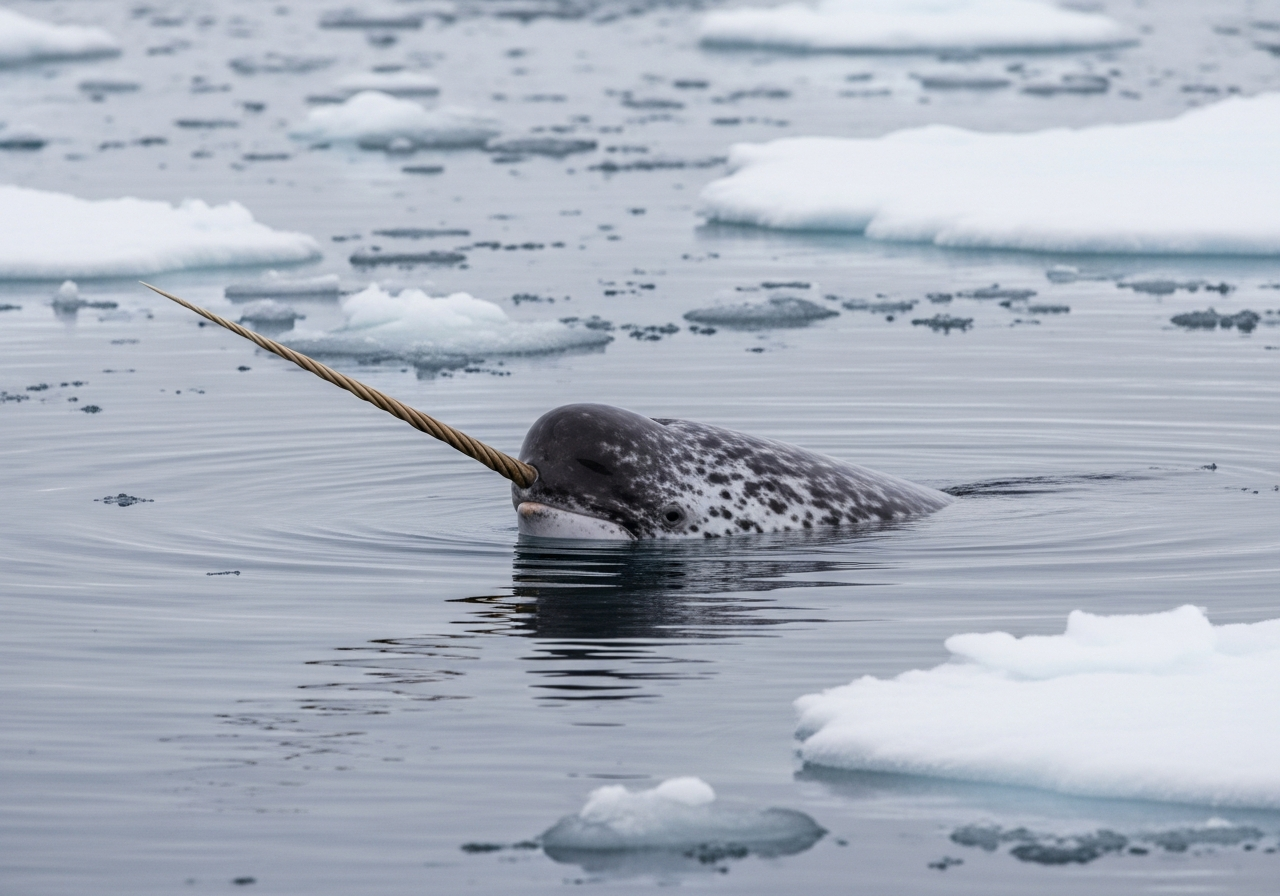
The narwhal is an Arctic whale famous for the long, spiraled tusk that grows from the head of most males. The tusk is actually an enlarged tooth packed with nerves. Narwhals live year-round in the icy waters of the Arctic, reach about 5 m (16 ft) excluding the tusk, and can live 50 years or more.
Top questions about the Narwhal
Narwhal facts at a glance
- Weight 1600 kg
- Length 5 m
- Top speed 10 km/h
- Lifespan 50 years
| Scientific name | Monodon monoceros |
|---|---|
| Diet | Carnivore (fish, squid, shrimp) |
| Habitat | Arctic oceans and ice-edge waters |
| Lifespan | 50+ years |
| Weight | 800–1,600 kg (1,800–3,500 lb) |
| Length | 4–5.5 m (13–18 ft) excluding tusk |
| Conservation status | Least Concern (IUCN) |
| Kingdom | Animalia |
|---|---|
| Phylum | Chordata |
| Class | Mammalia |
| Order | Artiodactyla |
| Family | Monodontidae |
| Genus | Monodon |
Where it lives
The narwhal (Monodon monoceros) is native to Arctic waters of Canada, Greenland, Norway, and Russia, with the largest numbers around Baffin Bay. — recorded across North America, Europe, Asia, Oceans in this guide’s range summary.
For occurrence records, see GBIF species search and sources below.
How big is a narwhal?
An adult narwhal measures 5 m long — about 2.9× the height of an average adult person (1.73 m) — and weighs around 1600 kg, about 23× an average adult’s body weight (70 kg).
Length vs an average adult’s height (to scale)
What is a group of narwhals called?
Group name (collective noun)
A group of Narwhals is called a pod. It is also known as a blessing.
Baby name
A baby Narwhal is called a calf.
Explore more animal collective nouns and baby animal names .
The tusk that inspired unicorns
The narwhal's spiraled tusk is its most famous feature — a single tooth that grows straight through the upper lip and can reach 3 m (10 ft) long. Found mainly in males, it is packed with millions of nerve endings, making it a sensitive organ as well as a possible weapon. In medieval Europe, narwhal tusks were sold as unicorn horns for enormous sums.
Life in the Arctic ice
Narwhals are one of the few whales that live in the high Arctic all year, moving with the advancing and retreating sea ice. In winter they dive beneath dense pack ice to depths of more than 1,500 m (4,900 ft) in search of fish, surfacing to breathe through narrow cracks and breathing holes in the ice.
Diet and diving
Narwhals are deep-diving carnivores that feed on Greenland halibut, Arctic cod, squid, and shrimp, often hunting near the seabed in near-total darkness. They make some of the deepest dives of any marine mammal and may use their tusks to stun fish, a behavior that has been filmed in the wild.
Habitat and range
Narwhals live in the Arctic waters of Canada, Greenland, Norway, and Russia, with the largest numbers around Baffin Bay between Canada and Greenland. They travel in groups and migrate seasonally between deep offshore wintering grounds and shallower coastal bays in summer.
Conservation
The narwhal is listed as Least Concern, but it is highly specialized and considered one of the marine mammals most vulnerable to climate change. Shrinking sea ice, increased shipping noise, and changing prey all threaten it, and it is still hunted under managed subsistence quotas by Arctic Indigenous communities.
Dig deeper into the Narwhal
- How Big Is A Narwhal?
Narwhal size and weight: typical 800–1,600 kg (1,800–3,500 lb), dimorphism, and growth.
- How Long Do Narwhals Live?
Narwhal lifespan is typically 50+ years. What shortens or extends life, life stages, and status (Least Concern).
- Narwhal: Key Facts
The narwhal is an Arctic whale famous for the long, spiraled tusk that grows from the head of most males.
- What Do Narwhals Eat?
What narwhals eat: Carnivore (fish, squid, shrimp), foraging style, and seasonal shifts in Arctic oceans and ice-edge waters.
- Where Do Narwhals Live?
Where narwhals live: Arctic oceans and ice-edge waters, native range cues, and human overlap. Status Least Concern.
Explore the Narwhal
Compare
Close relatives
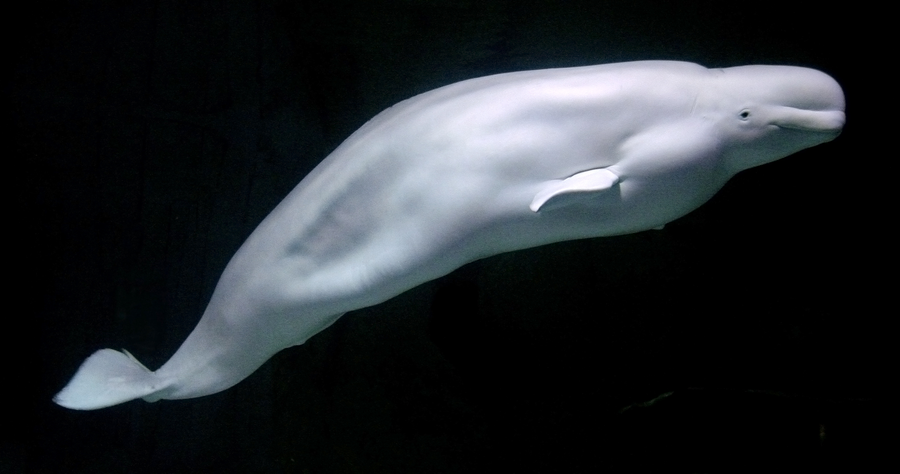
- Beluga Whale Same family
- Giraffe Same order
- Pygmy Hippopotamus Same order
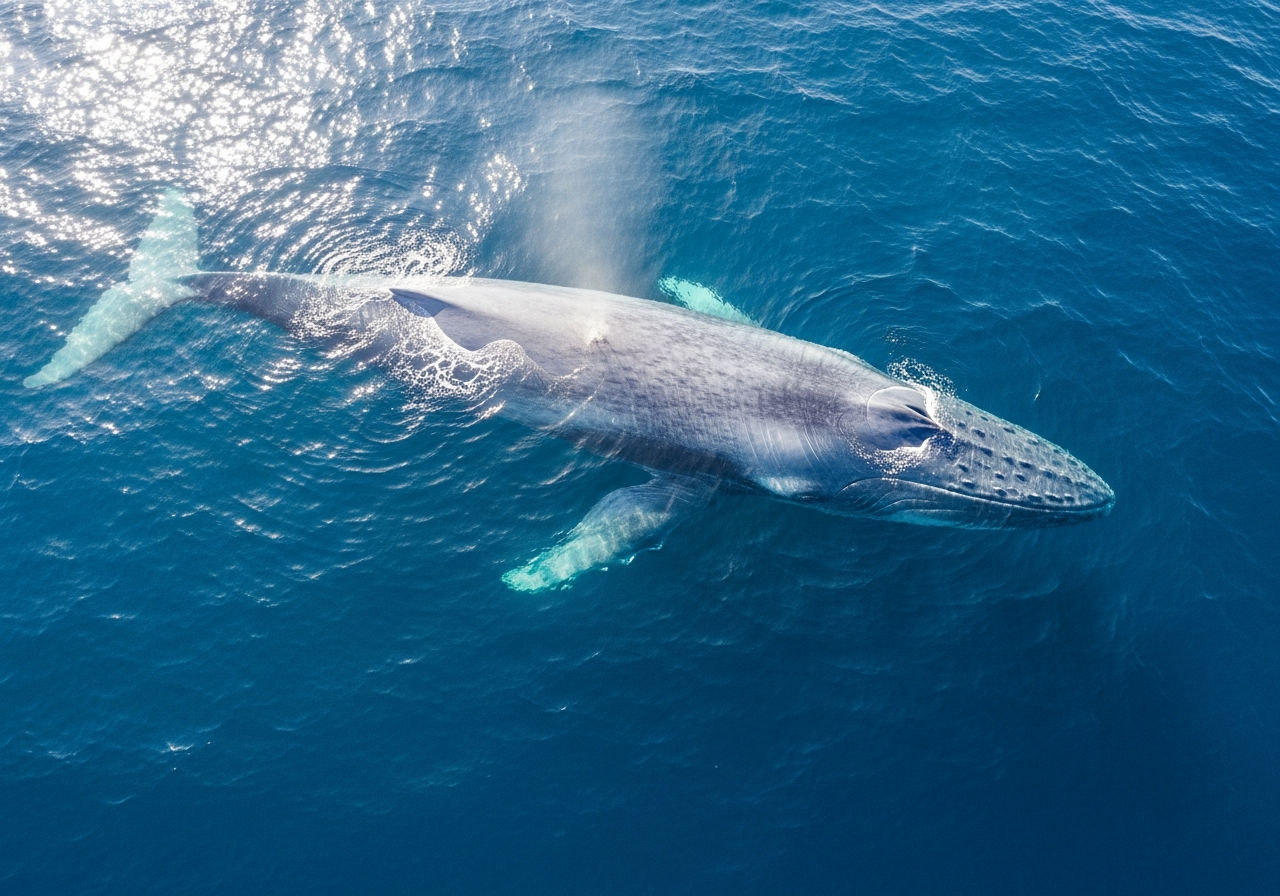
- Blue Whale Same order
Did you know? Narwhal facts
- The narwhal's 'tusk' is actually an enormously elongated tooth, usually grown by males.
- The tusk is packed with nerves and may sense the surrounding water.
- Narwhals live year-round in the icy Arctic, among the deepest-diving whales.
- They can dive over 1,500 m to feed beneath the sea ice.
- Narwhals are sometimes called the 'unicorns of the sea'.
- They rely on sea-ice habitat that is changing with the warming Arctic.
Diet & feeding
Narwhals feed mainly on fish such as Greenland halibut and Arctic cod, plus squid, often captured during deep dives beneath the sea ice.
Adaptations
- A spiral tusk rich in nerve endings may detect salinity and other water cues.
- Deep-diving physiology lets narwhals forage far below the surface and ice.
- Thick blubber insulates against the cold of year-round Arctic waters.
- Flexible navigation beneath shifting sea ice allows access to breathing leads.
Behaviour & ecology
- Narwhals form groups and undertake seasonal movements with the sea ice.
- They make deep dives to feed on fish and squid near the seabed.
- Males may cross or rub tusks in social interactions.
- They navigate and overwinter among dense pack ice.
Communication
- Narwhals use clicks, whistles, and pulsed calls for echolocation and contact.
- Vocalisations help coordinate groups beneath the ice.
- The tusk may also play a sensory and social signalling role.
Habitat & range
Narwhals are restricted to the Arctic waters of Canada, Greenland, and Russia, living among pack ice and deep fjords throughout the year.
Ecological role
As specialised Arctic predators, narwhals link deep-water prey to the ice-edge ecosystem and are an indicator species for a rapidly changing Arctic.
Conservation status of the Narwhal
The narwhal (Monodon monoceros) is listed as Least Concern on the IUCN Red List. Least Concern (LC) is the IUCN's lowest-risk category, assigned to widespread, abundant species that have been evaluated and found not to be threatened. It does not mean a species faces no pressures — only that it is not currently at risk of extinction.
The narwhal (Monodon monoceros) is assessed on the IUCN Red List. Look up on the IUCN Red List .
Frequently asked questions about the Narwhal
Is the narwhal's tusk a horn or a tooth?
It is a tooth. The tusk is a greatly enlarged canine tooth that grows through the upper lip, usually in males, and is filled with sensitive nerves.
Why is the narwhal called the unicorn of the sea?
Because of its single long, spiraled tusk. In medieval times these tusks were traded as mythical unicorn horns, and the resemblance gave the narwhal its nickname.
What do narwhals eat?
Narwhals are carnivores that feed on Greenland halibut, Arctic cod, squid, and shrimp, diving very deep beneath the sea ice to hunt.
Where do narwhals live?
Narwhals live year-round in the Arctic Ocean, mainly around Canada and Greenland, moving with the sea ice between deep offshore waters in winter and coastal bays in summer.
How long do narwhals live?
Narwhals are long-lived, commonly reaching 50 years and sometimes considerably more, based on studies of growth layers in their tissues.
What is a group of narwhals called?
A group of Narwhals is called a pod. It is also known as a blessing.
What is a baby narwhal called?
A baby Narwhal is called a calf.
Sources & references
This guide is compiled and reviewed against established zoological and conservation references. Key sources for the Narwhal:
-
IUCN Red List of Threatened Species
Conservation status (Least Concern) reflects the IUCN Red List category for Monodon monoceros.
-
iNaturalist — observations & photos
Search citizen-science observations and community IDs for Monodon monoceros. Useful for range checks and recent sightings — not a substitute for formal Red List status.
-
GBIF — occurrence data
Global Biodiversity Information Facility species search for Monodon monoceros. Explore published occurrence records used in range research.
- Lowry, L. et al. (2017). Monodon monoceros. IUCN Red List of Threatened Species.
Status (Least Concern) and Arctic dependence.
- Animal Diversity Web — Monodon monoceros. University of Michigan Museum of Zoology.
Life history, morphology, and range.
- Nowak, R. M. (1999). Walker's Mammals of the World (6th ed.). Johns Hopkins University Press.
Tusk and biology.
-
Global Animal Guide editorial standards
How we research, source, review, and update every guide for accuracy.