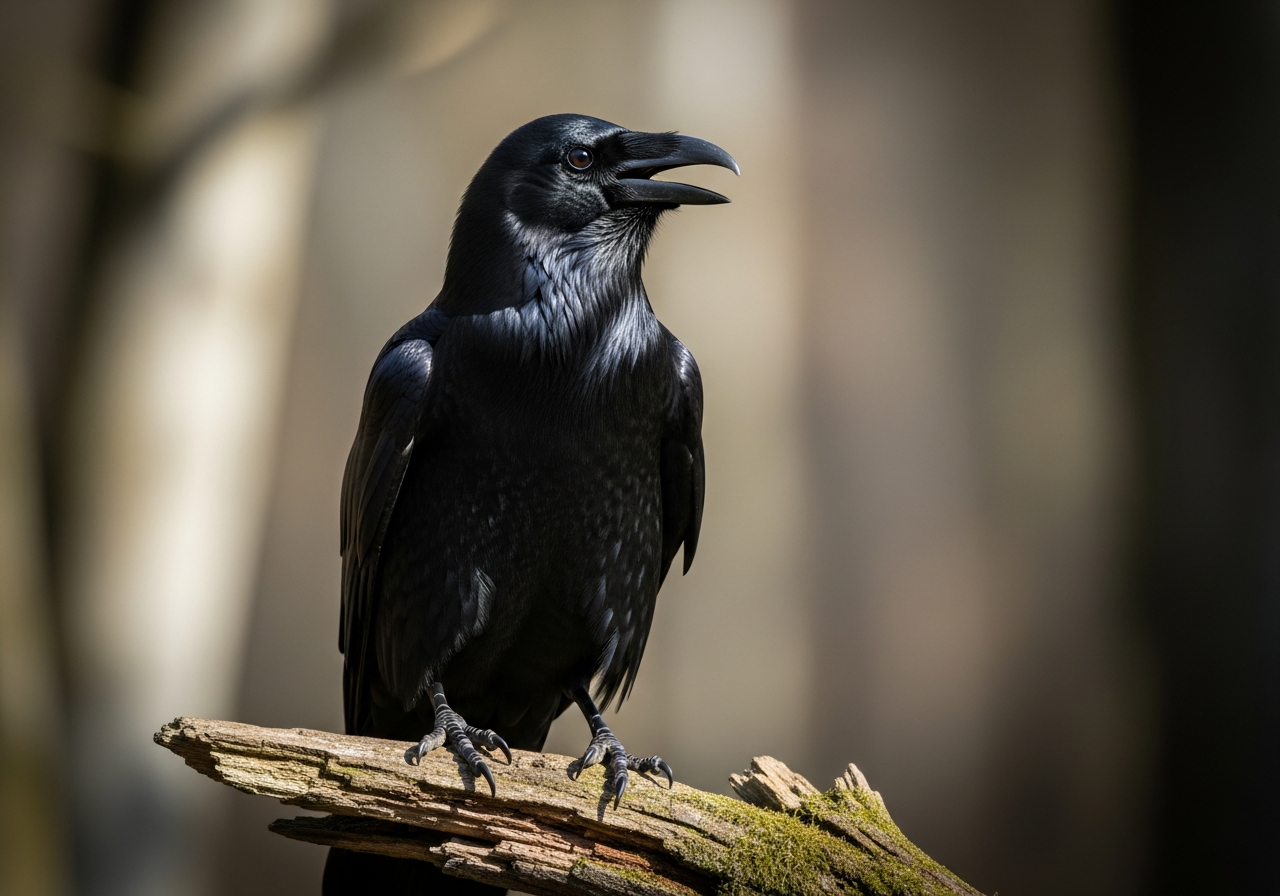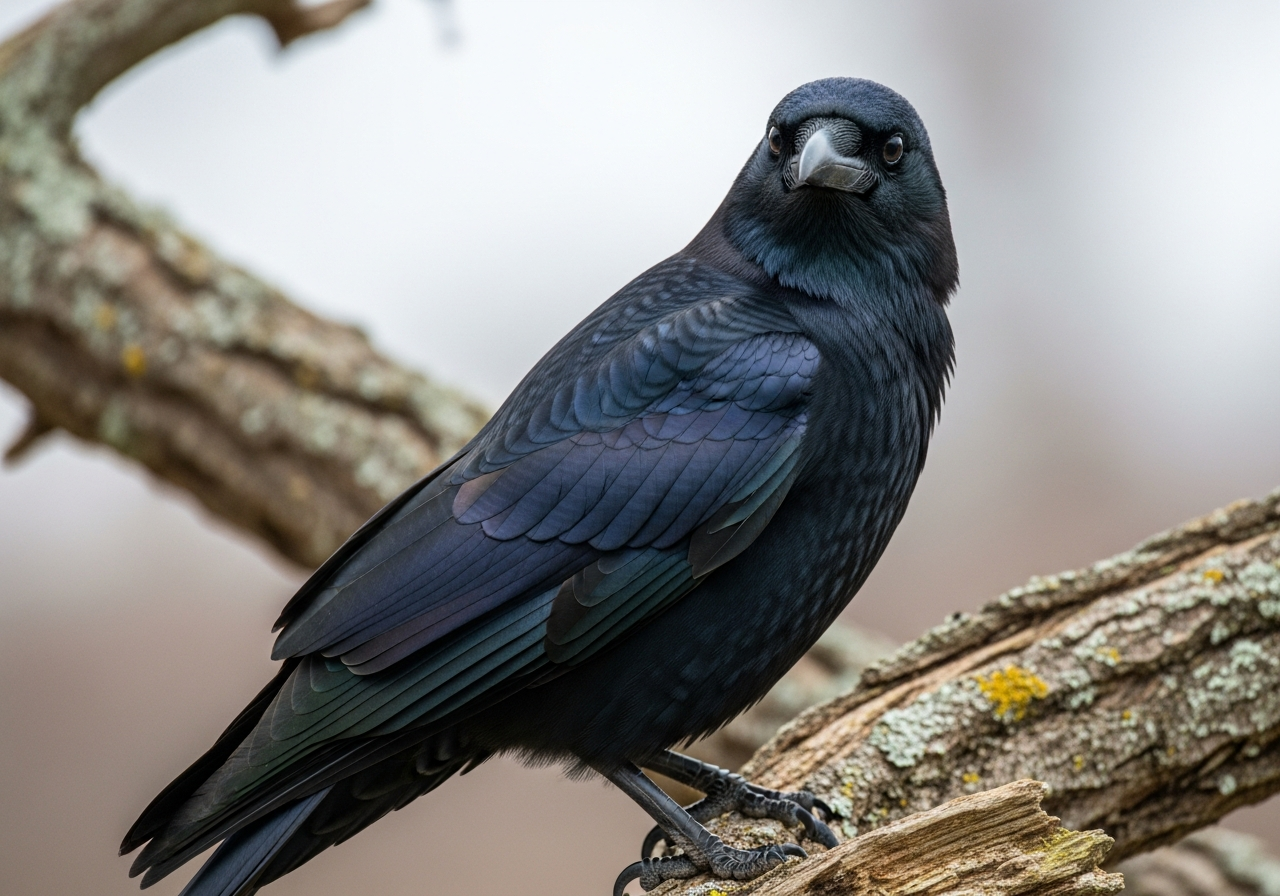
The crow (Corvus brachyrhynchos) is a bird of the crow family, Corvidae, in the order Passeriformes.
Quick answer
The American crow (Corvus brachyrhynchos) is a large, glossy-black songbird found across farmland, woodland, parks, and cities in North America. It weighs 300–600 g, spans 85–100 cm across the wings, and ranks among the most intelligent of all birds. Crows are opportunistic omnivores that live in tight family groups and typically survive 7–8 years in the wild, though some reach 16 or more.
Top questions about the Crow
Crow facts at a glance
- Weight 500 g
- Length 50 cm
- Top speed 60 km/h
- Lifespan 16 years
| Scientific name | Corvus brachyrhynchos |
|---|---|
| Diet | Omnivore (grain, insects, carrion, scraps) |
| Habitat | Farmland, woodland, parks, cities |
| Lifespan | 7–8 years wild (up to 16+) |
| Weight | 300–600 g (11–21 oz) |
| Wingspan | 85–100 cm (33–39 in) |
| Conservation status | Least Concern (IUCN) |
| Kingdom | Animalia |
|---|---|
| Phylum | Chordata |
| Class | Aves |
| Order | Passeriformes |
| Family | Corvidae |
| Genus | Corvus |
Where it lives
The crow (Corvus brachyrhynchos) is native to Fields, woodlands, parks, and cities across the United States and Canada. — recorded across North America in this guide’s range summary.
For occurrence records, see GBIF species search and sources below.
How big is a crow?
An adult crow measures 50 cm long — about 29% of the height of an average adult person (1.73 m) — and weighs around 500 g, about 1% of an average adult’s body weight (70 kg).
Length vs an average adult’s height (to scale)
What is a group of crows called?
Group name (collective noun)
A group of Crows is called a murder. It is also known as a horde.
Baby name
A baby Crow is called a chick.
Explore more animal collective nouns and baby animal names .
Intelligence and problem-solving
Crows are among the smartest animals on the planet, with problem-solving abilities that rival those of some primates. They fashion and use simple tools, remember individual human faces for years, and can hold what looks like a grudge against people who have threatened them. Captive and wild birds have both been recorded dropping hard-shelled nuts onto roads so that passing cars crack them open, then waiting for a safe gap in traffic to retrieve the food.
Diet and foraging
The crow is a true generalist, eating grain, insects, earthworms, carrion, eggs, small animals, and human scraps. This flexible menu is a big reason the species thrives everywhere from remote fields to busy city centres. Crows cache surplus food, hiding it under leaves or in bark crevices to recover later, and they watch other birds closely to steal from poorly hidden stores. Around rubbish bins and car parks they have learned to exploit almost any edible waste people leave behind.
Family life and roosts
Crows are highly social and often live in extended family groups, with young from previous years helping their parents raise the next brood. Outside the breeding season, thousands may gather at communal night roosts, streaming in from miles around at dusk. These roosts offer safety in numbers and may help birds share information about good feeding sites. Family members preen one another and defend a shared territory throughout the year.
Communication and calls
The familiar harsh "caw" is only part of a crow's vocabulary, which includes rattles, clicks, and surprisingly soft, musical notes. Crows use different calls to raise the alarm, rally the group, or scold a predator, and they can recognise the individual voices of their relatives. When a hawk, owl, or cat appears, a mob of crows will gather to harass it noisily until it moves on. Some birds even mimic other species and mechanical sounds.
Range and adaptability
American crows are found across most of North America, absent only from the far north and the driest deserts. They readily colonise farmland, woodland edges, suburbs, and city parks, and their numbers have grown as they exploit human landscapes. Crows are listed as Least Concern by the IUCN, reflecting a large and stable population. The species did suffer local declines from West Nile virus, but populations have largely recovered.
Dig deeper into the Crow
- Crow: Key Facts
Crows (Corvus brachyrhynchos) are birds found across North America. The glossy black genius of the bird world.
- How Fast Is A Crow?
Crow top speed is about about 60 km/h. Sprint vs endurance and what limits pace.
- How Long Do Crows Live?
Crow lifespan is typically 7–8 years wild (up to 16+). What shortens or extends life, life stages, and status (Least Concern).
- What Do Crows Eat?
What crows eat: Omnivore (grain, insects, carrion, scraps), foraging style, and seasonal shifts in Farmland, woodland, parks, cities.
- Where Do Crows Live?
Where crows live: Farmland, woodland, parks, cities, native range cues, and human overlap. Status Least Concern.
Explore the Crow
Close relatives
- Common Raven Same genus
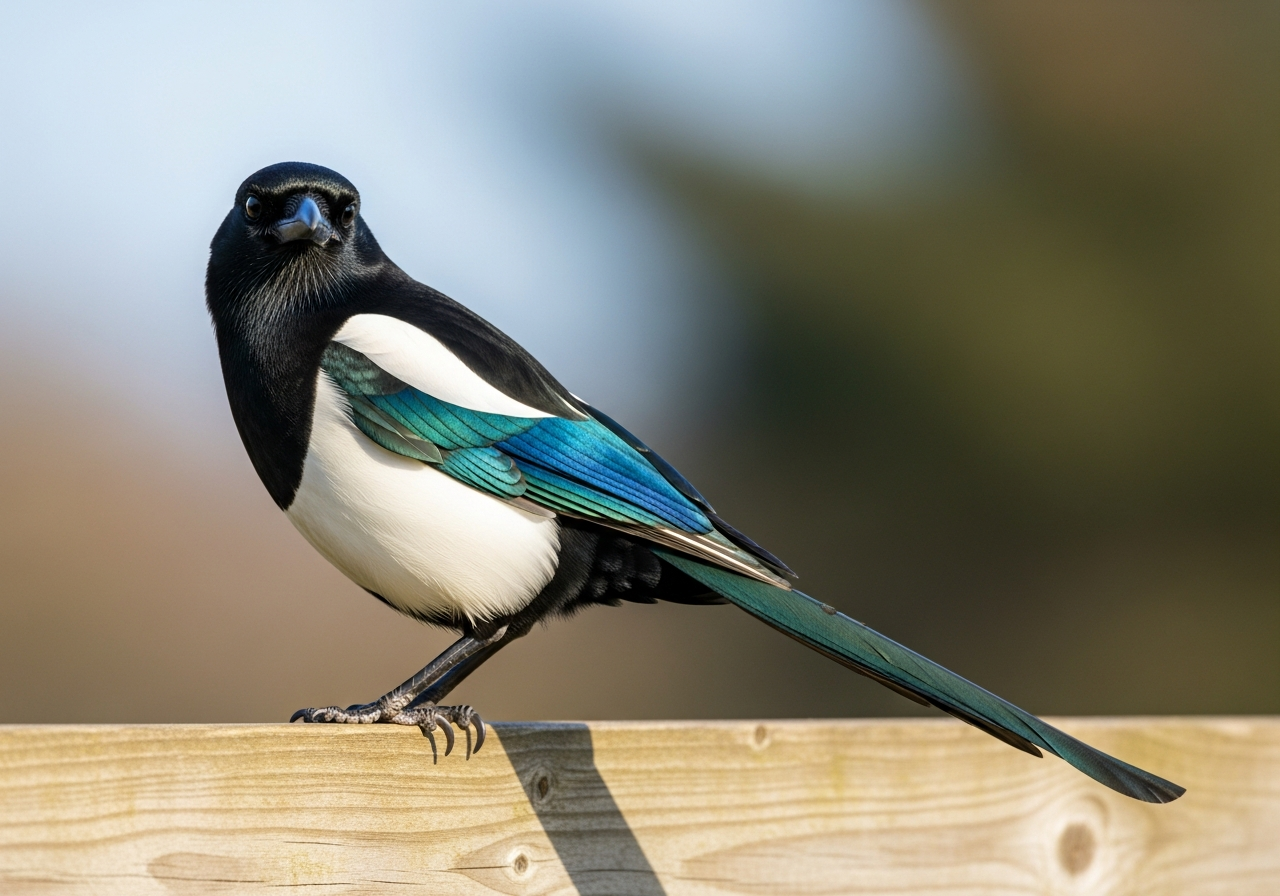
- Magpie Same family
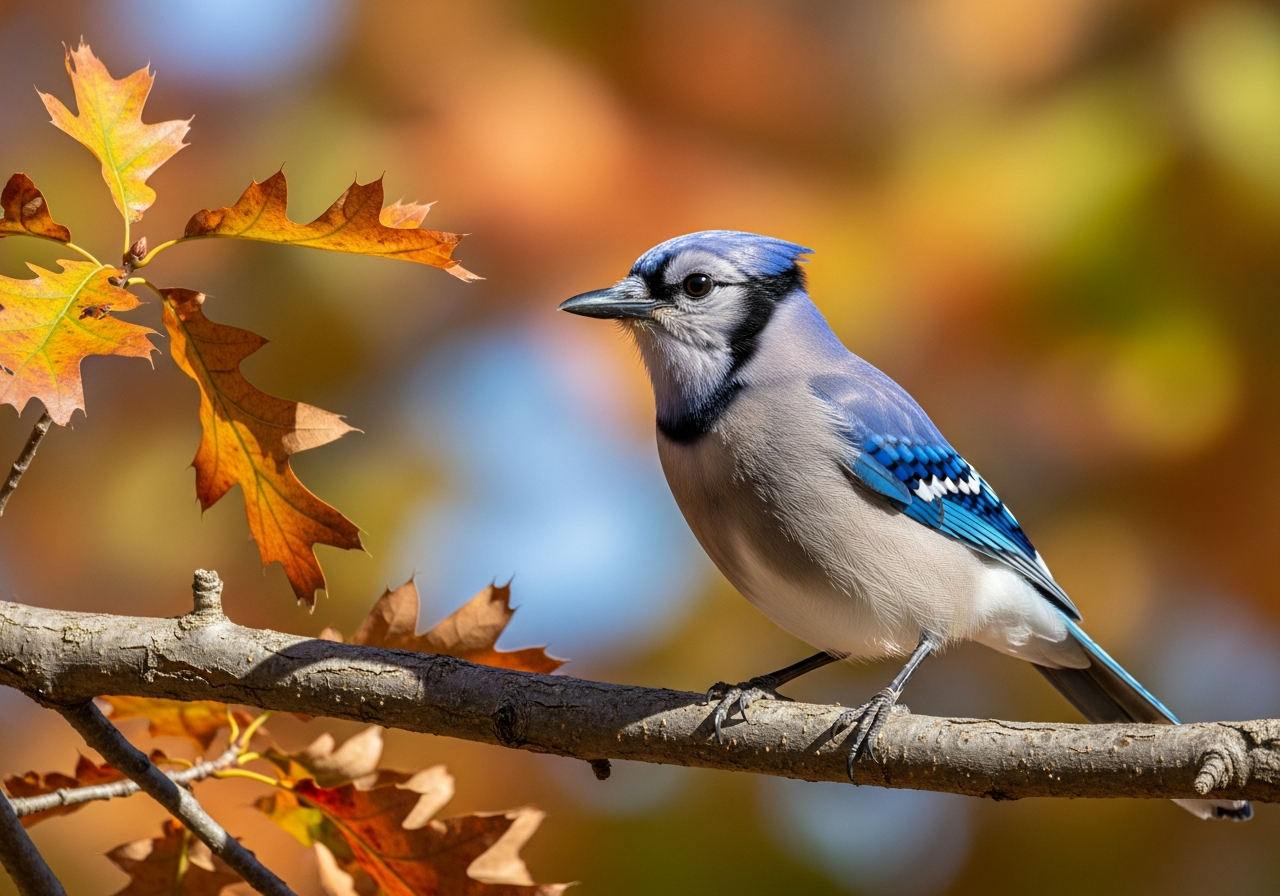
- Blue Jay Same family
- Canary Same order
Range & geography
Did you know? Crow facts
- The American crow is a large, all-black bird and one of the most intelligent animals on Earth, capable of using tools, solving puzzles, and recognising individual human faces.
- A group of crows is famously called a murder. Crows are highly social and also gather in huge communal roosts, and a baby crow is called a chick.
- Yes. Crows are among the smartest animals, using tools, solving multi-step problems, planning ahead, and recognising individual human faces for years, remembering those who have threatened them.
- Ravens are larger than crows, with shaggy throat feathers, a heavier curved bill, and a wedge-shaped tail. Ravens give a deep croak, while crows make a sharper, higher cawing call.
- Yes. Studies show crows recognise and remember specific human faces, react to people who have harmed them, and can pass that information to other crows, so a whole local group may scold a remembered threat.
- Conservation: Least Concern (IUCN).
Diet & feeding
Crow feeds primarily as a omnivore (grain, insects, carrion, scraps). Crows are corvids, ranking among the most intelligent of all animals. They use and even shape simple tools, drop hard-shelled food onto roads for cars to crack, and plan ahead for future needs. Crows also recognise and remember individual human faces
Adaptations
- Crows are corvids, ranking among the most intelligent of all animals. They use and even shape simple tools, drop hard-shelled food onto roads for cars to crack, and plan ahead for future needs. Crows also recognise and remember individual human faces for years, holding grudges against people who have threatened them and passing that wariness on to other crows.
- Crows are highly social and communicate with a wide vocabulary of caws and rattles. Families often stay together, with older offspring helping to raise the next brood — a behaviour called cooperative breeding. Outside the breeding season, crows gather in enormous communal roosts that can number in the tens of thousands, especially in winter and near towns.
Behaviour & ecology
- Crows are corvids, ranking among the most intelligent of all animals. They use and even shape simple tools, drop hard-shelled food onto roads for cars to crack, and plan ahead for future needs. Crows also recognise and remember individual human faces for years, holding grudges against people who have threatened them and passing that wariness on to other crows.
- Crows are highly social and communicate with a wide vocabulary of caws and rattles. Families often stay together, with older offspring helping to raise the next brood — a behaviour called cooperative breeding. Outside the breeding season, crows gather in enormous communal roosts that can number in the tens of thousands, especially in winter and near towns.
- As opportunistic omnivores, crows eat grain, fruit, insects, small animals, eggs, carrion, and human food waste. This flexible diet, paired with their intelligence, lets them thrive almost anywhere, from farmland to busy city centres. They are bold scavengers and quick to exploit new food sources.
Communication
- Crow uses calls and visual displays to communicate territory, alarm, and breeding status.
- Vocal repertoires vary by species and are often learned or refined during development.
Habitat & range
Farmland, woodland, parks, cities
Ecological role
Crow contributes to seed dispersal, insect control, or nutrient cycling depending on diet and foraging habits.
Conservation status of the Crow
The crow (Corvus brachyrhynchos) is listed as Least Concern on the IUCN Red List. Least Concern (LC) is the IUCN's lowest-risk category, assigned to widespread, abundant species that have been evaluated and found not to be threatened. It does not mean a species faces no pressures — only that it is not currently at risk of extinction.
The crow (Corvus brachyrhynchos) is assessed on the IUCN Red List. Look up on the IUCN Red List .
Frequently asked questions about the Crow
How intelligent are crows?
Crows are among the most intelligent birds known, capable of using tools, solving multi-step puzzles, and recognising individual human faces. Their reasoning skills are often compared to those of great apes, and they can plan ahead and remember hidden food for long periods.
How long do crows live?
Wild crows typically live about 7–8 years, though many survive well beyond that, with some reaching 16 or more. In captivity, protected from predators and disease, they can live even longer.
What do crows eat?
Crows are omnivores with an extremely varied diet, including grain, insects, worms, carrion, eggs, small animals, and human food scraps. This adaptability lets them thrive in farmland, woodland, and cities alike.
Can crows really remember faces?
Yes. Studies have shown that crows remember and react to specific human faces for years, especially people who have threatened or trapped them. They can even pass this recognition on to other crows, which then treat the same person as a threat.
Why do crows gather in large groups?
Outside the breeding season, crows form huge communal roosts that can number in the thousands. Gathering together offers protection from predators, warmth on cold nights, and possibly a way to share information about good feeding sites.
What is the difference between a crow and a raven?
Ravens are noticeably larger, with heavier bills, shaggy throat feathers, and a wedge-shaped tail in flight, while crows are slimmer with a fan-shaped tail. Ravens also give a deep croak rather than the crow's higher, sharper "caw."
What is a group of crows called?
A group of Crows is called a murder. It is also known as a horde.
What is a baby crow called?
A baby Crow is called a chick.
Sources & references
This guide is compiled and reviewed against established zoological and conservation references. Key sources for the Crow:
-
IUCN Red List of Threatened Species
Conservation status (Least Concern) reflects the IUCN Red List category for Corvus brachyrhynchos.
-
iNaturalist — observations & photos
Search citizen-science observations and community IDs for Corvus brachyrhynchos. Useful for range checks and recent sightings — not a substitute for formal Red List status.
-
GBIF — occurrence data
Global Biodiversity Information Facility species search for Corvus brachyrhynchos. Explore published occurrence records used in range research.
-
eBird — bird observations
Cornell Lab eBird target search for Crow. Check recent checklists and seasonal abundance where birders report this species.
- IUCN Red List — Corvus brachyrhynchos.
Conservation status (Least Concern) and population trends.
- Animal Diversity Web — Corvus brachyrhynchos. University of Michigan Museum of Zoology.
Life history, morphology, and range.
- Wikipedia — Crow.
General taxonomy and overview (cross-check primary sources).
-
Global Animal Guide editorial standards
How we research, source, review, and update every guide for accuracy.