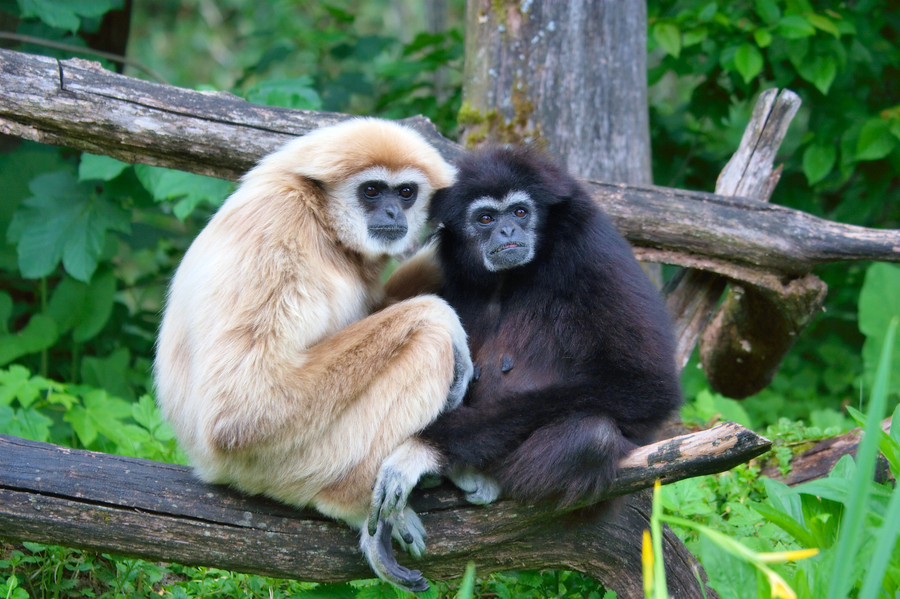
The white-handed gibbon (Hylobates lar) is a mammal of the family Hylobatidae, in the order Primates.
Quick answer
The white-handed gibbon (Hylobates lar) is a small, tailless ape of the rainforest canopy in Thailand, Malaysia, and Sumatra. Weighing only 5 to 7 kg, it swings through the treetops by its long arms and can move at up to 56 km/h. Pairs are famous for their loud, musical duets and can live 25 to 30 years in the wild. The species is listed as Endangered.
Top questions about the White-handed Gibbon
Also available in Español (Gibón de manos blancas)
White-handed Gibbon facts at a glance
- Weight 7 kg
- Length 90 cm
- Top speed 56 km/h
- Lifespan 30 years
| Scientific name | Hylobates lar |
|---|---|
| Diet | Frugivore — ripe fruit, leaves, flowers, and insects |
| Habitat | Tropical rainforests of Thailand, Malaysia, and Sumatra |
| Lifespan | 25–30 years in the wild |
| Weight | 5–7 kg (11–15 lb); males and females similar size |
| Top speed | Up to 56 km/h (35 mph) when brachiating |
| Conservation status | Endangered (IUCN) |
| Kingdom | Animalia |
|---|---|
| Phylum | Chordata |
| Class | Mammalia |
| Order | Primates |
| Family | Hylobatidae |
| Genus | Hylobates |
Where it lives
The white-handed gibbon (Hylobates lar) is native to White-handed gibbon in Thailand, Malaysia, Sumatra, and peninsular Southeast Asian rainforests. — recorded across Asia in this guide’s range summary.
For occurrence records, see GBIF species search and sources below.
How big is a white-handed gibbon?
An adult white-handed gibbon measures 90 cm long — about 52% of the height of an average adult person (1.73 m) — and weighs around 7.0 kg, about 10% of an average adult’s body weight (70 kg).
Length vs an average adult’s height (to scale)
What is a group of white-handed gibbons called?
Group name (collective noun)
A group of White-handed Gibbons is called a troop.
Baby name
A baby White-handed Gibbon is called an infant.
Explore more animal collective nouns and baby animal names .
Life in the canopy
White-handed gibbons spend almost their entire lives high in the rainforest canopy, rarely coming down to the ground. Their long arms, hook-like hands, and lightweight bodies of just 5 to 7 kg make them supremely agile among the branches. They are not monkeys but small apes, lacking a tail and instead relying on balance and their powerful shoulders to move. Their fur ranges from cream to dark brown, but the hands and feet are always pale, giving the species its name.
Brachiation: swinging through the trees
Gibbons are the fastest and most acrobatic of the tree-swinging apes, moving by a hand-over-hand technique called brachiation. Swinging beneath the branches, a white-handed gibbon can travel at up to 56 km/h and clear gaps of several metres in a single leap. Its ball-and-socket wrist joint lets the hand rotate freely, so momentum carries it smoothly from one hold to the next. This graceful, gravity-defying travel is far more efficient than climbing for an animal living in the treetops.
Singing duets
White-handed gibbons are among the most vocal of all apes, and mated pairs perform elaborate morning duets that ring through the forest. The female typically leads with a rising, whooping call known as the great call, while the male adds his own phrases. These songs advertise the pair's bond and warn rival gibbons away from their territory. A duet can carry for over a kilometre through dense rainforest, letting neighbours locate one another without meeting.
Diet and daily routine
Gibbons are mainly frugivores, favouring ripe fruit and supplementing it with young leaves, flowers, and the occasional insect. They forage by day, moving through a familiar home range and often returning to favourite fruiting trees. Because they seek out ripe fruit scattered across the canopy, they range widely each day in search of the best food. In the cool of midday they rest high in the branches before feeding again in the afternoon.
Family life
White-handed gibbons live in small family groups built around a bonded adult pair and their offspring. Both parents help defend the territory, and young gibbons stay with the family for several years before leaving to find mates of their own. A single infant is born after a long gestation and clings to its mother as she swings through the canopy. In the wild these apes can live 25 to 30 years, growing slowly and investing heavily in each youngster.
Why it is endangered
The white-handed gibbon is listed as Endangered by the IUCN, and its numbers are falling. The greatest threat is the loss of tropical rainforest to logging, agriculture, and palm-oil plantations, which fragments the continuous canopy these apes depend on. Gibbons are also captured for the illegal pet trade, with infants often taken after their mothers are killed. Protecting large, connected areas of intact rainforest is essential to their survival.
Dig deeper into the White-handed Gibbon
- Are White-handed Gibbons Endangered?
Are white-handed gibbons endangered? Status Endangered, main threats, and what protection means.
- White-handed Gibbon: Key Facts
The white-handed gibbon is an acrobatic ape that brachiates through Southeast Asian rainforests, covering 3 metres per second hand-over-hand.
- How Long Do White-handed Gibbons Live?
White-handed Gibbon lifespan is typically 25–30 years in the wild. What shortens or extends life, life stages, and status (Endangered).
- What Do White-handed Gibbons Eat?
What white-handed gibbons eat: Frugivore — ripe fruit, leaves, flowers, and insects, foraging style, and seasonal shifts in Tropical rainforests of Thailand, Malaysia, and Sumatra.
- Where Do White-handed Gibbons Live?
Where white-handed gibbons live: Tropical rainforests of Thailand, Malaysia, and Sumatra, native range cues, and human overlap. Status Endangered.
Explore the White-handed Gibbon
Compare
Close relatives
- Mountain Gorilla Same order
- Aye-aye Same order
- Japanese Macaque Same order
- Gorilla Same order
Collections
Range & geography
Did you know? White-handed Gibbon facts
- White-handed gibbons are acrobatic apes that brachiate through Southeast Asian rainforests.
- Gibbons are apes without tails, with longer arms and more complex pair bonding.
- Most gibbon species are threatened by deforestation and pet trade.
- Conservation: Endangered.
Diet & feeding
White-handed Gibbon feeds primarily as a fruit, leaves, insects.
Adaptations
- Gibbons swing hand-over-hand at speeds that cover 3 metres per second.
- Mated pairs sing coordinated morning duets audible over a kilometre away.
Behaviour & ecology
- Gibbons swing hand-over-hand at speeds that cover 3 metres per second.
- Mated pairs sing coordinated morning duets audible over a kilometre away.
Communication
- White-handed Gibbon uses scent, posture, and vocal signals to mark territory and coordinate social behaviour.
- Communication intensity often peaks during breeding seasons and territorial disputes.
Habitat & range
Tropical rainforests of Southeast Asia
Ecological role
White-handed Gibbon plays a recognised ecological role in tropical rainforests of southeast asia.
Conservation status of the White-handed Gibbon
The white-handed gibbon (Hylobates lar) is listed as Endangered on the IUCN Red List. Endangered (EN) means a species faces a very high risk of extinction in the wild. Populations are usually declining sharply due to habitat loss, hunting, disease, or climate pressure. It sits one level below Critically Endangered on the IUCN Red List.
Main threats to the white-handed gibbon
- Forest loss and fragmentation
- Hunting and the pet trade
- Infrastructure cutting canopy corridors
- Low reproductive rate limiting recovery
White-handed Gibbon (Hylobates lar) was most recently assessed for the IUCN Red List in 2020. View the full IUCN assessment .
Frequently asked questions about the White-handed Gibbon
Is a gibbon a monkey or an ape?
A gibbon is an ape, not a monkey. Like other apes it has no tail, and it belongs to the group known as the lesser apes, which are smaller and more agile than the great apes such as gorillas and chimpanzees.
How fast can a gibbon move through the trees?
A white-handed gibbon can swing through the canopy at up to 56 km/h (35 mph) using a hand-over-hand motion called brachiation. It can also leap several metres between branches in a single bound.
Why do gibbons sing?
Mated pairs sing loud, musical duets to strengthen their bond and to warn rival gibbons away from their territory. The songs can carry more than a kilometre through the forest, allowing neighbouring pairs to locate each other.
What do white-handed gibbons eat?
They are mainly frugivores, feeding on ripe fruit and adding young leaves, flowers, and the occasional insect to their diet. They travel widely through the canopy each day to reach fruiting trees.
How long do gibbons live?
White-handed gibbons typically live 25 to 30 years in the wild. They mature slowly and raise their young over several years within a close family group.
Why are gibbons endangered?
White-handed gibbons are Endangered mainly because of the loss and fragmentation of their rainforest habitat to logging, farming, and palm-oil plantations. They are also captured for the illegal pet trade, which further reduces wild populations.
What is a group of white-handed gibbons called?
A group of White-handed Gibbons is called a troop.
What is a baby white-handed gibbon called?
A baby White-handed Gibbon is called an infant.
Sources & references
This guide is compiled and reviewed against established zoological and conservation references. Key sources for the White-handed Gibbon:
-
IUCN Red List of Threatened Species
Conservation status (Endangered) reflects the IUCN Red List category for Hylobates lar, most recently assessed in 2020.
-
iNaturalist — observations & photos
Search citizen-science observations and community IDs for Hylobates lar. Useful for range checks and recent sightings — not a substitute for formal Red List status.
-
GBIF — occurrence data
Global Biodiversity Information Facility species search for Hylobates lar. Explore published occurrence records used in range research.
- IUCN Red List — Hylobates lar.
Conservation status (Endangered) and population trends.
- Animal Diversity Web — Hylobates lar. University of Michigan Museum of Zoology.
Life history, morphology, and range.
-
Global Animal Guide editorial standards
How we research, source, review, and update every guide for accuracy.