Image sourcing: see credits & licences
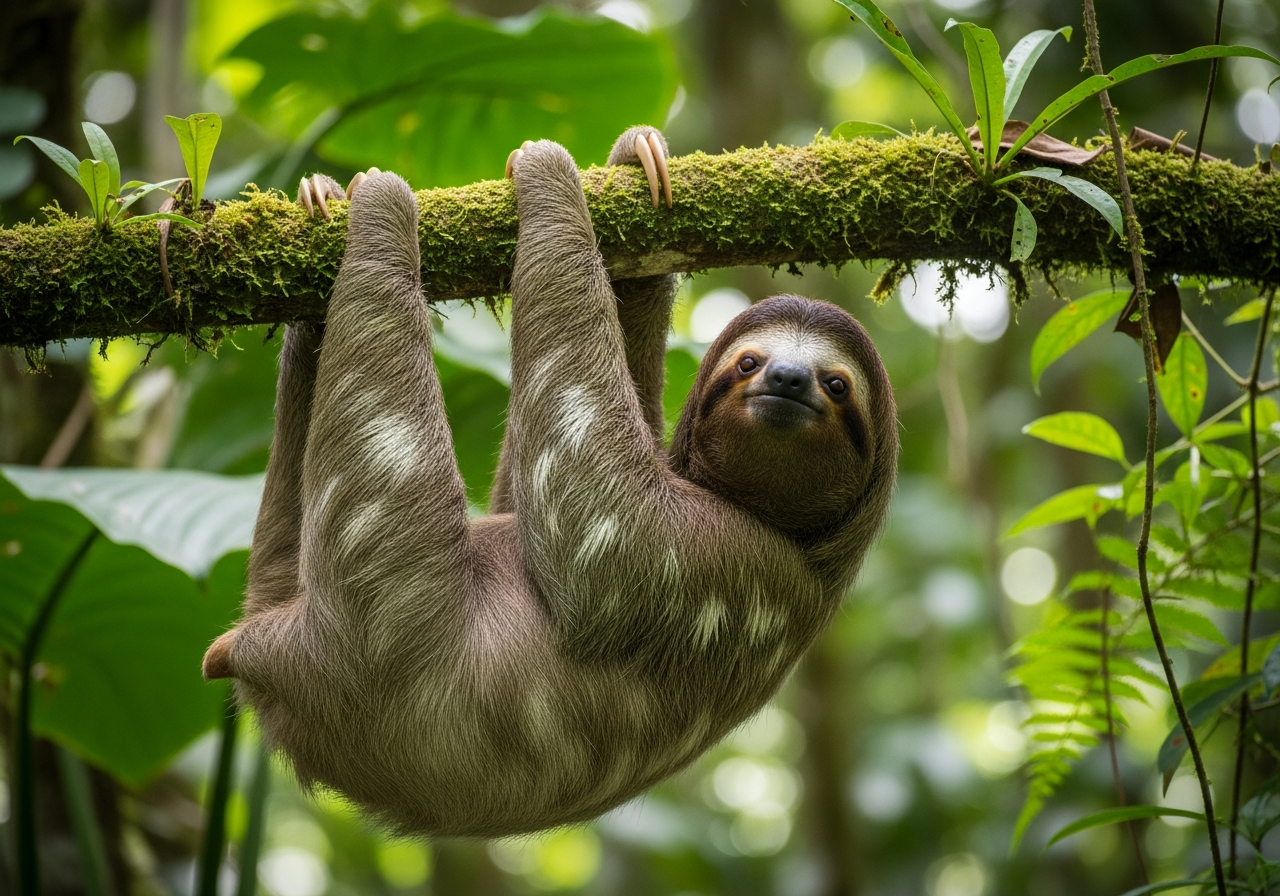
The sloth (Bradypus variegatus) is a mammal of the family Bradypodidae, in the order Pilosa.
Quick answer
Sloths are slow-moving tree-dwelling mammals native to the rainforests of Central and South America. They move at around 0.3 km/h (0.2 mph) and sleep up to 15 to 20 hours a day to conserve energy on a low-calorie leaf diet. Wild sloths typically live around 20 years.
Top questions about the Sloth
Also available in Español (Perezoso)
Sloth facts at a glance
- Weight 5 kg
- Length 60 cm
- Top speed 0 km/h
- Lifespan 20 years
| Scientific name | Bradypus variegatus |
|---|---|
| Diet | Herbivore (folivore) |
| Habitat | Tropical rainforest canopy |
| Lifespan | Around 20 years in the wild |
| Weight | 3.5–6 kg (8–13 lb) |
| Top speed | About 0.3 km/h (0.2 mph) |
| Conservation status | Least Concern (IUCN) |
| Kingdom | Animalia |
|---|---|
| Phylum | Chordata |
| Class | Mammalia |
| Order | Pilosa |
| Family | Bradypodidae |
| Genus | Bradypus |
Where it lives
The sloth (Bradypus variegatus) is native to The lowland and montane rainforest canopies of Central and South America. — recorded across South America, North America in this guide’s range summary.
For occurrence records, see GBIF species search and sources below.
How big is a sloth?
An adult sloth measures 60 cm long — about 35% of the height of an average adult person (1.73 m) — and weighs around 5.0 kg, about 7% of an average adult’s body weight (70 kg).
Length vs an average adult’s height (to scale)
What is a group of sloths called?
Group name (collective noun)
A group of Sloths is called a bed.
Baby name
A baby Sloth is called a baby.
Explore more animal collective nouns and baby animal names .
Built for a slow life
Sloths live life in slow motion to survive on a diet of leaves, which provide very little energy. They have an extremely slow metabolism and can take up to a month to digest a single meal. Their slow movements also make them nearly invisible to predators such as eagles and big cats, which hunt by detecting motion.
Life in the canopy
Sloths spend almost their entire lives hanging upside down in the rainforest canopy, gripping branches with long, curved claws. Their fur grows in the opposite direction to most mammals so rain runs off, and it often hosts algae that gives them a greenish tint and helps them blend into the leaves.
A surprising weekly routine
Despite living in trees, sloths climb all the way to the ground about once a week to defecate, one of the few times they are exposed to ground predators. They are also surprisingly capable swimmers, moving through water far faster than they ever move on land.
Conservation
Most sloth species are listed as Least Concern, but they depend heavily on continuous forest. Deforestation, road building, and power lines are growing threats, and rescue centers across Central and South America help rehabilitate injured and orphaned sloths.
Dig deeper into the Sloth
- How Long Do Sloths Live?
Sloth lifespan is typically Around 20 years in the wild. What shortens or extends life, life stages, and status (Least Concern).
- Sloth: Key Facts
Sloths are slow-moving tree-dwelling mammals native to the rainforests of Central and South America.
- What Do Sloths Eat?
What sloths eat: Herbivore (folivore), foraging style, and seasonal shifts in Tropical rainforest canopy.
- Where Do Sloths Live?
Where sloths live: Tropical rainforest canopy, native range cues, and human overlap. Status Least Concern.
Explore the Sloth
Close relatives
- Giant Anteater Same order
- Lion Same class
- Dog Same class
- Tiger Same class
Range & geography
Did you know? Sloth facts
- Sloths are so slow that algae grows on their fur, helping camouflage them.
- They can take a month to digest a single leaf-based meal.
- Sloths descend from the canopy only about once a week to defecate.
- Despite being slow on land, sloths are surprisingly capable swimmers.
- Their long claws make them awkward walkers but excellent hangers.
- Sloths have an unusually low and variable body temperature for a mammal.
Diet & feeding
Three-toed sloths are leaf specialists, while two-toed sloths take a broader diet of leaves, fruit, and buds; their slow digestion suits the low energy of foliage.
Adaptations
- A very low metabolic rate conserves energy on a nutrient-poor leaf diet.
- Long, curved claws lock onto branches, letting sloths hang with little effort.
- Algae-hosting grooved fur provides green camouflage in the canopy.
- Extra neck vertebrae let some sloths rotate the head far to scan for danger.
Behaviour & ecology
- Sloths are slow-moving, largely solitary, and spend most of life hanging in trees.
- They move and feed slowly to minimise energy use and avoid detection.
- Weekly descents to the ground to defecate are a rare and risky behaviour.
- Two-toed sloths are more nocturnal, three-toed more active by day.
Communication
- Sloths are mostly silent; females may give a shrill call to attract mates.
- Scent left at latrine sites may convey reproductive information.
- Slow movements and camouflage substitute for active signalling.
Habitat & range
Sloths inhabit the tropical rainforests of Central and South America, living high in the canopy where leaves, buds, and cover are abundant.
Ecological role
Sloths are slow-burning canopy herbivores whose fur hosts a miniature ecosystem of algae and invertebrates, and they help cycle nutrients in rainforest systems.
Conservation status of the Sloth
The sloth (Bradypus variegatus) is listed as Least Concern on the IUCN Red List. Least Concern (LC) is the IUCN's lowest-risk category, assigned to widespread, abundant species that have been evaluated and found not to be threatened. It does not mean a species faces no pressures — only that it is not currently at risk of extinction.
The sloth (Bradypus variegatus) is assessed on the IUCN Red List. Look up on the IUCN Red List .
Frequently asked questions about the Sloth
Why are sloths so slow?
Sloths are slow because they live on a low-energy diet of leaves and have a very slow metabolism. Moving slowly conserves energy and also helps them avoid predators that hunt by spotting movement.
What do sloths eat?
Sloths are mainly herbivores that eat leaves, buds, and tender shoots. Their diet provides little energy, which is why they digest food slowly and rest for most of the day.
How long do sloths sleep?
Wild sloths sleep roughly 15 hours a day, and some estimates run higher. They spend most of their waking hours resting or feeding slowly in the canopy.
Can sloths swim?
Yes. Sloths are surprisingly good swimmers and can move through water several times faster than they move on land, using their long arms to paddle.
How long do sloths live?
Wild sloths typically live around 20 years. In captivity, with reliable food and care, some sloths have lived into their 30s and beyond.
What is a group of sloths called?
A group of Sloths is called a bed.
What is a baby sloth called?
A baby Sloth is called a baby.
Sources & references
This guide is compiled and reviewed against established zoological and conservation references. Key sources for the Sloth:
-
IUCN Red List of Threatened Species
Conservation status (Least Concern) reflects the IUCN Red List category for Bradypus variegatus.
-
iNaturalist — observations & photos
Search citizen-science observations and community IDs for Bradypus variegatus. Useful for range checks and recent sightings — not a substitute for formal Red List status.
-
GBIF — occurrence data
Global Biodiversity Information Facility species search for Bradypus variegatus. Explore published occurrence records used in range research.
- Superina, M. et al. (2014). Sloth assessments. IUCN Red List of Threatened Species.
Status varies by species.
- Animal Diversity Web — Bradypus (three-toed sloth). University of Michigan Museum of Zoology.
Life history, morphology, and range.
- Nowak, R. M. (1999). Walker's Mammals of the World (6th ed.). Johns Hopkins University Press.
Physiology and behaviour.
-
Global Animal Guide editorial standards
How we research, source, review, and update every guide for accuracy.