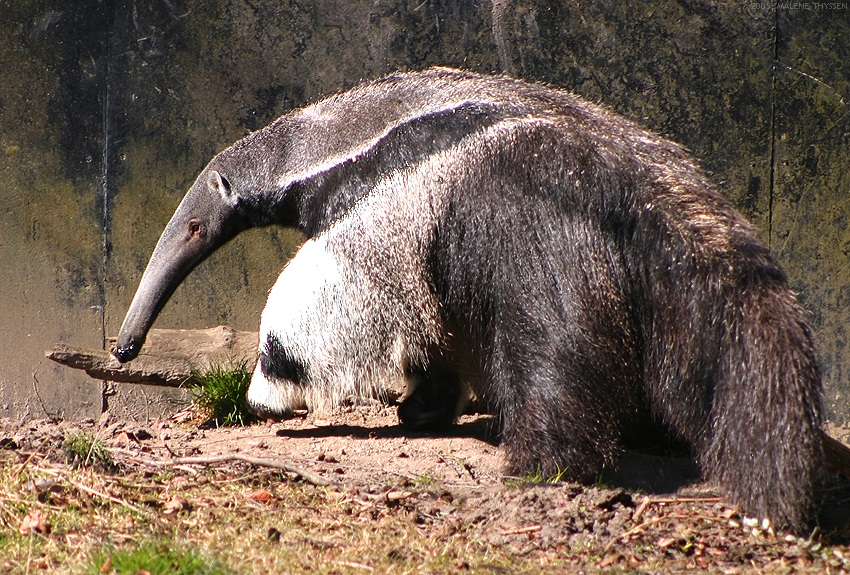
The giant anteater (Myrmecophaga tridactyla) is a mammal of the family Myrmecophagidae, in the order Pilosa.
Quick answer
The giant anteater is a unmistakable mammal with a long snout, bushy tail, and front claws used to tear open termite mounds. Its tongue extends up to 60 cm and flicks 150 times per minute into insect nests. Listed Vulnerable, it walks on knuckles to protect claws and carries single offspring on its back.
Top questions about the Giant Anteater
Also available in Español (Oso hormiguero gigante)
Giant Anteater facts at a glance
- Weight 40 kg
- Length 2.1 m
- Top speed 30 km/h
- Lifespan 16 years
| Scientific name | Myrmecophaga tridactyla |
|---|---|
| Diet | Insectivore — ants and termites |
| Habitat | Grasslands, savannas, and forests of Central and South America |
| Lifespan | 14–16 years in the wild |
| Weight | 33–50 kg (73–110 lb) |
| Top speed | Up to 30 km/h (19 mph) in gallop |
| Conservation status | Vulnerable (IUCN) |
| Kingdom | Animalia |
|---|---|
| Phylum | Chordata |
| Class | Mammalia |
| Order | Pilosa |
| Family | Myrmecophagidae |
| Genus | Myrmecophaga |
Where it lives
The giant anteater (Myrmecophaga tridactyla) is native to Grasslands, savannas, and open forests from Guatemala and Honduras south through Brazil, Paraguay, and Bolivia. — recorded across North America, South America in this guide’s range summary.
For occurrence records, see GBIF species search and sources below.
How big is a giant anteater?
An adult giant anteater measures 2.1 m long — about 1.2× the height of an average adult person (1.73 m) — and weighs around 40 kg, about 57% of an average adult’s body weight (70 kg).
Length vs an average adult’s height (to scale)
What is a group of giant anteaters called?
Group name (collective noun)
A group of Giant Anteaters is called a parade.
Baby name
A baby Giant Anteater is called a pup.
Explore more animal collective nouns and baby animal names .
Tongue mechanics
The sticky tongue is attached to the sternum and can extend 60 cm — longer than the skull — with no teeth in the tubular mouth. A giant anteater consumes up to 30,000 insects daily but spends only seconds at each nest to avoid soldier ant stings.
Knuckle walking and claws
Front claws up to 10 cm long tear concrete-hard termite mounds but would wear on pavement-like ground, so anteaters walk on their knuckles. When threatened, they rear up on hind legs and slash — capable of deterring jaguars and killing humans in rare encounters.
Mother and riding young
Females bear a single offspring that clings to the mother's back for up to a year, camouflaged by matching striping. Mothers are protective and may carry the young even while foraging.
Roadkill and habitat loss
Listed Vulnerable, giant anteaters are killed by vehicles crossing roads in Brazil's cerrado and by habitat conversion to soy and cattle pasture. Fire in grassland savannas also kills slow-moving individuals.
Dig deeper into the Giant Anteater
- Are Giant Anteaters Endangered?
Are giant anteaters endangered? Status Vulnerable, main threats, and what protection means.
- Giant Anteater: Key Facts
The giant anteater is a unmistakable mammal with a long snout, bushy tail, and front claws used to tear open termite mounds.
- How Long Do Giant Anteaters Live?
Giant Anteater lifespan is typically 14–16 years in the wild. What shortens or extends life, life stages, and status (Vulnerable).
- What Do Giant Anteaters Eat?
What giant anteaters eat: Insectivore — ants and termites, foraging style, and seasonal shifts in Grasslands, savannas, and forests of Central and South America.
- Where Do Giant Anteaters Live?
Where giant anteaters live: Grasslands, savannas, and forests of Central and South America, native range cues, and human overlap. Status Vulnerable.
Explore the Giant Anteater
Collections
Range & geography
Did you know? Giant Anteater facts
- The giant anteater is a unmistakable mammal with a long snout, bushy tail, and front claws used to tear open termite mounds.
- They avoid certain species with painful stings and move between nests, taking only seconds at each to limit bites.
- Vulnerable — declining from habitat loss, road mortality, and hunting in parts of Central America.
- Similar ecological niche but unrelated — anteaters are from the Americas (Xenarthra); aardvarks are African. Both eat ants but differ in anatomy.
- They can deter jaguars with slashing claws when standing on hind legs — jaguars sometimes prey on them but respect the defence.
- Conservation: Vulnerable (IUCN).
Diet & feeding
Giant Anteater feeds primarily as a insectivore — ants and termites. The sticky tongue is attached to the sternum and can extend 60 cm — longer than the skull — with no teeth in the tubular mouth. A giant anteater consumes up to 30,000 insects daily but spends only seconds at each nest to avoid soldier ant stings.
Adaptations
- The sticky tongue is attached to the sternum and can extend 60 cm — longer than the skull — with no teeth in the tubular mouth. A giant anteater consumes up to 30,000 insects daily but spends only seconds at each nest to avoid soldier ant stings.
- Front claws up to 10 cm long tear concrete-hard termite mounds but would wear on pavement-like ground, so anteaters walk on their knuckles. When threatened, they rear up on hind legs and slash — capable of deterring jaguars and killing humans in rare encounters.
Behaviour & ecology
- The sticky tongue is attached to the sternum and can extend 60 cm — longer than the skull — with no teeth in the tubular mouth. A giant anteater consumes up to 30,000 insects daily but spends only seconds at each nest to avoid soldier ant stings.
- Front claws up to 10 cm long tear concrete-hard termite mounds but would wear on pavement-like ground, so anteaters walk on their knuckles. When threatened, they rear up on hind legs and slash — capable of deterring jaguars and killing humans in rare encounters.
- Females bear a single offspring that clings to the mother's back for up to a year, camouflaged by matching striping. Mothers are protective and may carry the young even while foraging.
Communication
- Giant Anteater uses scent, posture, and vocal signals to mark territory and coordinate social behaviour.
- Communication intensity often peaks during breeding seasons and territorial disputes.
Habitat & range
Grasslands, savannas, and forests of Central and South America
Ecological role
Giant Anteater plays a recognised ecological role in grasslands, savannas, and forests of central and south america.
Conservation status of the Giant Anteater
The giant anteater (Myrmecophaga tridactyla) is listed as Vulnerable on the IUCN Red List. Vulnerable (VU) means a species faces a high risk of extinction in the medium-term future. It is the lowest-risk of the three 'threatened' IUCN categories — one step below Endangered, which is itself below Critically Endangered — and is often an early warning that a population is in trouble.
Main threats to the giant anteater
- Habitat loss from agriculture and fire
- Road mortality
- Hunting
- Wildfires in grassland and savanna
Giant Anteater (Myrmecophaga tridactyla) was most recently assessed for the IUCN Red List in 2014. View the full IUCN assessment .
Frequently asked questions about the Giant Anteater
Do anteaters eat all ants?
They avoid certain species with painful stings and move between nests, taking only seconds at each to limit bites.
Are giant anteaters endangered?
Vulnerable — declining from habitat loss, road mortality, and hunting in parts of Central America.
Giant anteater vs aardvark?
Similar ecological niche but unrelated — anteaters are from the Americas (Xenarthra); aardvarks are African. Both eat ants but differ in anatomy.
Can anteaters fight jaguars?
They can deter jaguars with slashing claws when standing on hind legs — jaguars sometimes prey on them but respect the defence.
Where do giant anteaters live?
From Honduras and Guatemala south through Brazil, Paraguay, and Bolivia — mainly savanna and open woodland.
What is a group of giant anteaters called?
A group of Giant Anteaters is called a parade.
What is a baby giant anteater called?
A baby Giant Anteater is called a pup.
Sources & references
This guide is compiled and reviewed against established zoological and conservation references. Key sources for the Giant Anteater:
-
IUCN Red List of Threatened Species
Conservation status (Vulnerable) reflects the IUCN Red List category for Myrmecophaga tridactyla, most recently assessed in 2014.
-
iNaturalist — observations & photos
Search citizen-science observations and community IDs for Myrmecophaga tridactyla. Useful for range checks and recent sightings — not a substitute for formal Red List status.
-
GBIF — occurrence data
Global Biodiversity Information Facility species search for Myrmecophaga tridactyla. Explore published occurrence records used in range research.
- IUCN Red List — Myrmecophaga tridactyla.
Conservation status (Vulnerable) and population trends.
- Animal Diversity Web — Myrmecophaga tridactyla. University of Michigan Museum of Zoology.
Life history, morphology, and range.
- Wikipedia — Giant Anteater.
General taxonomy and overview (cross-check primary sources).
-
Global Animal Guide editorial standards
How we research, source, review, and update every guide for accuracy.