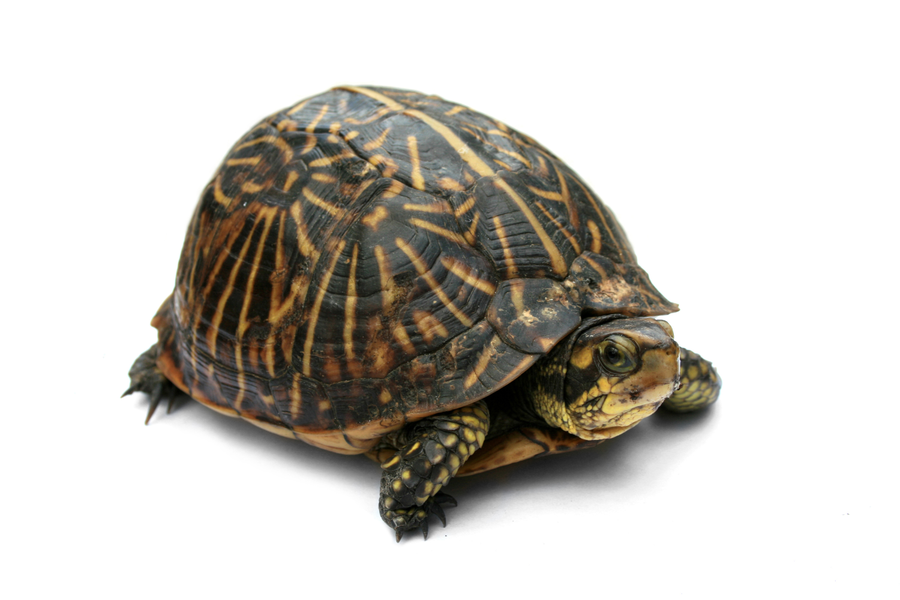
The eastern box turtle (Terrapene carolina) is a reptile of the family Emydidae, in the order Testudines.
Quick answer
The eastern box turtle (Terrapene carolina) is a small, land-dwelling turtle of the eastern United States, known for the hinged shell it can close like a box for protection. It lives in woodlands, meadows, and wetlands, eating insects, fruit, mushrooms, and carrion. Barely 15 cm long and weighing around half a kilogram, it is a famously slow, long-lived reptile that can survive 50 to 100 years. The IUCN lists it as Vulnerable.
Top questions about the Eastern Box Turtle
Eastern Box Turtle facts at a glance
- Weight 500 g
- Length 15 cm
- Top speed 1 km/h
- Lifespan 50 years
| Scientific name | Terrapene carolina |
|---|---|
| Diet | Omnivore — insects, fruit, mushrooms, and carrion |
| Habitat | Eastern US woodlands, meadows, and wetlands |
| Lifespan | 50–100 years (long-lived turtle) |
| Weight | 0.3–0.6 kg (0.7–1.3 lb); high-domed shell |
| Top speed | Up to 0.5 km/h (0.3 mph); slow walker |
| Conservation status | Vulnerable (IUCN) |
| Kingdom | Animalia |
|---|---|
| Phylum | Chordata |
| Class | Reptilia |
| Order | Testudines |
| Family | Emydidae |
| Genus | Terrapene |
Where it lives
The eastern box turtle (Terrapene carolina) is native to Eastern United States from Maine to Florida and west to Texas and Michigan in woodlands and meadows. — recorded across North America in this guide’s range summary.
For occurrence records, see GBIF species search and sources below.
How big is a eastern box turtle?
An adult eastern box turtle measures 15 cm long — about 9% of the height of an average adult person (1.73 m) — and weighs around 500 g, about 1% of an average adult’s body weight (70 kg).
Length vs an average adult’s height (to scale)
What is a group of eastern box turtles called?
Group name (collective noun)
A group of Eastern Box Turtles is called a bale.
Baby name
A baby Eastern Box Turtle is called a hatchling.
Explore more animal collective nouns and baby animal names .
The hinged shell
The box turtle takes its name from the hinge across its lower shell, or plastron, which lets it fold the front and back sections tightly shut. Pulled into its high-domed shell, the turtle can seal itself completely inside, leaving no soft parts exposed to a predator. This living armour is its main defence, since it is far too slow to flee from danger. The shell also bears colourful yellow or orange markings that vary from turtle to turtle.
Diet and feeding
Eastern box turtles are omnivores with a varied appetite that changes as they grow. Young turtles lean heavily towards animal prey such as insects, worms, and snails, while adults eat more plant matter, including fruit and mushrooms. They will also scavenge carrion when they find it. Remarkably, box turtles can eat certain fungi that are toxic to humans without coming to harm.
Habitat and home range
The species lives in the woodlands, meadows, and wetlands of the eastern United States, favouring moist, leafy ground with plenty of cover. Individual turtles are strongly tied to a small home range, often only a few hectares, which they may occupy for their entire lives. This deep attachment to home means a turtle moved far away will try to travel back, frequently dying on roads in the attempt. On hot days they shelter in leaf litter, logs, or shallow pools to stay cool and moist.
Longevity and reproduction
Box turtles are among the longest-lived of small reptiles, commonly reaching 50 years and sometimes approaching a century. They mature slowly, often taking several years to reach breeding age. After mating, the female digs a nest in soft soil and lays a small clutch of eggs, then leaves them to incubate unattended. Only a few hatchlings survive to adulthood, so the loss of even a handful of breeding adults can hurt a population.
Hibernation
In the colder parts of its range, the eastern box turtle spends winter in a state of dormancy. As temperatures drop it burrows into loose soil, leaf litter, or the mud of pond edges and slows its body down to survive the freeze. It can even tolerate small amounts of ice forming in its tissues without dying. When the ground warms in spring, the turtle emerges to resume feeding and breeding.
Why it is Vulnerable
The eastern box turtle is listed as Vulnerable by the IUCN, and its slow life history makes it hard to recover from losses. Habitat destruction, road deaths, and collection for the pet trade all take a steady toll on wild populations. Because the turtles breed slowly and rely on many years of adult survival, even modest ongoing losses cause long-term decline. Keeping woodland habitats connected and leaving wild turtles where they are found both help the species persist.
Dig deeper into the Eastern Box Turtle
- Are Eastern Box Turtles Endangered?
Are eastern box turtles endangered? Status Vulnerable, main threats, and what protection means.
- Eastern Box Turtle: Key Facts
Eastern box turtles close their hinged plastron completely when threatened, weighing about 0.5 kg and living 50–100 years.
- How Long Do Eastern Box Turtles Live?
Eastern Box Turtle lifespan is typically 50–100 years (long-lived turtle). What shortens or extends life, life stages, and status (Vulnerable).
- What Do Eastern Box Turtles Eat?
What eastern box turtles eat: Omnivore — insects, fruit, mushrooms, and carrion, foraging style, and seasonal shifts in Eastern US woodlands, meadows, and wetlands.
- Where Do Eastern Box Turtles Live?
Where eastern box turtles live: Eastern US woodlands, meadows, and wetlands, native range cues, and human overlap. Status Vulnerable.
Explore the Eastern Box Turtle
Close relatives
- Painted Turtle Same family
- Leatherback Sea Turtle Same order
- Hawksbill Sea Turtle Same order
- Alligator Snapping Turtle Same order
Collections
Range & geography
Did you know? Eastern Box Turtle facts
- Eastern box turtles close their hinged plastron completely like a box when threatened.
- 50–100 years with records over a century.
- Often illegal and harmful — wild turtles struggle in captivity.
- Conservation: Vulnerable.
Diet & feeding
Eastern Box Turtle feeds primarily as a omnivore — insects, fruit, mushrooms.
Adaptations
- A hinge on the plastron seals the turtle inside completely.
- Slow crossings make box turtles vulnerable to vehicles.
Behaviour & ecology
- A hinge on the plastron seals the turtle inside completely.
- Slow crossings make box turtles vulnerable to vehicles.
Communication
- Scent marking, body posture, and head-bobbing or tail signals communicate threat and dominance.
- Vocalisations are limited in many reptiles but hissing or bellowing occurs in some groups.
Habitat & range
Eastern US woodlands and meadows
Ecological role
Eastern Box Turtle plays a recognised ecological role in eastern us woodlands and meadows.
Conservation status of the Eastern Box Turtle
The eastern box turtle (Terrapene carolina) is listed as Vulnerable on the IUCN Red List. Vulnerable (VU) means a species faces a high risk of extinction in the medium-term future. It is the lowest-risk of the three 'threatened' IUCN categories — one step below Endangered, which is itself below Critically Endangered — and is often an early warning that a population is in trouble.
The eastern box turtle (Terrapene carolina) is assessed on the IUCN Red List. Look up on the IUCN Red List .
Frequently asked questions about the Eastern Box Turtle
Why is it called a box turtle?
It is named for the hinge across its lower shell, which lets the turtle fold the shell shut like a box. Sealed inside its high-domed shell, it can hide every soft part from predators, its main defence against attack.
What do eastern box turtles eat?
They are omnivores. Young turtles eat mostly insects, worms, and snails, while adults take more fruit and mushrooms, and both will scavenge carrion. They can safely eat some fungi that are poisonous to people.
How long do box turtles live?
Eastern box turtles are remarkably long-lived, commonly reaching 50 years and sometimes nearing 100. They grow and mature slowly, so a wild population depends on adults surviving for many decades.
How big do eastern box turtles get?
They are small turtles, only about 15 cm long and weighing roughly 0.3 to 0.6 kg. Their shell is distinctively high and domed, marked with variable yellow or orange patterns.
Why should you not move a box turtle?
Box turtles are strongly attached to a small home range they may keep for life. A turtle carried away will try to return, often dying on roads in the attempt, so wild ones are best left exactly where they are found.
Are eastern box turtles endangered?
They are listed as Vulnerable by the IUCN. Habitat loss, road deaths, and collection for the pet trade steadily reduce their numbers, and their very slow breeding makes recovery from these losses difficult.
What is a group of eastern box turtles called?
A group of Eastern Box Turtles is called a bale.
What is a baby eastern box turtle called?
A baby Eastern Box Turtle is called a hatchling.
Sources & references
This guide is compiled and reviewed against established zoological and conservation references. Key sources for the Eastern Box Turtle:
-
IUCN Red List of Threatened Species
Conservation status (Vulnerable) reflects the IUCN Red List category for Terrapene carolina.
-
iNaturalist — observations & photos
Search citizen-science observations and community IDs for Terrapene carolina. Useful for range checks and recent sightings — not a substitute for formal Red List status.
-
GBIF — occurrence data
Global Biodiversity Information Facility species search for Terrapene carolina. Explore published occurrence records used in range research.
- IUCN Red List — Terrapene carolina.
Conservation status (Vulnerable) and population trends.
- Animal Diversity Web — Terrapene carolina. University of Michigan Museum of Zoology.
Life history, morphology, and range.
-
Global Animal Guide editorial standards
How we research, source, review, and update every guide for accuracy.