Image sourcing: see credits & licences
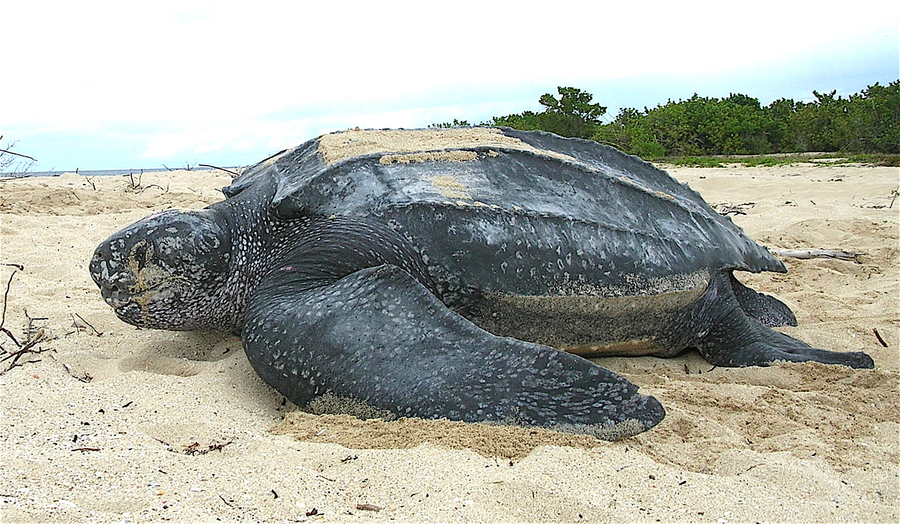
The leatherback sea turtle (Dermochelys coriacea) is a reptile of the family Dermochelyidae, in the order Testudines.
Quick answer
The leatherback is the largest sea turtle in the world and one of the widest-ranging reptiles, swimming across every ocean from the tropics to the cold edges of the Arctic. It reaches 1.8 m (6 ft) long, weighs 250 to 700 kg (550 to 1,540 lb) and feeds almost entirely on jellyfish. A strong swimmer, it can move at up to 35 km/h (22 mph) and lives around 40 to 45 years. The IUCN lists it as Vulnerable.
Top questions about the Leatherback Sea Turtle
Also available in Español (Tortuga laúd)
Leatherback Sea Turtle facts at a glance
- Weight 400 kg
- Length 1.8 m
- Top speed 35 km/h
- Lifespan 45 years
| Scientific name | Dermochelys coriacea |
|---|---|
| Diet | Carnivore — jellyfish and salps almost exclusively |
| Habitat | Oceans worldwide from tropics to Arctic edges |
| Lifespan | 40–45 years in the wild |
| Weight | 250–700 kg (550–1,540 lb); largest of all turtles |
| Top speed | Up to 35 km/h (22 mph) swimming |
| Conservation status | Vulnerable (IUCN) |
| Kingdom | Animalia |
|---|---|
| Phylum | Chordata |
| Class | Reptilia |
| Order | Testudines |
| Family | Dermochelyidae |
| Genus | Dermochelys |
Where it lives
The leatherback sea turtle (Dermochelys coriacea) is native to All oceans from Arctic edges to tropical nesting beaches — most wide-ranging sea turtle. — recorded across Africa, Asia, Europe, North America, Oceania, Oceans, South America in this guide’s range summary.
For occurrence records, see GBIF species search and sources below.
How big is a leatherback sea turtle?
An adult leatherback sea turtle measures 1.8 m long — about 1.0× the height of an average adult person (1.73 m) — and weighs around 400 kg, about 5.7× an average adult’s body weight (70 kg).
Length vs an average adult’s height (to scale)
What is a group of leatherback sea turtles called?
Group name (collective noun)
A group of Leatherback Sea Turtles is called a bale.
Baby name
A baby Leatherback Sea Turtle is called a hatchling.
Explore more animal collective nouns and baby animal names .
A shell like no other turtle
Unlike every other sea turtle, the leatherback has no hard bony shell. Instead its back is covered by a layer of tough, rubbery, oil-saturated skin over a mosaic of tiny bones, giving the animal its name. Seven raised ridges run the length of this teardrop-shaped body, streamlining it for a life of constant swimming. This flexible design lets the leatherback dive deeper than any other turtle, plunging beyond 1,000 m in search of prey.
The giant jellyfish specialist
The leatherback feeds almost exclusively on jellyfish and their relatives, the salps. Its throat is lined with backward-pointing spines that trap this slippery, gelatinous food and stop it slipping back out. Because jellyfish are mostly water, an adult must eat a huge volume every day to fuel its enormous body. This narrow diet leaves the turtle dangerously vulnerable to floating plastic bags, which it easily mistakes for a jellyfish and swallows.
Warm-blooded among reptiles
The leatherback is unusually good at keeping warm for a reptile, which is how it can feed in near-freezing water off Canada and Norway. Its large body, thick insulating fat and heat-generating muscles let it hold a core temperature well above the surrounding sea. This ability, sometimes called gigantothermy, makes it the most cold-tolerant of all turtles. It is one of the few reptiles regularly found in sub-polar waters.
Nesting and reproduction
Females return to tropical beaches every two to three years to nest, often crossing entire oceans to reach them. Over a single season a female may come ashore several times, each time digging a deep pit and laying around 80 fertile eggs. The temperature of the sand determines the sex of the hatchlings, with warmer nests producing more females. After about two months, palm-sized hatchlings dig their way out and scramble to the sea, where only a tiny fraction survive to adulthood.
An ocean traveller
Leatherbacks are among the most migratory of all animals, tracking blooms of jellyfish across thousands of kilometres of open ocean. Individuals tagged in the tropical Atlantic have been recorded feeding off the coasts of Canada and Europe within the same year. Powerful front flippers, which can span more than 2.5 m tip to tip, drive them along at speeds of up to 35 km/h. This wandering lifestyle spreads the species across a wider range than almost any other reptile.
Why it is threatened
The leatherback is listed as Vulnerable by the IUCN, and several regional populations have collapsed dramatically. The main threats are the harvesting of eggs, accidental capture in fishing gear, and the loss of nesting beaches to development and rising seas. Swallowed plastic and warming sand that skews hatchling sex ratios add further pressure. Protecting key nesting beaches and reducing bycatch are the most important steps for the species' recovery.
Dig deeper into the Leatherback Sea Turtle
- Are Leatherback Sea Turtles Endangered?
Are leatherback sea turtles endangered? Status Vulnerable, main threats, and what protection means.
- How Long Do Leatherback Sea Turtles Live?
Leatherback Sea Turtle lifespan is typically 40–45 years in the wild. What shortens or extends life, life stages, and status (Vulnerable).
- Leatherback Sea Turtle: Key Facts
Leatherbacks are the largest sea turtles — up to 700 kg with leathery shells and thermoregulation allowing cold-water foraging.
- What Do Leatherback Sea Turtles Eat?
What leatherback sea turtles eat: Carnivore — jellyfish and salps almost exclusively, foraging style, and seasonal shifts in Oceans worldwide from tropics to Arctic edges.
- Where Do Leatherback Sea Turtles Live?
Where leatherback sea turtles live: Oceans worldwide from tropics to Arctic edges, native range cues, and human overlap. Status Vulnerable.
Explore the Leatherback Sea Turtle
Close relatives
- Hawksbill Sea Turtle Same order
- Alligator Snapping Turtle Same order
- Loggerhead Sea Turtle Same order
- Eastern Box Turtle Same order
Collections
Did you know? Leatherback Sea Turtle facts
- Leatherbacks are the largest sea turtles — up to 700 kg with leathery shells and thermoregulation that lets them enter cold waters.
- A leathery carapace with ridges allows deep diving and flexibility.
- Up to 2 metres long and 700 kg — largest of all turtles.
- Conservation: Vulnerable.
Diet & feeding
Leatherback Sea Turtle feeds primarily as a jellyfish and salps. Leatherbacks dive over 1,000 metres pursuing jellyfish.
Adaptations
- Leatherbacks dive over 1,000 metres pursuing jellyfish.
- Plastic bags resemble jellyfish — ingestion kills many leatherbacks.
Behaviour & ecology
- Leatherbacks dive over 1,000 metres pursuing jellyfish.
- Plastic bags resemble jellyfish — ingestion kills many leatherbacks.
Communication
- Scent marking, body posture, and head-bobbing or tail signals communicate threat and dominance.
- Vocalisations are limited in many reptiles but hissing or bellowing occurs in some groups.
Habitat & range
Oceans worldwide
Ecological role
Leatherback Sea Turtle plays a recognised ecological role in oceans worldwide.
Conservation status of the Leatherback Sea Turtle
The leatherback sea turtle (Dermochelys coriacea) is listed as Vulnerable on the IUCN Red List. Vulnerable (VU) means a species faces a high risk of extinction in the medium-term future. It is the lowest-risk of the three 'threatened' IUCN categories — one step below Endangered, which is itself below Critically Endangered — and is often an early warning that a population is in trouble.
Main threats to the leatherback sea turtle
- Fisheries bycatch
- Egg harvest and nesting-beach disturbance
- Plastic ingestion and marine debris
- Climate change affecting nesting beaches
Leatherback Sea Turtle (Dermochelys coriacea) was most recently assessed for the IUCN Red List in 2013. View the full IUCN assessment .
Frequently asked questions about the Leatherback Sea Turtle
How big is a leatherback turtle?
Leatherbacks are the largest turtles on Earth. They reach about 1.8 m (6 ft) in length and weigh between 250 and 700 kg (550 to 1,540 lb), far heavier than any hard-shelled sea turtle.
What do leatherback turtles eat?
Leatherbacks eat almost nothing but jellyfish and their relatives, the salps. Backward-pointing spines in their throat help them grip and swallow this soft, slippery prey.
Why is it called a leatherback?
Unlike other sea turtles, it has no hard bony shell. Its back is covered by tough, leathery, rubbery skin over a layer of small bones, which is where the name comes from.
How long do leatherback turtles live?
Leatherbacks are thought to live around 40 to 45 years in the wild. Their exact lifespan is hard to measure because they spend almost their whole lives far out at sea.
How fast can a leatherback turtle swim?
Leatherbacks are powerful swimmers and can reach speeds of up to 35 km/h (22 mph). Their large front flippers, spanning over 2.5 m, propel them across entire oceans.
Are leatherback turtles endangered?
Leatherbacks are classified as Vulnerable by the IUCN, and some regional populations have declined sharply. Egg harvesting, accidental capture in fishing nets and the loss of nesting beaches are the biggest threats.
What is a group of leatherback sea turtles called?
A group of Leatherback Sea Turtles is called a bale.
What is a baby leatherback sea turtle called?
A baby Leatherback Sea Turtle is called a hatchling.
Sources & references
This guide is compiled and reviewed against established zoological and conservation references. Key sources for the Leatherback Sea Turtle:
-
IUCN Red List of Threatened Species
Conservation status (Vulnerable) reflects the IUCN Red List category for Dermochelys coriacea, most recently assessed in 2013.
-
iNaturalist — observations & photos
Search citizen-science observations and community IDs for Dermochelys coriacea. Useful for range checks and recent sightings — not a substitute for formal Red List status.
-
GBIF — occurrence data
Global Biodiversity Information Facility species search for Dermochelys coriacea. Explore published occurrence records used in range research.
- IUCN Red List — Dermochelys coriacea.
Conservation status (Vulnerable) and population trends.
- Animal Diversity Web — Dermochelys coriacea. University of Michigan Museum of Zoology.
Life history, morphology, and range.
-
Global Animal Guide editorial standards
How we research, source, review, and update every guide for accuracy.