Image sourcing: see credits & licences
The painted turtle (Chrysemys picta) is a reptile of the family Emydidae, in the order Testudines.
Quick answer
The painted turtle is a small, colourful freshwater turtle of ponds, lakes, and slow rivers across North America, named for the bright yellow and red markings on its skin and shell edges. It reaches about 18 cm and 0.2 to 0.4 kg, and is often seen basking in rows on logs. An omnivore that eats aquatic plants, insects, and small fish, it swims at up to 5 km/h and can live 25 to 35 years in the wild.
Top questions about the Painted Turtle
Painted Turtle facts at a glance
- Weight 300 g
- Length 18 cm
- Top speed 5 km/h
- Lifespan 35 years
| Scientific name | Chrysemys picta |
|---|---|
| Diet | Omnivore — aquatic plants, insects, and small fish |
| Habitat | Ponds, lakes, and slow rivers of North America |
| Lifespan | 25–35 years in the wild |
| Weight | 0.2–0.4 kg (0.4–0.9 lb); colourful stripes |
| Top speed | Up to 5 km/h (3 mph) swimming |
| Conservation status | Least Concern (IUCN) |
| Kingdom | Animalia |
|---|---|
| Phylum | Chordata |
| Class | Reptilia |
| Order | Testudines |
| Family | Emydidae |
| Genus | Chrysemys |
Where it lives
The painted turtle (Chrysemys picta) is native to Ponds and slow rivers from southern Canada through the United States to northern Mexico — most widespread North American turtle. — recorded across North America in this guide’s range summary.
For occurrence records, see GBIF species search and sources below.
How big is a painted turtle?
An adult painted turtle measures 18 cm long — about 10% of the height of an average adult person (1.73 m) — and weighs around 300 g, a small fraction of an average adult’s body weight (70 kg).
Length vs an average adult’s height (to scale)
What is a group of painted turtles called?
Group name (collective noun)
A group of Painted Turtles is called a bale.
Baby name
A baby Painted Turtle is called a hatchling.
Explore more animal collective nouns and baby animal names .
Appearance and markings
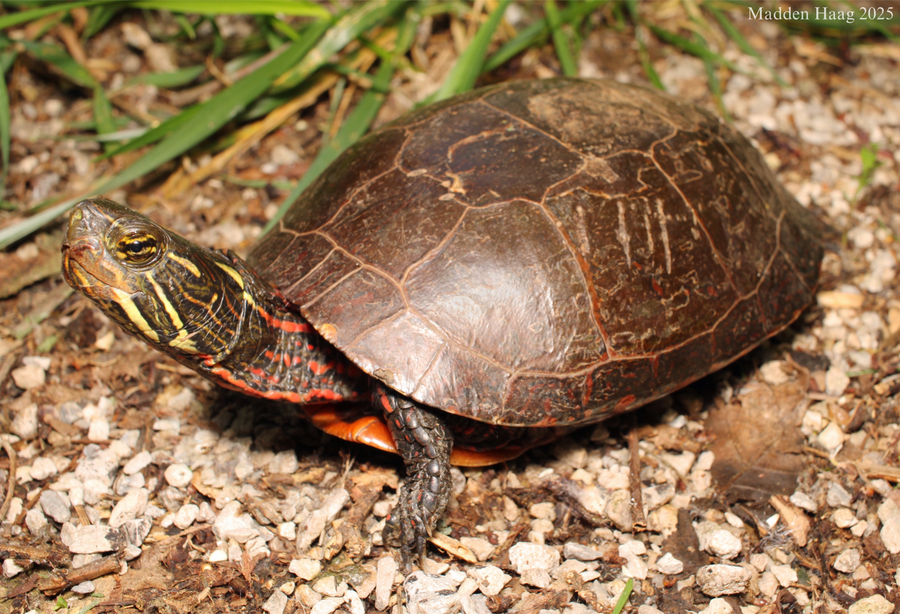
The painted turtle earns its name from the vivid pattern of yellow and red stripes on its head, neck, legs, and tail, set against a smooth, dark olive-to-black upper shell. The underside, or plastron, is often bright yellow, sometimes marked with a bold dark blotch depending on the subspecies. The shell is low and streamlined, an ideal shape for slipping easily through the water. At around 18 cm long, it is a modest-sized turtle, with females generally growing a little larger than males.
Basking and body temperature
As a cold-blooded reptile, the painted turtle relies on the sun to warm its body, and basking is a central part of its daily routine. On warm days many turtles haul out onto logs, rocks, and banks, often stacked together in rows to soak up the heat. Basking raises their body temperature to aid digestion and helps rid the shell of algae and parasites. At the first sign of danger they slide quickly back into the safety of the water.
Diet and feeding
Painted turtles are omnivores whose diet shifts with age and season. Young turtles tend to be more carnivorous, eating aquatic insects, tadpoles, small fish, and other invertebrates, while adults eat a greater share of aquatic plants and algae. They feed entirely in the water, where they can swallow and manoeuvre their food. This flexible, opportunistic diet allows them to thrive in a wide range of ponds, lakes, and quiet river backwaters.
Swimming and life in the water
Painted turtles are strong, graceful swimmers, using their webbed feet to paddle through the water at up to 5 km/h. They spend most of their lives in or near water, hauling out mainly to bask or, for females, to lay eggs. On land their pace is slow and deliberate, but in water they move with ease and can stay submerged for long periods. They favour shallow, slow-moving water with a soft bottom and plenty of aquatic vegetation.
Surviving the winter
In the cold northern parts of their range, painted turtles endure freezing winters by hibernating at the bottom of ponds beneath the ice. During this time their metabolism slows dramatically, and they can survive for months with little or no oxygen, absorbing what they need through their skin and the lining of the throat and cloaca. Painted turtle hatchlings are especially remarkable, often spending their first winter in the nest and tolerating partial freezing of their body tissues. This cold-hardiness lets the species range farther north than most other turtles.
Reproduction and lifespan
In late spring and early summer, females leave the water to dig nests in sandy or soft soil, laying a clutch of several elongated eggs before covering them and returning to the pond. As in many reptiles, the temperature of the nest determines the sex of the hatchlings, with warmer nests producing more females. The eggs hatch after roughly two to three months, and the young make their own way to water. Painted turtles are long-lived, commonly reaching 25 to 35 years in the wild.
Dig deeper into the Painted Turtle
- How Long Do Painted Turtles Live?
Painted Turtle lifespan is typically 25–35 years in the wild. What shortens or extends life, life stages, and status (Least Concern).
- Painted Turtle Basking Stacks
Painted turtles bask on logs across North American ponds with red and yellow skin stripes, weighing about 0.
- Painted Turtle Cold Tolerance
Painted turtles bask on logs across North American ponds with red and yellow skin stripes, weighing about 0.
- What Do Painted Turtles Eat?
What painted turtles eat: Omnivore — aquatic plants, insects, and small fish, foraging style, and seasonal shifts in Ponds, lakes, and slow rivers of North America.
- Where Do Painted Turtles Live?
Where painted turtles live: Ponds, lakes, and slow rivers of North America, native range cues, and human overlap. Status Least Concern.
Explore the Painted Turtle
Close relatives
- Eastern Box Turtle Same family
- Leatherback Sea Turtle Same order
- Hawksbill Sea Turtle Same order
- Alligator Snapping Turtle Same order
Range & geography
Did you know? Painted Turtle facts
- Painted turtles bask on logs across North American ponds, with red and yellow stripes on skin and shell.
- Sliders have red ear patches and are more invasive globally.
- Yes — underwater in mud through winter.
- Conservation: Least Concern.
Diet & feeding
Painted Turtle feeds primarily as a omnivore — plants, insects, fish. Turtles stack on logs regulating body temperature before diving to feed.
Adaptations
- Turtles stack on logs regulating body temperature before diving to feed.
- Painted turtles survive frozen ponds by anaerobic metabolism.
Behaviour & ecology
- Turtles stack on logs regulating body temperature before diving to feed.
- Painted turtles survive frozen ponds by anaerobic metabolism.
Communication
- Scent marking, body posture, and head-bobbing or tail signals communicate threat and dominance.
- Vocalisations are limited in many reptiles but hissing or bellowing occurs in some groups.
Habitat & range
Ponds and slow rivers in North America
Ecological role
Painted Turtle plays a recognised ecological role in ponds and slow rivers in north america.
Conservation status of the Painted Turtle
The painted turtle (Chrysemys picta) is listed as Least Concern on the IUCN Red List. Least Concern (LC) is the IUCN's lowest-risk category, assigned to widespread, abundant species that have been evaluated and found not to be threatened. It does not mean a species faces no pressures — only that it is not currently at risk of extinction.
The painted turtle (Chrysemys picta) is assessed on the IUCN Red List. Look up on the IUCN Red List .
Frequently asked questions about the Painted Turtle
Why is it called a painted turtle?
It is named for the bright yellow and red markings that decorate its head, legs, tail, and shell edges, which look as though they were painted on. These colours stand out against its smooth, dark upper shell.
How big do painted turtles get?
Painted turtles grow to about 18 cm in shell length and weigh roughly 0.2 to 0.4 kg. Females are generally a little larger than males.
What do painted turtles eat?
They are omnivores that eat aquatic plants, algae, insects, tadpoles, and small fish. Young turtles eat more animal prey, while adults take a larger share of plants.
How long do painted turtles live?
In the wild, painted turtles commonly live 25 to 35 years. Their long lifespan and hardy nature make them one of North America's most widespread and successful turtles.
How do painted turtles survive winter?
They hibernate at the bottom of ponds beneath the ice, slowing their metabolism dramatically. They can survive for months with very little oxygen, absorbing what they need through their skin and other tissues.
Why do painted turtles bask on logs?
As cold-blooded reptiles, they bask in the sun to warm their bodies, which aids digestion and helps clear algae and parasites from the shell. They often pile onto logs in rows and slide into the water at the first sign of danger.
What is a group of painted turtles called?
A group of Painted Turtles is called a bale.
What is a baby painted turtle called?
A baby Painted Turtle is called a hatchling.
Sources & references
This guide is compiled and reviewed against established zoological and conservation references. Key sources for the Painted Turtle:
-
IUCN Red List of Threatened Species
Conservation status (Least Concern) reflects the IUCN Red List category for Chrysemys picta.
-
iNaturalist — observations & photos
Search citizen-science observations and community IDs for Chrysemys picta. Useful for range checks and recent sightings — not a substitute for formal Red List status.
-
GBIF — occurrence data
Global Biodiversity Information Facility species search for Chrysemys picta. Explore published occurrence records used in range research.
- IUCN Red List — Chrysemys picta.
Conservation status (Least Concern) and population trends.
- Animal Diversity Web — Chrysemys picta. University of Michigan Museum of Zoology.
Life history, morphology, and range.
-
Global Animal Guide editorial standards
How we research, source, review, and update every guide for accuracy.