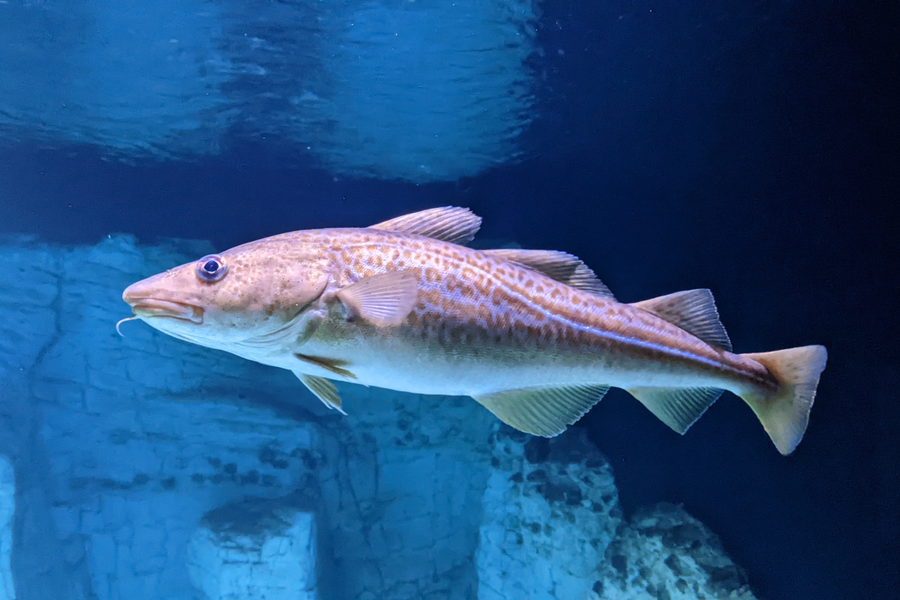
The Atlantic cod (Gadus morhua) is a ray-finned fish of the family Gadidae, in the order Gadiformes.
Quick answer
Atlantic cod is a cold-water groundfish that shaped the economies of Newfoundland, Iceland, and New England for centuries before overfishing collapsed many stocks. Growing to 40 kg (88 lb) and living 25 years, it supports fisheries where recovered and remains Vulnerable in the northwest Atlantic.
Top questions about the Atlantic Cod
Atlantic Cod facts at a glance
- Weight 5 kg
- Length 80 cm
- Top speed 15 km/h
- Lifespan 20 years
| Scientific name | Gadus morhua |
|---|---|
| Diet | Carnivore — fish, crustaceans, and worms |
| Habitat | Cold continental shelf waters of the North Atlantic |
| Lifespan | Up to 25 years in the wild |
| Weight | 2–40 kg (4–88 lb); most market fish 2–8 kg |
| Top speed | Steady swimmer; schooling migrations |
| Conservation status | Vulnerable (IUCN) |
| Kingdom | Animalia |
|---|---|
| Phylum | Chordata |
| Class | Actinopterygii |
| Order | Gadiformes |
| Family | Gadidae |
| Genus | Gadus |
Where it lives
The atlantic cod (Gadus morhua) is native to Cold continental shelf waters of the North Atlantic from North America and Greenland to Iceland, Norway, and the Barents Sea — historic spawning grounds on Grand Banks and North Sea. — recorded across Europe, North America, Oceans in this guide’s range summary.
For occurrence records, see GBIF species search and sources below.
How big is a atlantic cod?
An adult atlantic cod measures 80 cm long — about 46% of the height of an average adult person (1.73 m) — and weighs around 5.0 kg, about 7% of an average adult’s body weight (70 kg).
Length vs an average adult’s height (to scale)
What is a group of atlantic cods called?
Group name (collective noun)
A group of Atlantic Cods is called a school.
Baby name
A baby Atlantic Cod is called a fry.
Explore more animal collective nouns and baby animal names .
Historic fishery collapse
Northwest Atlantic cod stocks crashed in 1992 when Canada's Grand Banks fishery closed — one of history's most famous fishery collapses after centuries of seemingly unlimited harvest. Recovery has been partial and slow, illustrating how even prolific species can be depleted.
Barbel and bottom feeding
A whisker-like barbel on the chin helps cod detect prey on the seafloor — worms, crabs, and smaller fish. Cod migrate between shallow spawning grounds and deeper feeding areas, historically forming dense shoals that made them easy targets for trawlers.
Cultural and culinary importance
Fish and chips, bacalao, and lutefisk all depend on cod. Basque and Viking fishermen pursued cod across the Atlantic for centuries before modern industrial trawling. Cod liver oil supplied vitamin D to generations of children.
Modern management
Listed Vulnerable, Atlantic cod fisheries are now regulated with quotas, closed areas, and gear restrictions. Icelandic and Northeast Arctic stocks are healthier than Northwest Atlantic populations. Climate change shifts spawning grounds northward, complicating recovery.
Dig deeper into the Atlantic Cod
- Are Atlantic Cods Endangered?
Are Atlantic cods endangered? Status Vulnerable, main threats, and what protection means.
- Atlantic Cod: Key Facts
Atlantic cod is a cold-water groundfish that shaped the economies of Newfoundland, Iceland, and New England for centuries before overfishing collapsed…
- How Long Do Atlantic Cods Live?
Atlantic Cod lifespan is typically Up to 25 years in the wild. What shortens or extends life, life stages, and status (Vulnerable).
- What Do Atlantic Cods Eat?
What Atlantic cods eat: Carnivore — fish, crustaceans, and worms, foraging style, and seasonal shifts in Cold continental shelf waters of the North Atlantic.
- Where Do Atlantic Cods Live?
Where Atlantic cods live: Cold continental shelf waters of the North Atlantic, native range cues, and human overlap. Status Vulnerable.
Explore the Atlantic Cod
Close relatives
- Great White Shark Same class
- Ocean Sunfish Same class
- Rainbow Trout Same class
- Thresher Shark Same class
Collections
Did you know? Atlantic Cod facts
- Atlantic cod is a cold-water groundfish that shaped the economies of Newfoundland, Iceland, and New England for centuries before overfishing collapsed many stocks.
- Decades of industrial trawling removed fish faster than they could reproduce, combined with poor management and environmental shifts — the 1992 moratorium on Canada's Grand Banks is the landmark example.
- Some stocks remain depleted or Vulnerable, especially in the northwest Atlantic. Northeast Atlantic and Icelandic fisheries are more sustainable under strict quotas.
- Salted and dried cod — a staple of Portuguese, Spanish, and Caribbean cuisine preserved for centuries before refrigeration.
- Typically 2–8 kg in fisheries, but individuals can exceed 40 kg and live 25 years in unfished populations.
- Conservation: Vulnerable (IUCN).
Diet & feeding
Atlantic Cod feeds primarily as a carnivore — fish, crustaceans, and worms. A whisker-like barbel on the chin helps cod detect prey on the seafloor — worms, crabs, and smaller fish. Cod migrate between shallow spawning grounds and deeper feeding areas, historically forming dense shoals that made them easy targets for t
Adaptations
- Northwest Atlantic cod stocks crashed in 1992 when Canada's Grand Banks fishery closed — one of history's most famous fishery collapses after centuries of seemingly unlimited harvest. Recovery has been partial and slow, illustrating how even prolific species can be depleted.
- A whisker-like barbel on the chin helps cod detect prey on the seafloor — worms, crabs, and smaller fish. Cod migrate between shallow spawning grounds and deeper feeding areas, historically forming dense shoals that made them easy targets for trawlers.
Behaviour & ecology
- Northwest Atlantic cod stocks crashed in 1992 when Canada's Grand Banks fishery closed — one of history's most famous fishery collapses after centuries of seemingly unlimited harvest. Recovery has been partial and slow, illustrating how even prolific species can be depleted.
- A whisker-like barbel on the chin helps cod detect prey on the seafloor — worms, crabs, and smaller fish. Cod migrate between shallow spawning grounds and deeper feeding areas, historically forming dense shoals that made them easy targets for trawlers.
- Fish and chips, bacalao, and lutefisk all depend on cod. Basque and Viking fishermen pursued cod across the Atlantic for centuries before modern industrial trawling. Cod liver oil supplied vitamin D to generations of children.
Communication
- Lateral-line and visual cues coordinate schooling, courtship, or territorial behaviour.
- Some species produce low-frequency sounds or drumming for spawning or defence.
Habitat & range
Cold continental shelf waters of the North Atlantic
Ecological role
Atlantic Cod acts as a predator that helps regulate prey populations and maintain balance in cold continental shelf waters of the north atlantic.
Conservation status of the Atlantic Cod
The atlantic cod (Gadus morhua) is listed as Vulnerable on the IUCN Red List. Vulnerable (VU) means a species faces a high risk of extinction in the medium-term future. It is the lowest-risk of the three 'threatened' IUCN categories — one step below Endangered, which is itself below Critically Endangered — and is often an early warning that a population is in trouble.
The atlantic cod (Gadus morhua) is assessed on the IUCN Red List. Look up on the IUCN Red List .
Frequently asked questions about the Atlantic Cod
Why did cod collapse?
Decades of industrial trawling removed fish faster than they could reproduce, combined with poor management and environmental shifts — the 1992 moratorium on Canada's Grand Banks is the landmark example.
Is cod still overfished?
Some stocks remain depleted or Vulnerable, especially in the northwest Atlantic. Northeast Atlantic and Icelandic fisheries are more sustainable under strict quotas.
What is bacalao?
Salted and dried cod — a staple of Portuguese, Spanish, and Caribbean cuisine preserved for centuries before refrigeration.
How big do Atlantic cod get?
Typically 2–8 kg in fisheries, but individuals can exceed 40 kg and live 25 years in unfished populations.
Where do Atlantic cod live?
Cold waters of the North Atlantic from North America to Greenland, Iceland, Norway, and the Barents Sea — on continental shelves and banks.
What is a group of atlantic cods called?
A group of Atlantic Cods is called a school.
What is a baby atlantic cod called?
A baby Atlantic Cod is called a fry.
Sources & references
This guide is compiled and reviewed against established zoological and conservation references. Key sources for the Atlantic Cod:
-
IUCN Red List of Threatened Species
Conservation status (Vulnerable) reflects the IUCN Red List category for Gadus morhua.
-
iNaturalist — observations & photos
Search citizen-science observations and community IDs for Gadus morhua. Useful for range checks and recent sightings — not a substitute for formal Red List status.
-
GBIF — occurrence data
Global Biodiversity Information Facility species search for Gadus morhua. Explore published occurrence records used in range research.
- IUCN Red List — Gadus morhua.
Conservation status (Vulnerable) and population trends.
- Animal Diversity Web — Gadus morhua. University of Michigan Museum of Zoology.
Life history, morphology, and range.
-
Global Animal Guide editorial standards
How we research, source, review, and update every guide for accuracy.