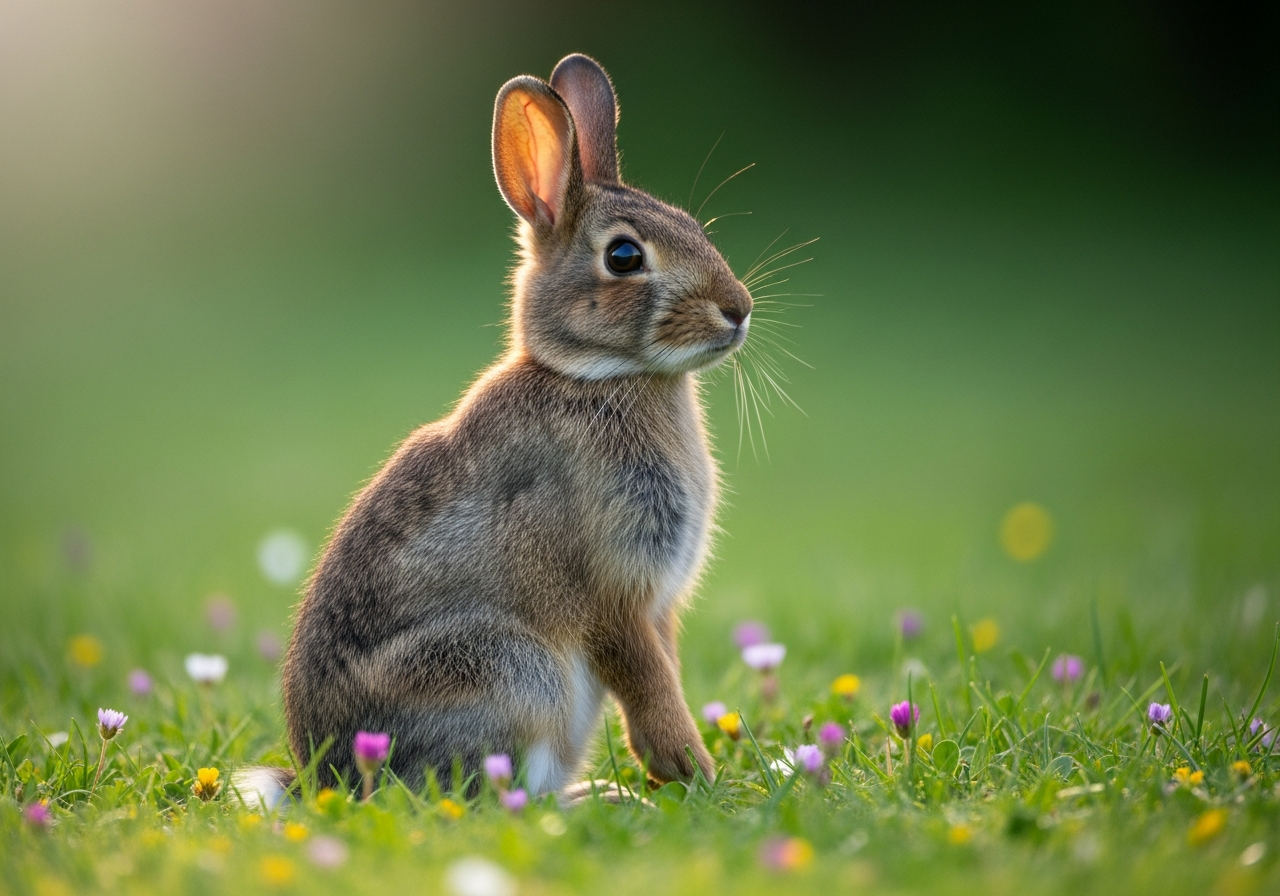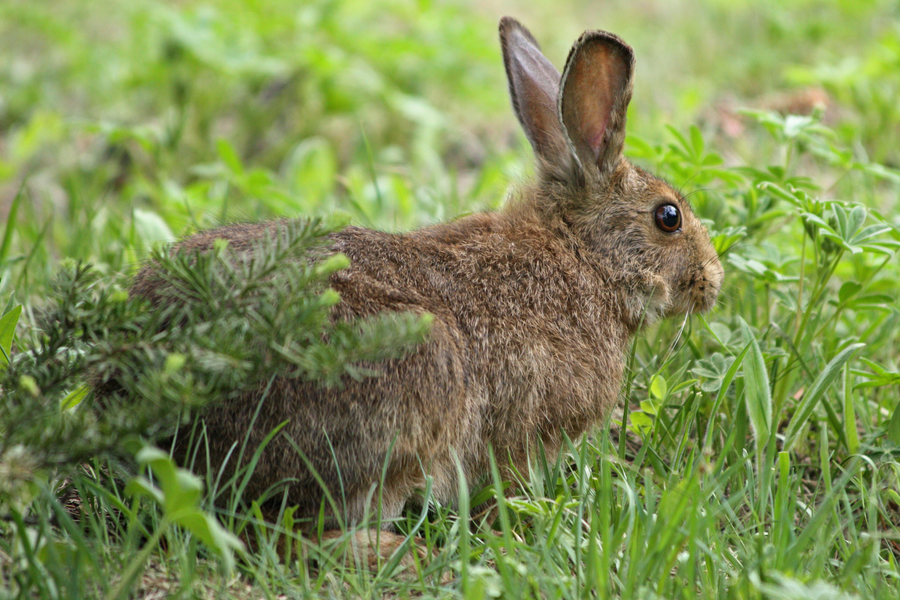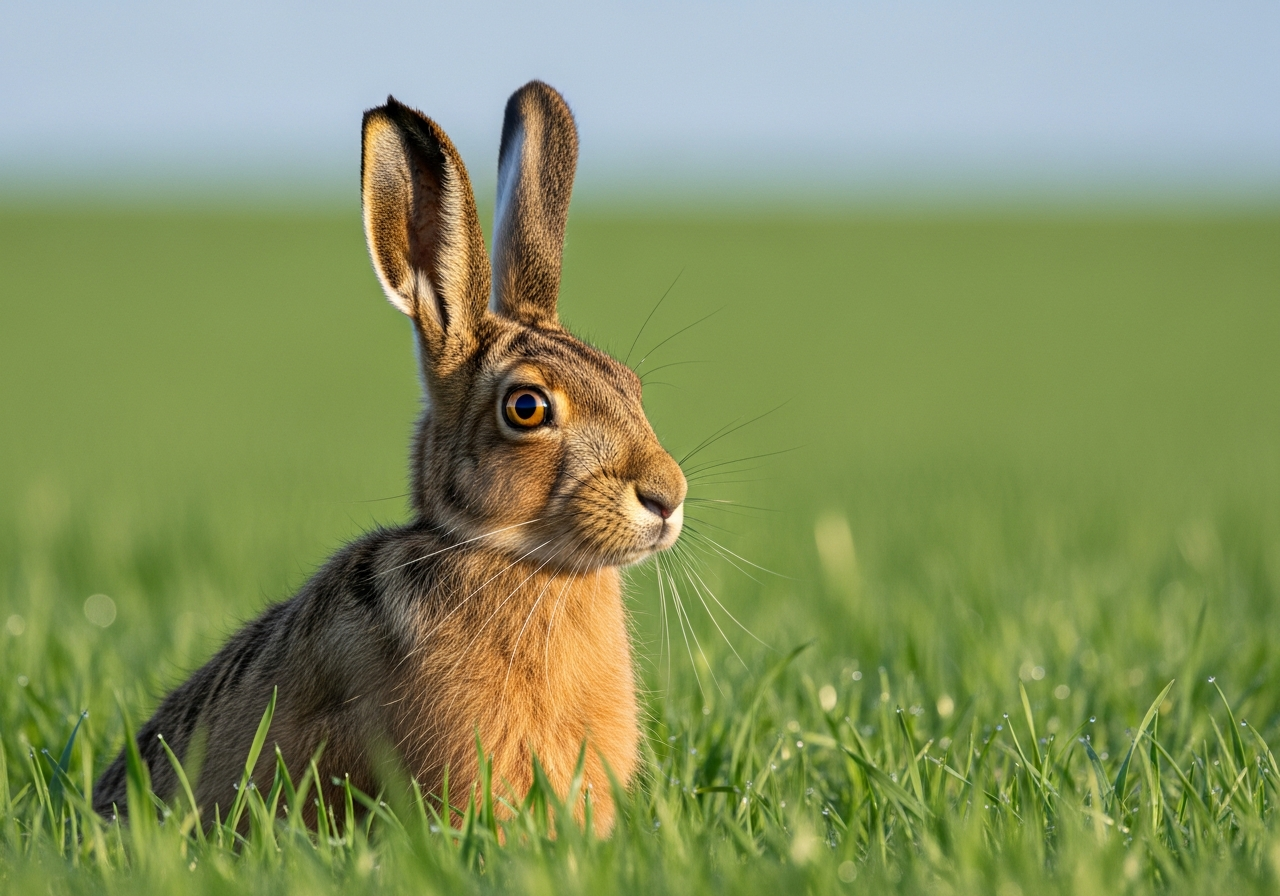
The hare (Lepus europaeus) is a mammal of the family Leporidae, in the order Lagomorpha.
Quick answer
The European brown hare is a large, fast relative of the rabbit, with very long black-tipped ears, powerful hind legs, and amber eyes. Unlike rabbits, hares live above ground in shallow scrapes called forms and their young are born fully furred with open eyes. Brown hares can sprint up to about 70 km/h (43 mph), making them one of the fastest land mammals in Britain.
Top questions about the Hare
Hare facts at a glance
- Weight 5 kg
- Length 70 cm
- Top speed 70 km/h
- Lifespan 12 years
| Scientific name | Lepus europaeus |
|---|---|
| Diet | Herbivore (grasses, herbs, crops, bark) |
| Habitat | Open farmland, grassland, meadows |
| Lifespan | 3–4 years wild (up to 12) |
| Weight | 3–5 kg (7–11 lb) |
| Top speed | 70 km/h (43 mph) |
| Conservation status | Least Concern (IUCN) |
| Kingdom | Animalia |
|---|---|
| Phylum | Chordata |
| Class | Mammalia |
| Order | Lagomorpha |
| Family | Leporidae |
| Genus | Lepus |
Where it lives
The hare (Lepus europaeus) is native to Native to open country across Europe and western Asia; widely introduced elsewhere, including parts of the Americas and Australia. — recorded across Europe, Asia in this guide’s range summary.
For occurrence records, see GBIF species search and sources below.
How big is a hare?
An adult hare measures 70 cm long — about 40% of the height of an average adult person (1.73 m) — and weighs around 5.0 kg, about 7% of an average adult’s body weight (70 kg).
Length vs an average adult’s height (to scale)
What is a group of hares called?
Group name (collective noun)
A group of Hares is called a drove. It is also known as a down or a husk.
Baby name
A baby Hare is called a leveret.
Explore more animal collective nouns and baby animal names .
Built for speed
The brown hare relies on speed and stamina rather than burrows to escape danger. Its long, muscular hind legs let it reach around 70 km/h and twist sharply at full pace, and its huge ears give excellent hearing and help shed heat. When a predator is near, a hare often freezes flat against the ground, trusting its camouflage before exploding into a sprint.
Forms, leverets, and life above ground
Unlike rabbits, hares do not dig burrows. They rest in shallow depressions in the grass called forms and live their whole lives above ground. Their young, called leverets, are born fully furred with their eyes open and can move almost immediately — the mother leaves them hidden separately and visits briefly to nurse, reducing the chance a predator finds the whole litter.
Mad as a March hare
In spring, brown hares are famous for 'boxing' — standing on their hind legs and striking at each other with their front paws. For a long time this was thought to be rival males fighting, but it is usually a female fending off an over-eager male. This dramatic courtship behaviour, most visible in March, gave rise to the saying 'mad as a March hare'.
Range and conservation
The brown hare is native to Europe and western Asia and has been introduced to other regions, including parts of the Americas and Australia. It is listed as Least Concern globally, but in the United Kingdom numbers have fallen sharply since the early 20th century due to changes in farming, loss of varied habitat, and illegal hare coursing, making it a priority species for conservation.
Dig deeper into the Hare
- How Fast Is A Hare?
Hare top speed is about 70 km/h (43 mph). Sprint vs endurance and what limits pace.
- How Long Do Hares Live?
Hare lifespan is typically 3–4 years wild (up to 12). What shortens or extends life, life stages, and status (Least Concern).
- What Do Hares Eat?
What hares eat: Herbivore (grasses, herbs, crops, bark), foraging style, and seasonal shifts in Open farmland, grassland, meadows.
- Where Do Hares Live?
Where hares live: Open farmland, grassland, meadows, native range cues, and human overlap. Status Least Concern.
Explore the Hare
Close relatives
- Snowshoe Hare Same genus
- Rabbit Same family
- Lion Same class
- Dog Same class
Range & geography
Did you know? Hare facts
- The European brown hare is a large, fast relative of the rabbit, with very long black-tipped ears, powerful hind legs, and amber eyes.
- Hares are larger, with longer legs and ears, and live above ground in open forms rather than burrows. Their young are born furred with open eyes, while rabbit kittens are born blind and helpless in a nest.
- A group of hares is called a drove, and other terms include a down or a husk. A baby hare is called a leveret.
- Brown hares can sprint at about 70 km/h (43 mph) and change direction sharply at speed, making them one of the fastest land mammals in Britain and very hard for predators to catch.
- Conservation: Least Concern (IUCN).
Diet & feeding
Hare feeds primarily as a herbivore (grasses, herbs, crops, bark). The brown hare relies on speed and stamina rather than burrows to escape danger. Its long, muscular hind legs let it reach around 70 km/h and twist sharply at full pace, and its huge ears give excellent hearing and help shed heat. When a predator is nea
Adaptations
- The brown hare relies on speed and stamina rather than burrows to escape danger. Its long, muscular hind legs let it reach around 70 km/h and twist sharply at full pace, and its huge ears give excellent hearing and help shed heat. When a predator is near, a hare often freezes flat against the ground, trusting its camouflage before exploding into a sprint.
- Unlike rabbits, hares do not dig burrows. They rest in shallow depressions in the grass called forms and live their whole lives above ground. Their young, called leverets, are born fully furred with their eyes open and can move almost immediately — the mother leaves them hidden separately and visits briefly to nurse, reducing the chance a predator finds the whole litter.
Behaviour & ecology
- The brown hare relies on speed and stamina rather than burrows to escape danger. Its long, muscular hind legs let it reach around 70 km/h and twist sharply at full pace, and its huge ears give excellent hearing and help shed heat. When a predator is near, a hare often freezes flat against the ground, trusting its camouflage before exploding into a sprint.
- Unlike rabbits, hares do not dig burrows. They rest in shallow depressions in the grass called forms and live their whole lives above ground. Their young, called leverets, are born fully furred with their eyes open and can move almost immediately — the mother leaves them hidden separately and visits briefly to nurse, reducing the chance a predator finds the whole litter.
- In spring, brown hares are famous for 'boxing' — standing on their hind legs and striking at each other with their front paws. For a long time this was thought to be rival males fighting, but it is usually a female fending off an over-eager male. This dramatic courtship behaviour, most visible in March, gave rise to the saying 'mad as a March hare'.
Communication
- Hare uses scent, posture, and vocal signals to mark territory and coordinate social behaviour.
- Communication intensity often peaks during breeding seasons and territorial disputes.
Habitat & range
Open farmland, grassland, meadows
Ecological role
Hare shapes vegetation through grazing or browsing and serves as prey for larger predators where ranges overlap.
Conservation status of the Hare
The hare (Lepus europaeus) is listed as Least Concern on the IUCN Red List. Least Concern (LC) is the IUCN's lowest-risk category, assigned to widespread, abundant species that have been evaluated and found not to be threatened. It does not mean a species faces no pressures — only that it is not currently at risk of extinction.
The hare (Lepus europaeus) is assessed on the IUCN Red List. Look up on the IUCN Red List .
Frequently asked questions about the Hare
What is the difference between a hare and a rabbit?
Hares are larger, with longer legs and ears, and live above ground in open forms rather than burrows. Their young are born furred with open eyes, while rabbit kittens are born blind and helpless in a nest.
What is a group of hares called?
A group of hares is called a drove, and other terms include a down or a husk. A baby hare is called a leveret.
How fast can a hare run?
Brown hares can sprint at about 70 km/h (43 mph) and change direction sharply at speed, making them one of the fastest land mammals in Britain and very hard for predators to catch.
Why do hares box in spring?
Boxing is part of courtship. It is usually a female fending off a male she is not ready to mate with, striking out with her front paws. It is most often seen in March, giving rise to 'mad as a March hare'.
Where do hares live?
Brown hares live in open countryside such as farmland, grassland, and meadows across Europe and western Asia. Instead of burrowing, they shelter in shallow scrapes in the ground called forms.
What is a baby hare called?
A baby Hare is called a leveret.
Sources & references
This guide is compiled and reviewed against established zoological and conservation references. Key sources for the Hare:
-
IUCN Red List of Threatened Species
Conservation status (Least Concern) reflects the IUCN Red List category for Lepus europaeus.
-
iNaturalist — observations & photos
Search citizen-science observations and community IDs for Lepus europaeus. Useful for range checks and recent sightings — not a substitute for formal Red List status.
-
GBIF — occurrence data
Global Biodiversity Information Facility species search for Lepus europaeus. Explore published occurrence records used in range research.
- IUCN Red List — Lepus europaeus.
Conservation status (Least Concern) and population trends.
- Animal Diversity Web — Lepus europaeus. University of Michigan Museum of Zoology.
Life history, morphology, and range.
- Wikipedia — Hare.
General taxonomy and overview (cross-check primary sources).
-
Global Animal Guide editorial standards
How we research, source, review, and update every guide for accuracy.