Image sourcing: see credits & licences
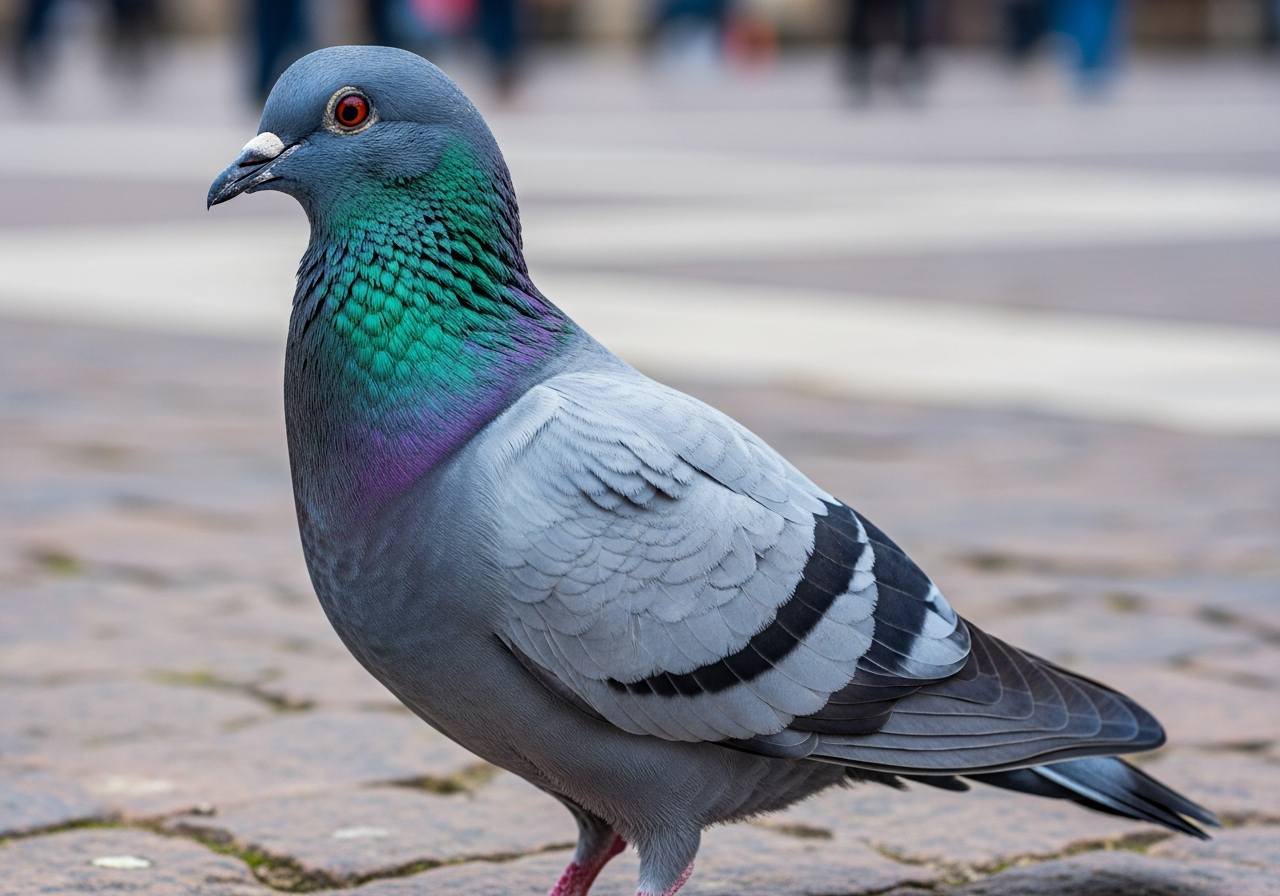
The pigeon (Columba livia) is a bird of the family Columbidae, in the order Columbiformes.
Quick answer
The pigeon (Columba livia), also called the rock dove, is a familiar grey city bird found on every continent except Antarctica. Descended from wild cliff-dwelling doves, it weighs 300 to 500 g and can fly at 90 km/h (56 mph), even faster when racing. Pigeons are famed for an extraordinary homing sense that lets them navigate back over hundreds of miles, and they are listed as Least Concern.
Top questions about the Pigeon
Pigeon facts at a glance
- Weight 400 g
- Length 35 cm
- Top speed 90 km/h
- Lifespan 15 years
| Scientific name | Columba livia |
|---|---|
| Diet | Granivore (seeds, grain, scraps) |
| Habitat | Cities, cliffs, farmland worldwide |
| Lifespan | 3–5 years wild (up to 15) |
| Weight | 300–500 g (11–18 oz) |
| Top speed | 90 km/h (56 mph), faster when racing |
| Conservation status | Least Concern (IUCN) |
| Kingdom | Animalia |
|---|---|
| Phylum | Chordata |
| Class | Aves |
| Order | Columbiformes |
| Family | Columbidae |
| Genus | Columba |
Where it lives
The pigeon (Columba livia) is native to The wild rock dove is native to Europe, North Africa, and southwest Asia; feral pigeons now live in cities on every continent except Antarctica. — recorded across Europe, Asia, Africa in this guide’s range summary.
For occurrence records, see GBIF species search and sources below.
How big is a pigeon?
An adult pigeon measures 35 cm long — about 20% of the height of an average adult person (1.73 m) — and weighs around 400 g, about 1% of an average adult’s body weight (70 kg).
Length vs an average adult’s height (to scale)
What is a group of pigeons called?
Group name (collective noun)
A group of Pigeons is called a flock. It is also known as a kit or a dropping.
Baby name
A baby Pigeon is called a squab.
Explore more animal collective nouns and baby animal names .
Origins and appearance
The city pigeon is a domesticated and feral form of the wild rock dove, a bird that naturally nests on sea cliffs and rocky ledges. That cliff heritage is why pigeons feel at home on the ledges and window sills of buildings, which mimic their ancestral crags. Typical birds are grey with two dark wing bars and a glossy green-and-purple neck, though centuries of domestication have produced many colours and patterns.
Diet and city life
Pigeons are granivores that naturally eat seeds and grain, but in towns they readily scavenge bread, scraps, and other human food. This adaptable diet is a key reason they thrive in cities across the world. They feed in flocks and can drink by sucking water up directly, unlike most birds that must tip their heads back to swallow.
Breeding and crop milk
Pigeons breed year-round in mild conditions and usually lay two white eggs at a time. Both parents share incubation and feed their chicks, called squabs, on a rich secretion known as crop milk that is produced in the lining of the crop. This nutritious food lets pigeons raise young even when seeds are scarce, helping them nest repeatedly through the year.
Flight and speed
Pigeons are powerful, fast fliers, cruising at around 90 km/h (56 mph) and reaching higher speeds when racing over long distances. Their strong flight muscles and streamlined build let them cover great distances with ease. Racing pigeons bred for speed and endurance can fly home across hundreds of miles in a single day.
Intelligence and lifespan
Pigeons are surprisingly intelligent birds that can recognise individual human faces, learn to distinguish letters of the alphabet, and even tell apart paintings by different artists in laboratory tests. In the wild they usually live 3 to 5 years, but well-kept birds can reach around 15 years of age. Widespread and adaptable, the pigeon is listed as Least Concern by the IUCN.
Dig deeper into the Pigeon
- How Fast Is A Pigeon?
Pigeon top speed is about 90 km/h (56 mph), faster when racing. Sprint vs endurance and what limits pace.
- How Long Do Pigeons Live?
Pigeon lifespan is typically 3–5 years wild (up to 15). What shortens or extends life, life stages, and status (Least Concern).
- Pigeon: Key Facts
Pigeons (Columba livia) are birds found across Europe, Asia, Africa. The city bird with an extraordinary sense of direction.
- What Do Pigeons Eat?
What pigeons eat: Granivore (seeds, grain, scraps), foraging style, and seasonal shifts in Cities, cliffs, farmland worldwide.
- Where Do Pigeons Live?
Where pigeons live: Cities, cliffs, farmland worldwide, native range cues, and human overlap. Status Least Concern.
Explore the Pigeon
Compare
Close relatives
- Chicken Same class
- Wandering Albatross Same class
- Southern Cassowary Same class
- California Condor Same class
Range & geography
Did you know? Pigeon facts
- The common pigeon, or rock dove, is a familiar grey bird of cities worldwide and the ancestor of all domestic and racing pigeons.
- A group of pigeons is called a flock, and a trained group flown together is sometimes called a kit. A baby pigeon is called a squab.
- Homing pigeons navigate using a combination of the sun, the Earth's magnetic field, their sense of smell, and familiar landmarks, allowing them to return over hundreds of kilometres from unfamiliar places.
- Yes, broadly. Pigeon and dove are common names for birds in the same family, with no strict scientific difference; 'dove' often refers to smaller species and 'pigeon' to larger ones.
- Baby pigeons, called squabs, stay hidden in the nest on ledges and in cavities until they are nearly adult-sized, so by the time they leave they look much like grown pigeons.
- Conservation: Least Concern (IUCN).
Diet & feeding
Pigeon feeds primarily as a granivore (seeds, grain, scraps). Pigeons can breed year-round wherever food is plentiful, which is part of why they are so common in cities. Unusually, both parents produce a nutritious secretion called crop milk to feed their chicks, known as squabs, in their first days. A pair can raise s
Adaptations
- Pigeons have a remarkable ability to find their way home over long distances, even from places they have never been. They appear to navigate using the sun, the Earth's magnetic field, smell, and familiar landmarks. This talent has been used for thousands of years to carry messages, and racing pigeons can cover hundreds of kilometres at average speeds of around 80 km/h.
- The rock dove was one of the first birds ever domesticated, kept for food, sport, and communication for at least 5,000 years. Homing pigeons carried news of ancient Olympic victories and military dispatches; one pigeon, Cher Ami, saved a trapped battalion in the First World War. Today's feral city pigeons are descended from these domestic birds that returned to the wild.
Behaviour & ecology
- Pigeons have a remarkable ability to find their way home over long distances, even from places they have never been. They appear to navigate using the sun, the Earth's magnetic field, smell, and familiar landmarks. This talent has been used for thousands of years to carry messages, and racing pigeons can cover hundreds of kilometres at average speeds of around 80 km/h.
- The rock dove was one of the first birds ever domesticated, kept for food, sport, and communication for at least 5,000 years. Homing pigeons carried news of ancient Olympic victories and military dispatches; one pigeon, Cher Ami, saved a trapped battalion in the First World War. Today's feral city pigeons are descended from these domestic birds that returned to the wild.
- Pigeons can breed year-round wherever food is plentiful, which is part of why they are so common in cities. Unusually, both parents produce a nutritious secretion called crop milk to feed their chicks, known as squabs, in their first days. A pair can raise several broods a year, helping populations stay high.
Communication
- Pigeon uses calls and visual displays to communicate territory, alarm, and breeding status.
- Vocal repertoires vary by species and are often learned or refined during development.
Habitat & range
Cities, cliffs, farmland worldwide
Ecological role
Pigeon contributes to seed dispersal, insect control, or nutrient cycling depending on diet and foraging habits.
Conservation status of the Pigeon
The pigeon (Columba livia) is listed as Least Concern on the IUCN Red List. Least Concern (LC) is the IUCN's lowest-risk category, assigned to widespread, abundant species that have been evaluated and found not to be threatened. It does not mean a species faces no pressures — only that it is not currently at risk of extinction.
The pigeon (Columba livia) is assessed on the IUCN Red List. Look up on the IUCN Red List .
Frequently asked questions about the Pigeon
How do pigeons find their way home?
Pigeons combine several senses to navigate, including detecting the Earth's magnetic field, using the position of the sun, and relying on smell and low-frequency sound. Together these allow a homing pigeon to return from hundreds of miles away in unfamiliar country.
How fast can a pigeon fly?
Pigeons typically fly at around 90 km/h (56 mph) and can go even faster when racing over long distances. Their strong flight muscles let them cover great distances quickly.
What do pigeons eat?
Pigeons are seed and grain eaters by nature, but in cities they readily feed on bread, scraps, and other human food. This flexible diet is one reason they thrive in urban areas worldwide.
How long do pigeons live?
Wild city pigeons usually live around 3 to 5 years, largely because of predators, traffic, and disease. Well-cared-for birds, including racing and pet pigeons, can live up to about 15 years.
Are pigeons intelligent?
Yes, pigeons are notably intelligent. In laboratory studies they can recognise individual human faces, learn letters of the alphabet, and even distinguish between paintings by different artists.
Why are there so many pigeons in cities?
City pigeons descend from wild rock doves that nest on cliffs, so building ledges suit them perfectly. Combined with a flexible diet of human food scraps and year-round breeding, this lets them flourish in towns everywhere.
What is a group of pigeons called?
A group of Pigeons is called a flock. It is also known as a kit or a dropping.
What is a baby pigeon called?
A baby Pigeon is called a squab.
Sources & references
This guide is compiled and reviewed against established zoological and conservation references. Key sources for the Pigeon:
-
IUCN Red List of Threatened Species
Conservation status (Least Concern) reflects the IUCN Red List category for Columba livia.
-
iNaturalist — observations & photos
Search citizen-science observations and community IDs for Columba livia. Useful for range checks and recent sightings — not a substitute for formal Red List status.
-
GBIF — occurrence data
Global Biodiversity Information Facility species search for Columba livia. Explore published occurrence records used in range research.
-
eBird — bird observations
Cornell Lab eBird target search for Pigeon. Check recent checklists and seasonal abundance where birders report this species.
- IUCN Red List — Columba livia.
Conservation status (Least Concern) and population trends.
- Animal Diversity Web — Columba livia. University of Michigan Museum of Zoology.
Life history, morphology, and range.
- Wikipedia — Pigeon.
General taxonomy and overview (cross-check primary sources).
-
Global Animal Guide editorial standards
How we research, source, review, and update every guide for accuracy.