Image sourcing: see credits & licences
The sand tiger shark (Carcharias taurus) is a cartilaginous fish of the family Odontaspididae, in the order Lamniformes.
Quick answer
The sand tiger shark is a large, slow-moving coastal shark found in warm and temperate seas worldwide, often seen hovering motionless in aquariums. Despite a mouthful of jagged teeth and a fierce appearance, it is docile and rarely dangerous to people. It grows to about 3 metres, weighs 90 to 190 kg, lives 12 to 15 years, and is listed as Vulnerable by the IUCN.
Top questions about the Sand Tiger Shark
Also available in Español (Tiburón tigre de arena)
Sand Tiger Shark facts at a glance
- Weight 150 kg
- Length 3 m
- Top speed 35 km/h
- Lifespan 15 years
| Scientific name | Carcharias taurus |
|---|---|
| Diet | Carnivore — fish, squid, and smaller sharks |
| Habitat | Coastal waters worldwide — sandy nearshore |
| Lifespan | 12–15 years in the wild |
| Weight | 90–160 kg (200–350 lb); max about 190 kg |
| Top speed | Up to 35 km/h (22 mph) |
| Conservation status | Vulnerable (IUCN) |
| Kingdom | Animalia |
|---|---|
| Phylum | Chordata |
| Class | Chondrichthyes |
| Order | Lamniformes |
| Family | Odontaspididae |
| Genus | Carcharias |
Where it lives
The sand tiger shark (Carcharias taurus) is native to Coastal warm temperate waters worldwide — sandy nearshore from Japan to Australia and both Atlantic coasts. — recorded across Africa, Asia, Europe, North America, Oceania, South America in this guide’s range summary.
For occurrence records, see GBIF species search and sources below.
How big is a sand tiger shark?
An adult sand tiger shark measures 3 m long — about 1.7× the height of an average adult person (1.73 m) — and weighs around 150 kg, about 2.1× an average adult’s body weight (70 kg).
Length vs an average adult’s height (to scale)
What is a group of sand tiger sharks called?
Group name (collective noun)
A group of Sand Tiger Sharks is called a shiver.
Baby name
A baby Sand Tiger Shark is called a pup.
Explore more animal collective nouns and baby animal names .
Appearance and teeth
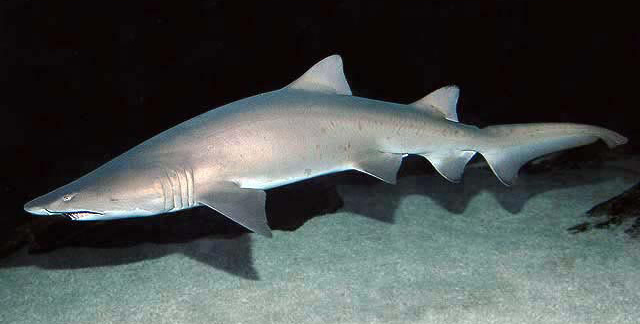
The sand tiger shark has a stout, brownish-grey body, a pointed snout, and small eyes, often speckled with reddish or dark spots along the flanks. Its most striking feature is its mouth, which stays slightly open to reveal rows of long, narrow, backward-curving teeth even when relaxed. These needle-like teeth are perfect for gripping slippery fish but are not designed for cutting, which is why the shark swallows most prey whole or in large pieces. This toothy grin gives it a menacing look that belies its calm nature.
The gulping-air trick
Sand tiger sharks are the only sharks known to gulp air at the surface and hold it in their stomachs to achieve near-perfect buoyancy. This lets them hang almost motionless in the water, hovering silently above the seabed as they wait for prey. The ability makes them energy-efficient ambush hunters and is one reason they thrive in aquariums, where they can be seen suspended in mid-water. No other shark uses this method of controlling its depth.
Hunting and diet
As a carnivore, the sand tiger shark preys on bony fish, squid, rays, and smaller sharks. It is mainly a nocturnal hunter, using its buoyancy and slow, deliberate swimming to sneak up on prey before a quick lunge. Sand tigers sometimes cooperate to herd schools of fish into tighter groups, making them easier to catch. Despite the fearsome dentition, their diet is dominated by fish they can swallow rather than large struggling prey.
Habitat and range
Sand tiger sharks live in warm and temperate coastal waters around much of the world, favouring sandy nearshore zones, rocky reefs, and submerged ledges. They are typically found from the surf line down to depths of around 190 metres and often shelter in caves and gullies by day. Individuals may undertake seasonal migrations, moving toward the poles in summer and back toward the equator in winter. Their preference for shallow coastal water brings them into frequent contact with divers, who generally find them placid.
Reproduction and embryo rivalry
Sand tiger sharks have one of the most extraordinary reproductive strategies in the animal kingdom, known as intrauterine cannibalism. The first embryo to develop in each of the two uteruses eats its smaller siblings before birth, so a female typically gives birth to just two well-developed pups. Each pup emerges around a metre long and ready to fend for itself. This low reproductive rate means populations recover very slowly from any decline.
Why it is vulnerable
The sand tiger shark is listed as Vulnerable by the IUCN, largely because it produces so few young. Overfishing, accidental capture in nets, and historic culls near beaches have driven serious declines in several regions. With a wild lifespan of only about 12 to 15 years and just two pups per litter, the species cannot quickly replace lost numbers. Protective legislation now shields it in a number of countries, including much of its range in Australia and the United States.
Dig deeper into the Sand Tiger Shark
- Are Sand Tiger Sharks Endangered?
Are sand tiger sharks endangered? Status Vulnerable, main threats, and what protection means.
- How Long Do Sand Tiger Sharks Live?
Sand Tiger Shark lifespan is typically 12–15 years in the wild. What shortens or extends life, life stages, and status (Vulnerable).
- Sand Tiger Shark: Key Facts
Sand tiger sharks expose rows of pointed teeth even when mouths are closed, weighing about 150 kg and living 15 years.
- What Do Sand Tiger Sharks Eat?
What sand tiger sharks eat: Carnivore — fish, squid, and smaller sharks, foraging style, and seasonal shifts in Coastal waters worldwide — sandy nearshore.
- Where Do Sand Tiger Sharks Live?
Where sand tiger sharks live: Coastal waters worldwide — sandy nearshore, native range cues, and human overlap. Status Vulnerable.
Explore the Sand Tiger Shark
Close relatives
- Great White Shark Same order
- Thresher Shark Same order
- Basking Shark Same order
- Goblin Shark Same order
Collections
Did you know? Sand Tiger Shark facts
- Sand tiger sharks expose rows of pointed teeth even when mouth is closed.
- Unrelated — sand tigers are smaller, coastal, and far less dangerous.
- Vulnerable — slow reproduction makes recovery difficult.
- Conservation: Vulnerable.
Diet & feeding
Sand Tiger Shark feeds primarily as a fish and squid. Embryos eat siblings in utero — only two pups born per litter.
Adaptations
- Sand tigers gulp air at the surface to adjust stomach buoyancy.
- Embryos eat siblings in utero — only two pups born per litter.
Behaviour & ecology
- Sand tigers gulp air at the surface to adjust stomach buoyancy.
- Embryos eat siblings in utero — only two pups born per litter.
Communication
- Lateral-line and visual cues coordinate schooling, courtship, or territorial behaviour.
- Some species produce low-frequency sounds or drumming for spawning or defence.
Habitat & range
Coastal waters worldwide
Ecological role
Sand Tiger Shark occupies a defined trophic level in aquatic food webs, linking plankton or smaller fish to larger predators.
Conservation status of the Sand Tiger Shark
The sand tiger shark (Carcharias taurus) is listed as Vulnerable on the IUCN Red List. Vulnerable (VU) means a species faces a high risk of extinction in the medium-term future. It is the lowest-risk of the three 'threatened' IUCN categories — one step below Endangered, which is itself below Critically Endangered — and is often an early warning that a population is in trouble.
The sand tiger shark (Carcharias taurus) is assessed on the IUCN Red List. Look up on the IUCN Red List .
Frequently asked questions about the Sand Tiger Shark
Are sand tiger sharks dangerous to humans?
Sand tiger sharks look intimidating but are generally docile and pose little threat to people. They are not considered man-eaters, and unprovoked attacks are extremely rare, which is why they are among the most common sharks kept in public aquariums.
Why do sand tiger sharks gulp air?
Sand tiger sharks gulp air at the surface and store it in their stomachs to fine-tune their buoyancy. This allows them to hover almost motionless in the water without swimming, saving energy and helping them ambush prey. They are the only sharks known to do this.
How big do sand tiger sharks get?
Sand tiger sharks typically reach about 3 metres in length and weigh 90 to 160 kg, with the largest individuals approaching 190 kg. Despite this size, they are slow, unhurried swimmers.
What do sand tiger sharks eat?
Sand tiger sharks are carnivores that feed mainly on bony fish, squid, rays, and smaller sharks. They hunt mostly at night, using stealth and their long gripping teeth to seize prey, which they usually swallow whole.
Why are sand tiger sharks endangered?
Sand tiger sharks are listed as Vulnerable because they breed extremely slowly, producing only two pups per litter. Overfishing, bycatch, and beach-protection culls have caused steep declines that the species struggles to recover from.
Do sand tiger shark embryos eat each other?
Yes. In a process called intrauterine cannibalism, the largest embryo in each uterus consumes its smaller siblings before birth. As a result, a female usually gives birth to just two large, fully developed pups.
What is a group of sand tiger sharks called?
A group of Sand Tiger Sharks is called a shiver.
What is a baby sand tiger shark called?
A baby Sand Tiger Shark is called a pup.
Sources & references
This guide is compiled and reviewed against established zoological and conservation references. Key sources for the Sand Tiger Shark:
-
IUCN Red List of Threatened Species
Conservation status (Vulnerable) reflects the IUCN Red List category for Carcharias taurus.
-
iNaturalist — observations & photos
Search citizen-science observations and community IDs for Carcharias taurus. Useful for range checks and recent sightings — not a substitute for formal Red List status.
-
GBIF — occurrence data
Global Biodiversity Information Facility species search for Carcharias taurus. Explore published occurrence records used in range research.
- IUCN Red List — Carcharias taurus.
Conservation status (Vulnerable) and population trends.
- Animal Diversity Web — Carcharias taurus. University of Michigan Museum of Zoology.
Life history, morphology, and range.
-
Global Animal Guide editorial standards
How we research, source, review, and update every guide for accuracy.