Image sourcing: see credits & licences
Quick answer
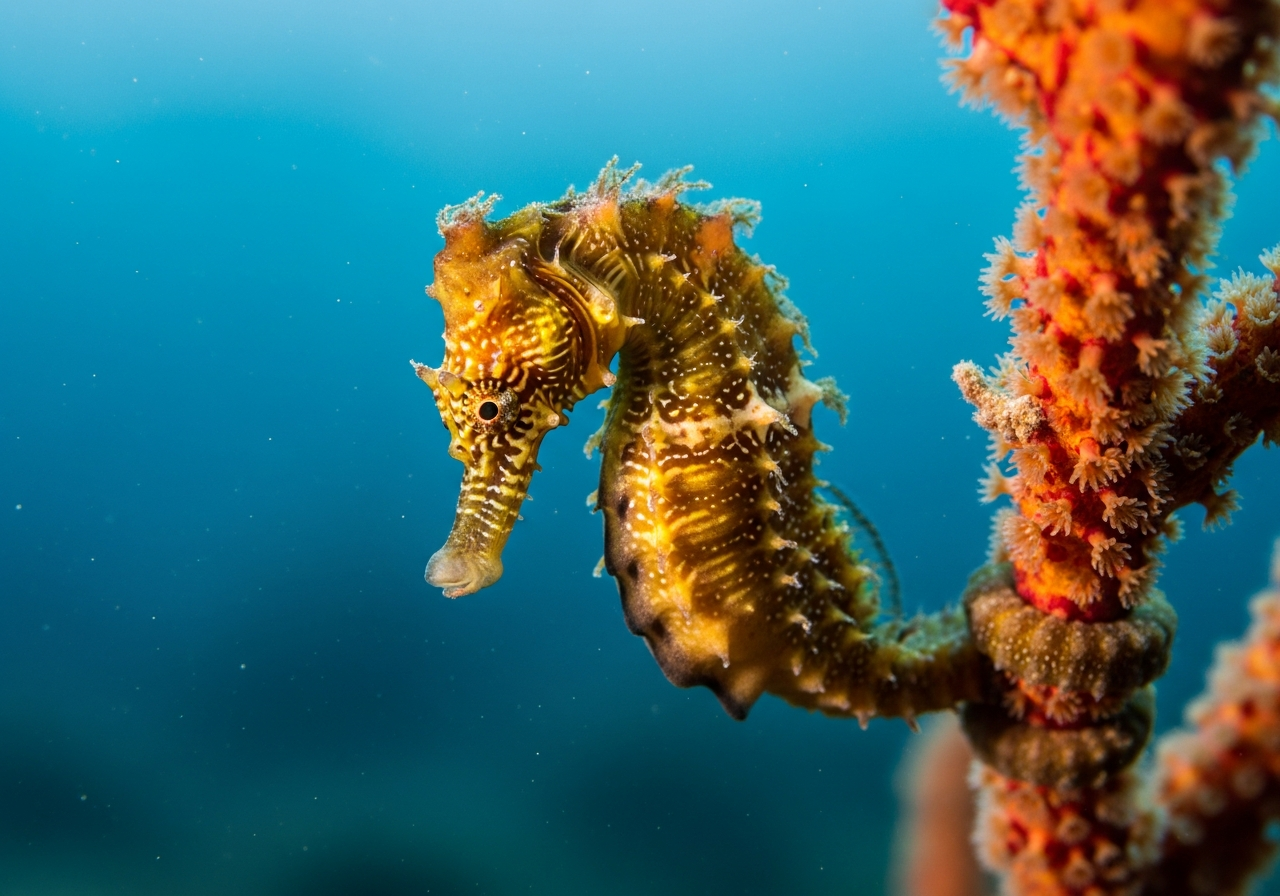
The seahorse is a small marine fish with a horse-like head, an upright posture, and a curling, prehensile tail that grips seagrass and coral. It is one of the only animals in which the male becomes pregnant, carrying the eggs in a pouch until they hatch. Seahorses are weak swimmers that feed by ambush, and many of the roughly 46 species are threatened.
Top questions about the Seahorse
Seahorse facts at a glance
- Weight 10 g
- Length 20 cm
- Top speed 2 km/h
- Lifespan 4 years
| Scientific name | Hippocampus (genus) |
|---|---|
| Diet | Carnivore (tiny crustaceans) |
| Habitat | Seagrass beds, reefs, and estuaries |
| Lifespan | 1–5 years depending on species |
| Length | 1.5–35 cm (0.6–14 in) |
| Top speed | Among the slowest fish |
| Conservation status | Vulnerable (many species) |
| Kingdom | Animalia |
|---|---|
| Phylum | Chordata |
| Class | Actinopterygii |
| Order | Syngnathiformes |
| Family | Syngnathidae |
| Genus | Hippocampus |
Where it lives
The seahorse (Hippocampus) is native to Shallow seagrass beds, reefs, and estuaries in tropical and temperate seas worldwide. — recorded across Oceans in this guide’s range summary.
For occurrence records, see GBIF species search and sources below.
How big is a seahorse?
An adult seahorse measures 20 cm long — about 12% of the height of an average adult person (1.73 m) — and weighs around 10 g, a small fraction of an average adult’s body weight (70 kg).
Length vs an average adult’s height (to scale)
What is a group of seahorses called?
Group name (collective noun)
A group of Seahorses is called a herd.
Baby name
A baby Seahorse is called a fry.
Explore more animal collective nouns and baby animal names .
Pregnant fathers
Seahorses are famous for male pregnancy. The female deposits her eggs into a special brood pouch on the male's belly, where he fertilizes and carries them, supplying oxygen and nutrients, until he gives birth to dozens or even hundreds of tiny, fully formed young.
An unusual fish
Despite appearances, seahorses are true fish. They swim upright, propelled by a small, rapidly beating dorsal fin, and steer with tiny fins behind the eyes. With no scales, their bodies are protected by bony plates under the skin, and a prehensile tail lets them anchor to seagrass and coral against the current.
Ambush feeding
Seahorses have no stomach and no teeth, so they must eat almost constantly. They are ambush predators, anchoring in place and waiting for tiny crustaceans to drift near before sucking them up through their long, tubular snouts with a rapid snap of the head.
Conservation
Many seahorse species are threatened, with several listed as Vulnerable. They are harvested in huge numbers for traditional medicine, the curio trade, and aquariums, and they suffer from the loss of the seagrass and reef habitats they depend on. International trade in seahorses is now regulated.
Dig deeper into the Seahorse
- Are Seahorses Endangered?
Are seahorses endangered? Status Vulnerable, main threats, and what protection means.
- How Long Do Seahorses Live?
Seahorse lifespan is typically 1–5 years depending on species. What shortens or extends life, life stages, and status (Vulnerable).
- Seahorse: Key Facts
The seahorse is a small marine fish with a horse-like head, an upright posture, and a curling, prehensile tail that grips seagrass and coral.
- What Do Seahorses Eat?
What seahorses eat: Carnivore (tiny crustaceans), foraging style, and seasonal shifts in Seagrass beds, reefs, and estuaries.
- Where Do Seahorses Live?
Where seahorses live: Seagrass beds, reefs, and estuaries, native range cues, and human overlap. Status Vulnerable.
Explore the Seahorse
Close relatives
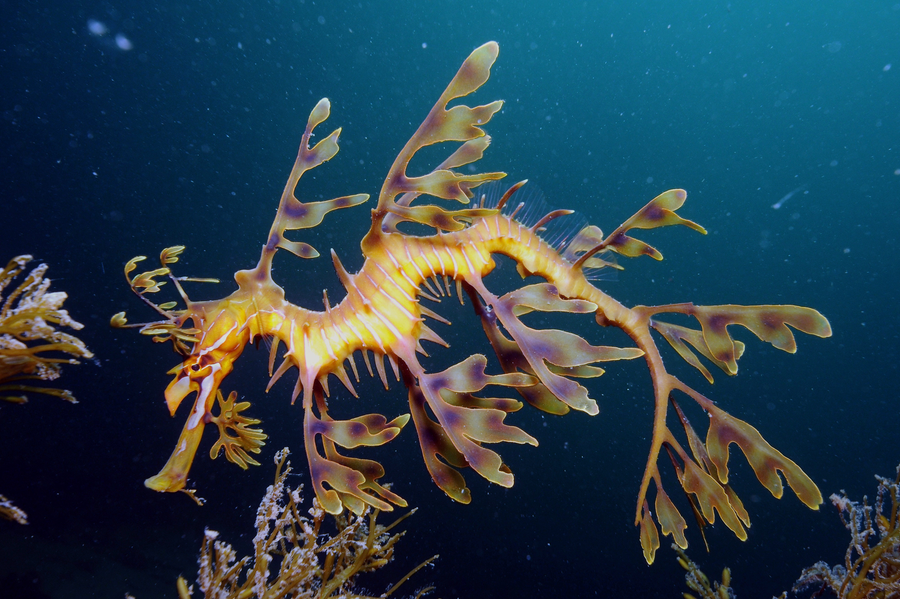
- Leafy Seadragon Same family
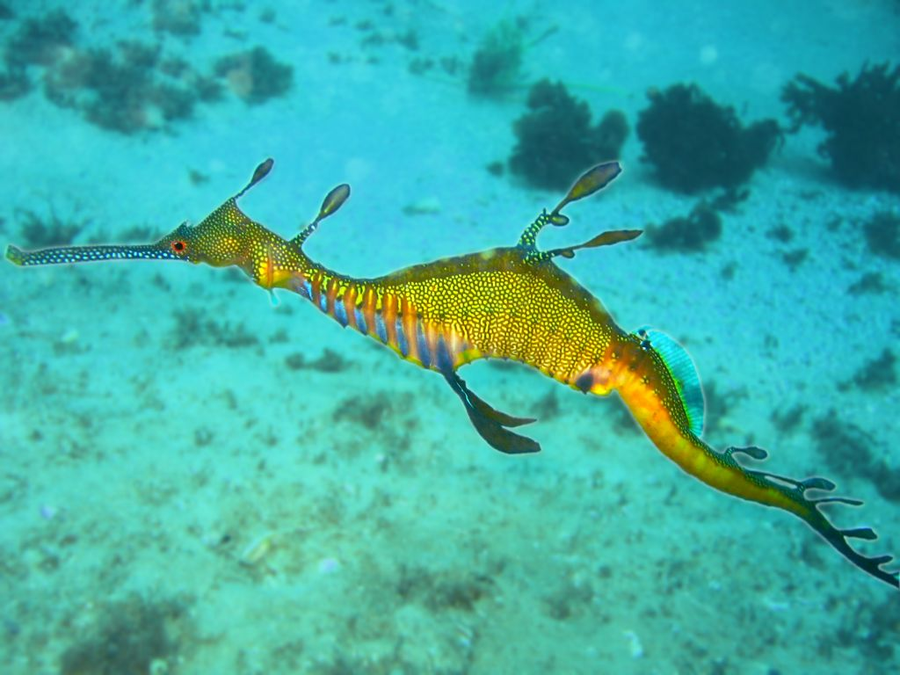
- Weedy Seadragon Same family
- Great White Shark Same class
- Ocean Sunfish Same class
Collections
Range & geography
Did you know? Seahorse facts
- The seahorse is a small marine fish with a horse-like head, an upright posture, and a curling, prehensile tail that grips seagrass and coral.
- Yes. The female transfers her eggs into a pouch on the male's belly, where he fertilizes and carries them until they hatch, then releases the fully formed young, so the father truly gives birth.
- Yes, seahorses are true fish. They breathe through gills, have a swim bladder, and swim using fins, even though their upright posture and horse-like head make them look very different from typical fish.
- Seahorses are carnivores that feed on tiny crustaceans such as copepods and brine shrimp, sucking them up through their tube-shaped snouts. Having no stomach, they must eat almost constantly.
- Seahorses are among the slowest fish. They swim upright using a fast-fluttering dorsal fin to move forward and tiny fins near the eyes to steer, and they grip seagrass with their tails to rest.
- Conservation: Vulnerable (many species).
Diet & feeding
Seahorse feeds primarily as a carnivore (tiny crustaceans). Despite appearances, seahorses are true fish. They swim upright, propelled by a small, rapidly beating dorsal fin, and steer with tiny fins behind the eyes. With no scales, their bodies are protected by bony plates under the skin, and a prehensile tail lets th
Adaptations
- Seahorses are famous for male pregnancy. The female deposits her eggs into a special brood pouch on the male's belly, where he fertilizes and carries them, supplying oxygen and nutrients, until he gives birth to dozens or even hundreds of tiny, fully formed young.
- Despite appearances, seahorses are true fish. They swim upright, propelled by a small, rapidly beating dorsal fin, and steer with tiny fins behind the eyes. With no scales, their bodies are protected by bony plates under the skin, and a prehensile tail lets them anchor to seagrass and coral against the current.
Behaviour & ecology
- Seahorses are famous for male pregnancy. The female deposits her eggs into a special brood pouch on the male's belly, where he fertilizes and carries them, supplying oxygen and nutrients, until he gives birth to dozens or even hundreds of tiny, fully formed young.
- Despite appearances, seahorses are true fish. They swim upright, propelled by a small, rapidly beating dorsal fin, and steer with tiny fins behind the eyes. With no scales, their bodies are protected by bony plates under the skin, and a prehensile tail lets them anchor to seagrass and coral against the current.
- Seahorses have no stomach and no teeth, so they must eat almost constantly. They are ambush predators, anchoring in place and waiting for tiny crustaceans to drift near before sucking them up through their long, tubular snouts with a rapid snap of the head.
Communication
- Lateral-line and visual cues coordinate schooling, courtship, or territorial behaviour.
- Some species produce low-frequency sounds or drumming for spawning or defence.
Habitat & range
Seagrass beds, reefs, and estuaries
Ecological role
Seahorse acts as a predator that helps regulate prey populations and maintain balance in seagrass beds, reefs, and estuaries.
Conservation status of the Seahorse
The seahorse (Hippocampus) is listed as Vulnerable on the IUCN Red List. Vulnerable (VU) means a species faces a high risk of extinction in the medium-term future. It is the lowest-risk of the three 'threatened' IUCN categories — one step below Endangered, which is itself below Critically Endangered — and is often an early warning that a population is in trouble.
The seahorse (Hippocampus) is assessed on the IUCN Red List. Look up on the IUCN Red List .
Frequently asked questions about the Seahorse
Do male seahorses really give birth?
Yes. The female transfers her eggs into a pouch on the male's belly, where he fertilizes and carries them until they hatch, then releases the fully formed young, so the father truly gives birth.
Is a seahorse a fish?
Yes, seahorses are true fish. They breathe through gills, have a swim bladder, and swim using fins, even though their upright posture and horse-like head make them look very different from typical fish.
What do seahorses eat?
Seahorses are carnivores that feed on tiny crustaceans such as copepods and brine shrimp, sucking them up through their tube-shaped snouts. Having no stomach, they must eat almost constantly.
How do seahorses swim?
Seahorses are among the slowest fish. They swim upright using a fast-fluttering dorsal fin to move forward and tiny fins near the eyes to steer, and they grip seagrass with their tails to rest.
Why are seahorses endangered?
Many seahorse species are Vulnerable due to overharvesting for traditional medicine, souvenirs, and the aquarium trade, along with the loss of the seagrass beds and coral reefs they depend on.
What is a group of seahorses called?
A group of Seahorses is called a herd.
What is a baby seahorse called?
A baby Seahorse is called a fry.
Sources & references
This guide is compiled and reviewed against established zoological and conservation references. Key sources for the Seahorse:
-
IUCN Red List of Threatened Species
Conservation status (Vulnerable) reflects the IUCN Red List category for Hippocampus.
-
iNaturalist — observations & photos
Search citizen-science observations and community IDs for Hippocampus. Useful for range checks and recent sightings — not a substitute for formal Red List status.
-
GBIF — occurrence data
Global Biodiversity Information Facility species search for Hippocampus. Explore published occurrence records used in range research.
- IUCN Red List — Hippocampus.
Conservation status (Vulnerable) and population trends.
- Wikipedia — Seahorse.
General taxonomy and overview (cross-check primary sources).
-
Global Animal Guide editorial standards
How we research, source, review, and update every guide for accuracy.