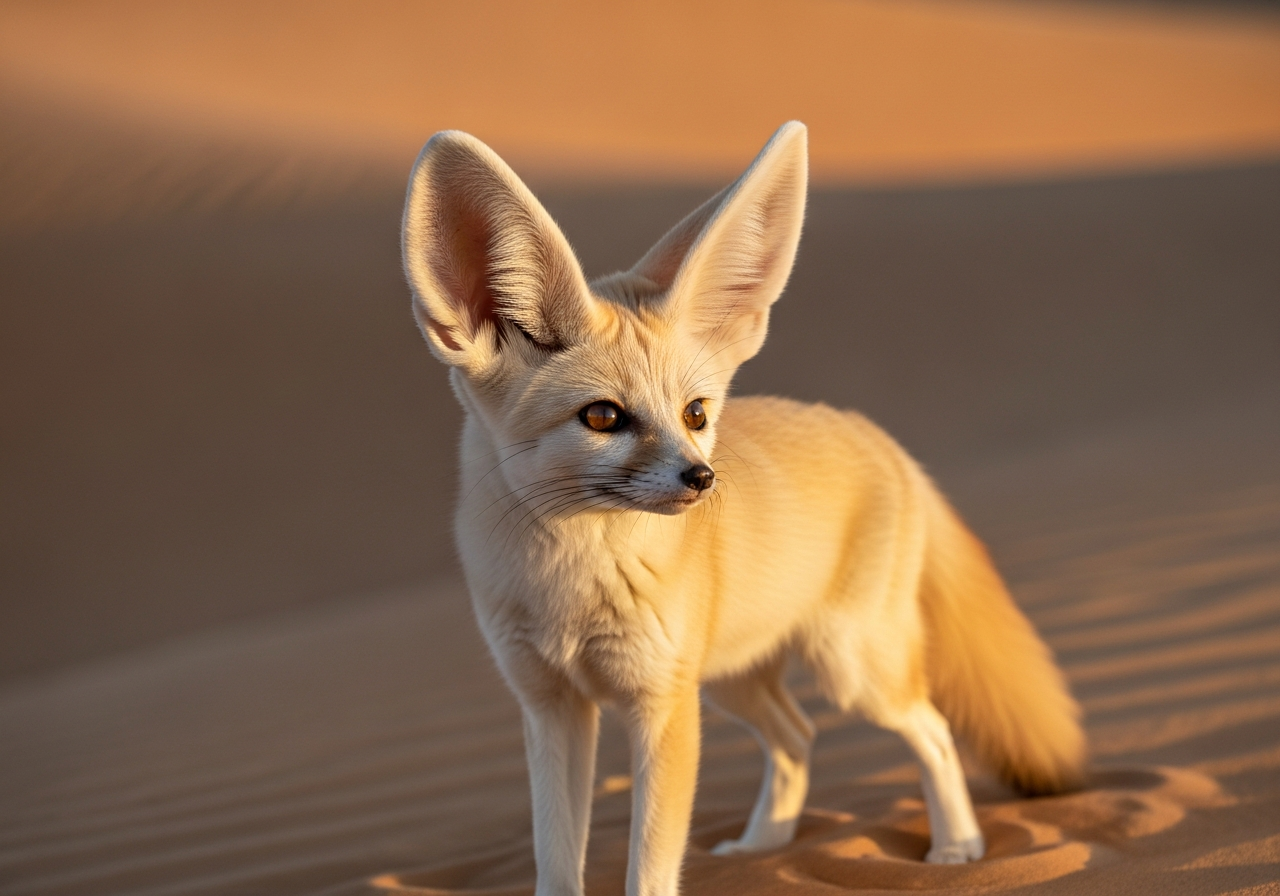
The fennec fox (Vulpes zerda) is a mammal of the dog family, Canidae, in the order Carnivora.
Quick answer
The fennec fox is the world's smallest fox, native to the deserts of North Africa and the Sahara. Its huge ears radiate body heat and pick up the sound of prey underground, while pale fur and furry feet help it survive scorching sand. Fennec foxes weigh about 1 kg and live 10 to 14 years.
Top questions about the Fennec Fox
Also available in Español (Fénec)
Fennec Fox facts at a glance
- Weight 1.2 kg
- Length 40 cm
- Top speed 32 km/h
- Lifespan 12 years
| Scientific name | Vulpes zerda |
|---|---|
| Diet | Omnivore (insects, small animals, plants) |
| Habitat | Sandy deserts of North Africa and the Sahara |
| Lifespan | 10–14 years |
| Weight | 0.7–1.6 kg (1.5–3.5 lb) |
| Length | Around 40 cm (16 in) plus tail |
| Conservation status | Least Concern (IUCN) |
| Kingdom | Animalia |
|---|---|
| Phylum | Chordata |
| Class | Mammalia |
| Order | Carnivora |
| Family | Canidae |
| Genus | Vulpes |
Where it lives
The fennec fox (Vulpes zerda) is native to The sandy deserts of North Africa and the Sahara, from Morocco and Mauritania east to the Sinai Peninsula. — recorded across Africa in this guide’s range summary.
For occurrence records, see GBIF species search and sources below.
How big is a fennec fox?
An adult fennec fox measures 40 cm long — about 23% of the height of an average adult person (1.73 m) — and weighs around 1.2 kg, about 2% of an average adult’s body weight (70 kg).
Length vs an average adult’s height (to scale)
What is a group of fennec foxes called?
Group name (collective noun)
A group of Fennec Foxes is called a skulk. It is also known as a leash.
Baby name
A baby Fennec Fox is called a kit. It may also be called a pup.
Explore more animal collective nouns and baby animal names .
Ears built for the desert
Relative to its body, the fennec fox has the largest ears of any carnivore — up to 15 cm (6 in) long. They serve two jobs: the wide surface radiates excess body heat to keep the fox cool, and the sensitive hearing lets it locate insects and small animals moving beneath the sand. Few features illustrate desert adaptation more clearly.
Surviving extreme heat
The fennec fox is superbly adapted to one of the harshest habitats on Earth. Thick fur even covers the soles of its feet, protecting them from hot sand and improving grip. It can go for long periods without drinking, taking most of its water from food, and shelters in cool underground dens by day, emerging to hunt in the cool of night.
Habitat and range
The fennec fox lives across the sandy deserts of North Africa, including the Sahara, from Morocco and Mauritania east to the Sinai and Arabian fringes. It favors stable sand dunes with sparse vegetation where it can dig dens, and it is rarely found far from this arid desert habitat.
Conservation
The fennec fox is listed as Least Concern, and across most of its remote range it remains reasonably common. Localized threats include trapping for the pet trade and for sale to tourists, plus habitat disturbance from expanding human settlement. It is legally protected in several countries within its range.
Dig deeper into the Fennec Fox
- Fennec Fox: Key Facts
The fennec fox is the world's smallest fox, native to the deserts of North Africa and the Sahara.
- How Fast Is A Fennec Fox?
Fennec Fox top speed is about about 32 km/h. Sprint vs endurance and what limits pace.
- How Long Do Fennec Foxs Live?
Fennec Fox lifespan is typically 10–14 years. What shortens or extends life, life stages, and status (Least Concern).
- What Do Fennec Foxs Eat?
What fennec foxs eat: Omnivore (insects, small animals, plants), foraging style, and seasonal shifts in Sandy deserts of North Africa and the Sahara.
- Where Do Fennec Foxs Live?
Where fennec foxs live: Sandy deserts of North Africa and the Sahara, native range cues, and human overlap. Status Least Concern.
Explore the Fennec Fox
Compare
Close relatives
- Arctic Fox Same genus
- Red Fox Same genus
- Dog Same family
- Gray Wolf Same family
Range & geography
Did you know? Fennec Fox facts
- The fennec fox is the world's smallest fox, native to the deserts of North Africa and the Sahara.
- Their oversized ears do two things: they radiate body heat to keep the fox cool in the desert, and their keen hearing lets the fox detect insects and small prey moving under the sand.
- The fennec is the smallest fox in the world, weighing about 1 kg (2–3 lb) — roughly the size of a small house cat, but with far larger ears.
- Fennec foxes are omnivores that eat insects, small rodents, birds, eggs, and plants such as roots and fruit, getting much of the water they need from their food.
- In some places people do keep them, but they are wild desert animals with specialized needs and are illegal to own in many areas. Demand for pets is also a threat to wild populations.
- Conservation: Least Concern (IUCN).
Diet & feeding
Fennec Fox feeds primarily as a omnivore (insects, small animals, plants). Relative to its body, the fennec fox has the largest ears of any carnivore — up to 15 cm (6 in) long. They serve two jobs: the wide surface radiates excess body heat to keep the fox cool, and the sensitive hearing lets it locate insects and smal
Adaptations
- Relative to its body, the fennec fox has the largest ears of any carnivore — up to 15 cm (6 in) long. They serve two jobs: the wide surface radiates excess body heat to keep the fox cool, and the sensitive hearing lets it locate insects and small animals moving beneath the sand. Few features illustrate desert adaptation more clearly.
- The fennec fox is superbly adapted to one of the harshest habitats on Earth. Thick fur even covers the soles of its feet, protecting them from hot sand and improving grip. It can go for long periods without drinking, taking most of its water from food, and shelters in cool underground dens by day, emerging to hunt in the cool of night.
Behaviour & ecology
- Relative to its body, the fennec fox has the largest ears of any carnivore — up to 15 cm (6 in) long. They serve two jobs: the wide surface radiates excess body heat to keep the fox cool, and the sensitive hearing lets it locate insects and small animals moving beneath the sand. Few features illustrate desert adaptation more clearly.
- The fennec fox is superbly adapted to one of the harshest habitats on Earth. Thick fur even covers the soles of its feet, protecting them from hot sand and improving grip. It can go for long periods without drinking, taking most of its water from food, and shelters in cool underground dens by day, emerging to hunt in the cool of night.
- Unlike many foxes, fennecs are social animals that live in small family groups and dig extensive communal burrows. They are highly vocal, using a range of barks, squeaks, whimpers, and chatters to communicate. Pairs are thought to mate for life, and both parents help care for the pups born in the spring.
Communication
- Fennec Fox uses scent, posture, and vocal signals to mark territory and coordinate social behaviour.
- Communication intensity often peaks during breeding seasons and territorial disputes.
Habitat & range
Sandy deserts of North Africa and the Sahara
Ecological role
Fennec Fox plays a recognised ecological role in sandy deserts of north africa and the sahara.
Conservation status of the Fennec Fox
The fennec fox (Vulpes zerda) is listed as Least Concern on the IUCN Red List. Least Concern (LC) is the IUCN's lowest-risk category, assigned to widespread, abundant species that have been evaluated and found not to be threatened. It does not mean a species faces no pressures — only that it is not currently at risk of extinction.
The fennec fox (Vulpes zerda) is assessed on the IUCN Red List. Look up on the IUCN Red List .
Frequently asked questions about the Fennec Fox
Why do fennec foxes have such big ears?
Their oversized ears do two things: they radiate body heat to keep the fox cool in the desert, and their keen hearing lets the fox detect insects and small prey moving under the sand.
How big is a fennec fox?
The fennec is the smallest fox in the world, weighing about 1 kg (2–3 lb) — roughly the size of a small house cat, but with far larger ears.
What do fennec foxes eat?
Fennec foxes are omnivores that eat insects, small rodents, birds, eggs, and plants such as roots and fruit, getting much of the water they need from their food.
Can you keep a fennec fox as a pet?
In some places people do keep them, but they are wild desert animals with specialized needs and are illegal to own in many areas. Demand for pets is also a threat to wild populations.
Where do fennec foxes live?
Fennec foxes live in the sandy deserts of North Africa and the Sahara, sheltering in underground dens by day and hunting in the cool of the night.
What is a group of fennec foxes called?
A group of Fennec Foxes is called a skulk. It is also known as a leash.
What is a baby fennec fox called?
A baby Fennec Fox is called a kit. It may also be called a pup.
Sources & references
This guide is compiled and reviewed against established zoological and conservation references. Key sources for the Fennec Fox:
-
IUCN Red List of Threatened Species
Conservation status (Least Concern) reflects the IUCN Red List category for Vulpes zerda.
-
iNaturalist — observations & photos
Search citizen-science observations and community IDs for Vulpes zerda. Useful for range checks and recent sightings — not a substitute for formal Red List status.
-
GBIF — occurrence data
Global Biodiversity Information Facility species search for Vulpes zerda. Explore published occurrence records used in range research.
- IUCN Red List — Vulpes zerda.
Conservation status (Least Concern) and population trends.
- Animal Diversity Web — Vulpes zerda. University of Michigan Museum of Zoology.
Life history, morphology, and range.
- Wikipedia — Fennec Fox.
General taxonomy and overview (cross-check primary sources).
-
Global Animal Guide editorial standards
How we research, source, review, and update every guide for accuracy.
Social and vocal
Unlike many foxes, fennecs are social animals that live in small family groups and dig extensive communal burrows. They are highly vocal, using a range of barks, squeaks, whimpers, and chatters to communicate. Pairs are thought to mate for life, and both parents help care for the pups born in the spring.