Image sourcing: see credits & licences
The mole (Talpa europaea) is a mammal of the family Talpidae, in the order Eulipotyphla.
Quick answer
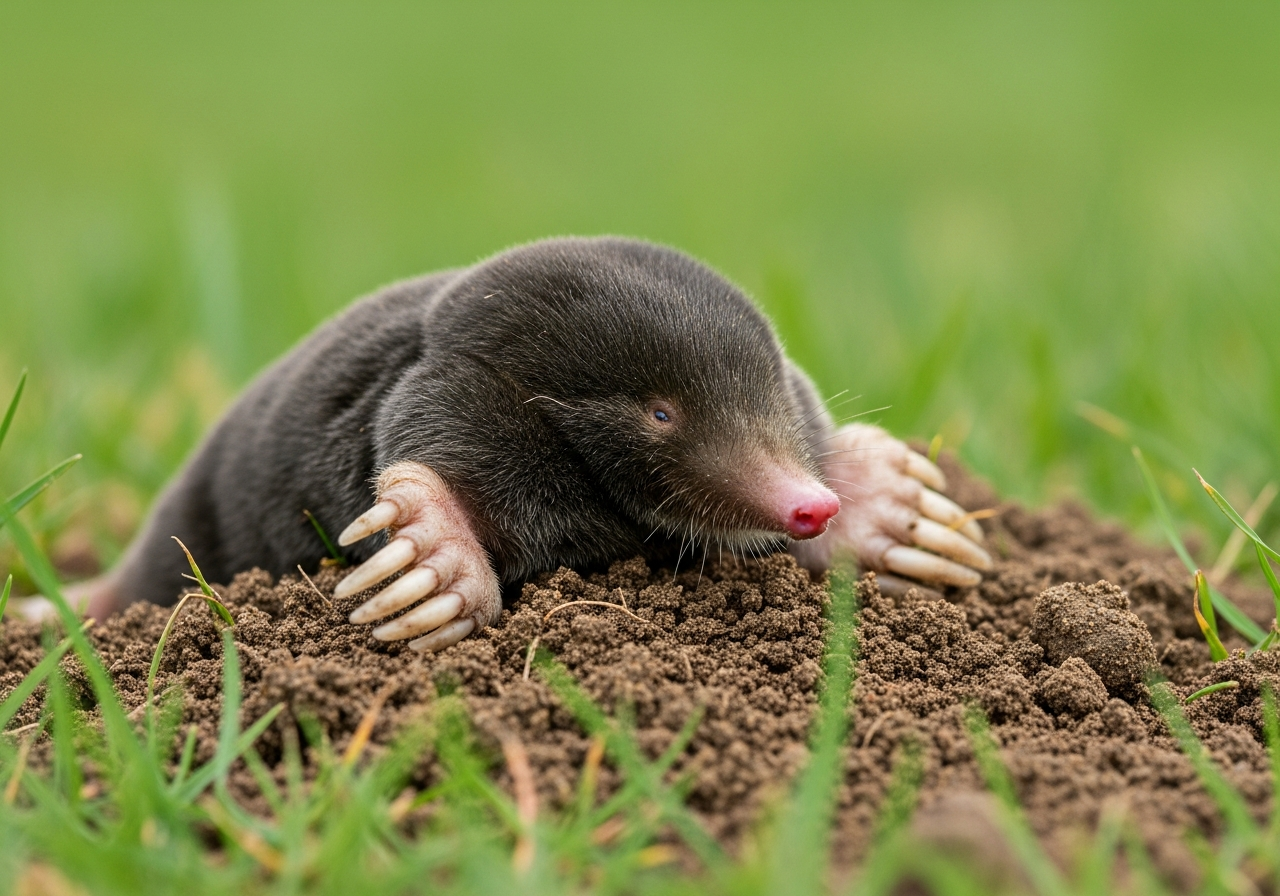
The European mole is a small, cylindrical burrowing mammal with velvety black fur, tiny eyes, and enormous spade-like front paws built for digging. It spends almost its entire life underground, hunting earthworms in a network of tunnels, and the molehills on lawns are the soil it pushes to the surface. Moles weigh only about 70–130 g and usually live around 3 years.
Top questions about the Mole
Mole facts at a glance
- Weight 110 g
- Length 14 cm
- Top speed 4 km/h
- Lifespan 6 years
| Scientific name | Talpa europaea |
|---|---|
| Diet | Insectivore (mostly earthworms) |
| Habitat | Underground tunnels in grassland, woodland, gardens |
| Lifespan | About 3 years (up to 6) |
| Weight | 70–130 g (2.5–4.6 oz) |
| Top speed | Around 4 km/h digging through soil |
| Conservation status | Least Concern (IUCN) |
| Kingdom | Animalia |
|---|---|
| Phylum | Chordata |
| Class | Mammalia |
| Order | Eulipotyphla |
| Family | Talpidae |
| Genus | Talpa |
Where it lives
The mole (Talpa europaea) is native to Mainland Britain and most of continental Europe, east into Russia; absent from Ireland. — recorded across Europe, Asia in this guide’s range summary.
For occurrence records, see GBIF species search and sources below.
How big is a mole?
An adult mole measures 14 cm long — about 8% of the height of an average adult person (1.73 m) — and weighs around 110 g, a small fraction of an average adult’s body weight (70 kg).
Length vs an average adult’s height (to scale)
What is a group of moles called?
Group name (collective noun)
A group of Moles is called a labour.
Baby name
A baby Mole is called a pup.
Explore more animal collective nouns and baby animal names .
Built for digging
The mole is one of nature's most specialised diggers. Its broad, outward-facing front paws work like shovels, and an extra thumb-like bone widens each paw to move more soil. Its fur has no grain, so it can move forwards or backwards in a tight tunnel without snagging, and a high tolerance for carbon dioxide lets it breathe the stale air of its burrows.
Diet and the worm larder
Moles are insectivores that feed mainly on earthworms, detecting the vibrations of prey falling into their tunnels. When food is plentiful a mole will bite the heads off surplus earthworms to paralyse them and store them alive in a special chamber — caches of hundreds of worms have been found in a single larder. A mole must eat frequently and can starve within a day if it cannot feed.
Habitat and molehills
The European mole lives across most of Britain and continental Europe in any soil soft enough to tunnel, from meadows and woodland to gardens and playing fields. The familiar molehills are simply the spoil heaps of excavated earth; a single mole digs and maintains an extensive territory of tunnels and is usually solitary, defending its system against other moles.
Conservation
Moles are listed as Least Concern and remain common, although they are absent from Ireland. They are widely regarded as a garden and pasture pest because of their molehills, but they also aerate soil and control insect pests. Their main natural predators include owls, buzzards, foxes, and stoats when they venture briefly above ground.
Dig deeper into the Mole
- How Long Do Moles Live?
Mole lifespan is typically About 3 years (up to 6). What shortens or extends life, life stages, and status (Least Concern).
- What Do Moles Eat?
What moles eat: Insectivore (mostly earthworms), foraging style, and seasonal shifts in Underground tunnels in grassland, woodland, gardens.
- Where Do Moles Live?
Where moles live: Underground tunnels in grassland, woodland, gardens, native range cues, and human overlap. Status Least Concern.
Explore the Mole
Close relatives
- Hedgehog Same order
- Common Shrew Same order
- Lion Same class
- Dog Same class
Range & geography
Did you know? Mole facts
- The European mole is a small, cylindrical burrowing mammal with velvety black fur, tiny eyes, and enormous spade-like front paws built for digging.
- A group of moles is called a labour. Moles are mostly solitary, so groups are uncommon outside of a mother with her young, and a baby mole is called a pup.
- Moles are not completely blind, but their eyes are tiny and hidden in the fur and can only sense light and movement. Living underground, they rely far more on touch, smell, and vibration than on sight.
- Moles are insectivores that feed mainly on earthworms, along with insect larvae, grubs, and other small soil invertebrates. They can store live, paralysed earthworms in underground larders for later.
- Molehills are the heaps of soil a mole pushes to the surface as it digs and maintains its tunnel network. The tunnels act as traps that earthworms fall into, providing the mole with food.
- Conservation: Least Concern (IUCN).
Diet & feeding
Mole feeds primarily as a insectivore (mostly earthworms). The mole is one of nature's most specialised diggers. Its broad, outward-facing front paws work like shovels, and an extra thumb-like bone widens each paw to move more soil. Its fur has no grain, so it can move forwards or backwards in a tight tunnel without sn
Adaptations
- The mole is one of nature's most specialised diggers. Its broad, outward-facing front paws work like shovels, and an extra thumb-like bone widens each paw to move more soil. Its fur has no grain, so it can move forwards or backwards in a tight tunnel without snagging, and a high tolerance for carbon dioxide lets it breathe the stale air of its burrows.
- Moles are insectivores that feed mainly on earthworms, detecting the vibrations of prey falling into their tunnels. When food is plentiful a mole will bite the heads off surplus earthworms to paralyse them and store them alive in a special chamber — caches of hundreds of worms have been found in a single larder. A mole must eat frequently and can starve within a day if it cannot feed.
Behaviour & ecology
- The mole is one of nature's most specialised diggers. Its broad, outward-facing front paws work like shovels, and an extra thumb-like bone widens each paw to move more soil. Its fur has no grain, so it can move forwards or backwards in a tight tunnel without snagging, and a high tolerance for carbon dioxide lets it breathe the stale air of its burrows.
- Moles are insectivores that feed mainly on earthworms, detecting the vibrations of prey falling into their tunnels. When food is plentiful a mole will bite the heads off surplus earthworms to paralyse them and store them alive in a special chamber — caches of hundreds of worms have been found in a single larder. A mole must eat frequently and can starve within a day if it cannot feed.
- The European mole lives across most of Britain and continental Europe in any soil soft enough to tunnel, from meadows and woodland to gardens and playing fields. The familiar molehills are simply the spoil heaps of excavated earth; a single mole digs and maintains an extensive territory of tunnels and is usually solitary, defending its system against other moles.
Communication
- Mole uses scent, posture, and vocal signals to mark territory and coordinate social behaviour.
- Communication intensity often peaks during breeding seasons and territorial disputes.
Habitat & range
Underground tunnels in grassland, woodland, gardens
Ecological role
Mole plays a recognised ecological role in underground tunnels in grassland, woodland, gardens.
Conservation status of the Mole
The mole (Talpa europaea) is listed as Least Concern on the IUCN Red List. Least Concern (LC) is the IUCN's lowest-risk category, assigned to widespread, abundant species that have been evaluated and found not to be threatened. It does not mean a species faces no pressures — only that it is not currently at risk of extinction.
The mole (Talpa europaea) is assessed on the IUCN Red List. Look up on the IUCN Red List .
Frequently asked questions about the Mole
What is a group of moles called?
A group of moles is called a labour. Moles are mostly solitary, so groups are uncommon outside of a mother with her young, and a baby mole is called a pup.
Are moles blind?
Moles are not completely blind, but their eyes are tiny and hidden in the fur and can only sense light and movement. Living underground, they rely far more on touch, smell, and vibration than on sight.
What do moles eat?
Moles are insectivores that feed mainly on earthworms, along with insect larvae, grubs, and other small soil invertebrates. They can store live, paralysed earthworms in underground larders for later.
Why do moles make molehills?
Molehills are the heaps of soil a mole pushes to the surface as it digs and maintains its tunnel network. The tunnels act as traps that earthworms fall into, providing the mole with food.
How long do moles live?
European moles usually live around 3 years in the wild, though some reach up to about 6 years. Many die young from starvation, predation, or being killed as garden pests.
What is a baby mole called?
A baby Mole is called a pup.
Sources & references
This guide is compiled and reviewed against established zoological and conservation references. Key sources for the Mole:
-
IUCN Red List of Threatened Species
Conservation status (Least Concern) reflects the IUCN Red List category for Talpa europaea.
-
iNaturalist — observations & photos
Search citizen-science observations and community IDs for Talpa europaea. Useful for range checks and recent sightings — not a substitute for formal Red List status.
-
GBIF — occurrence data
Global Biodiversity Information Facility species search for Talpa europaea. Explore published occurrence records used in range research.
- IUCN Red List — Talpa europaea.
Conservation status (Least Concern) and population trends.
- Animal Diversity Web — Talpa europaea. University of Michigan Museum of Zoology.
Life history, morphology, and range.
- Wikipedia — Mole.
General taxonomy and overview (cross-check primary sources).
-
Global Animal Guide editorial standards
How we research, source, review, and update every guide for accuracy.