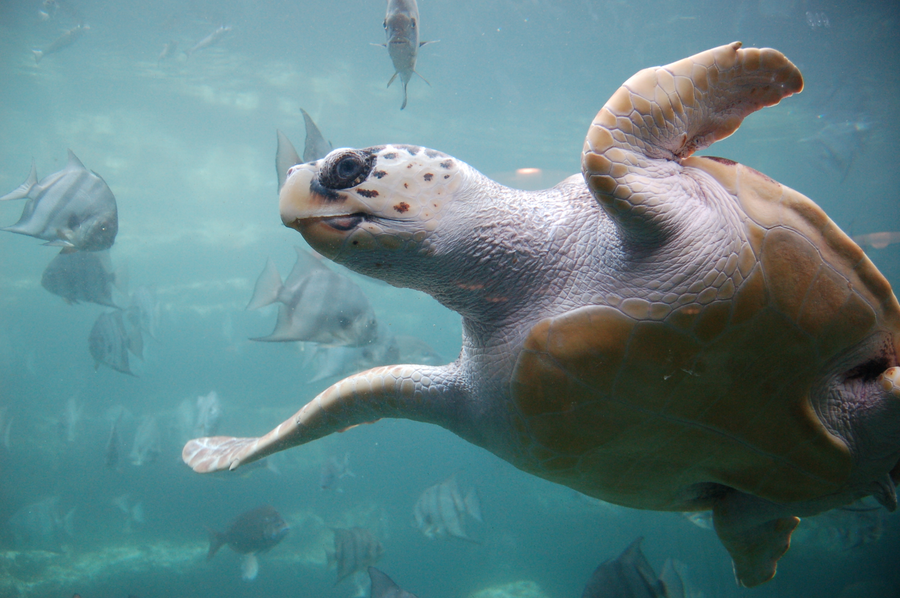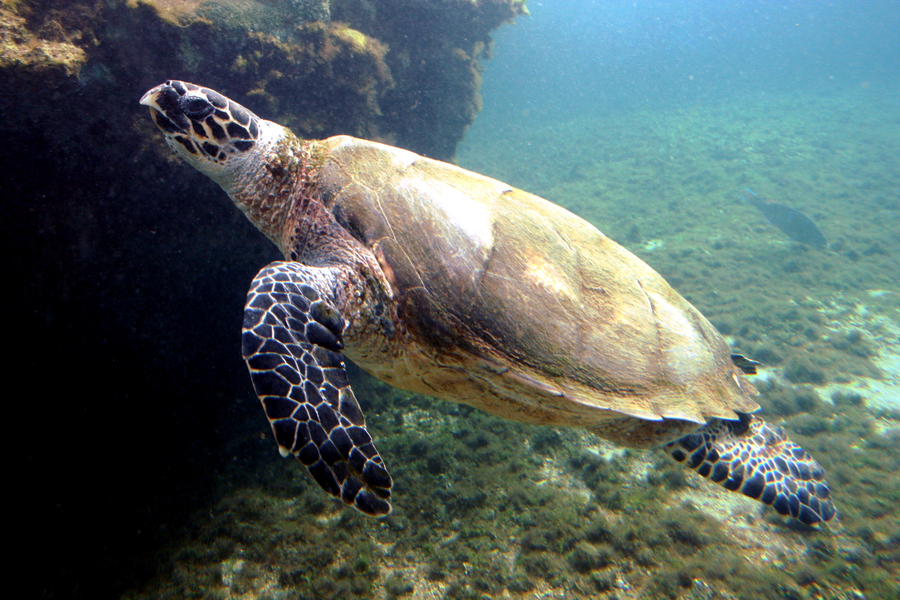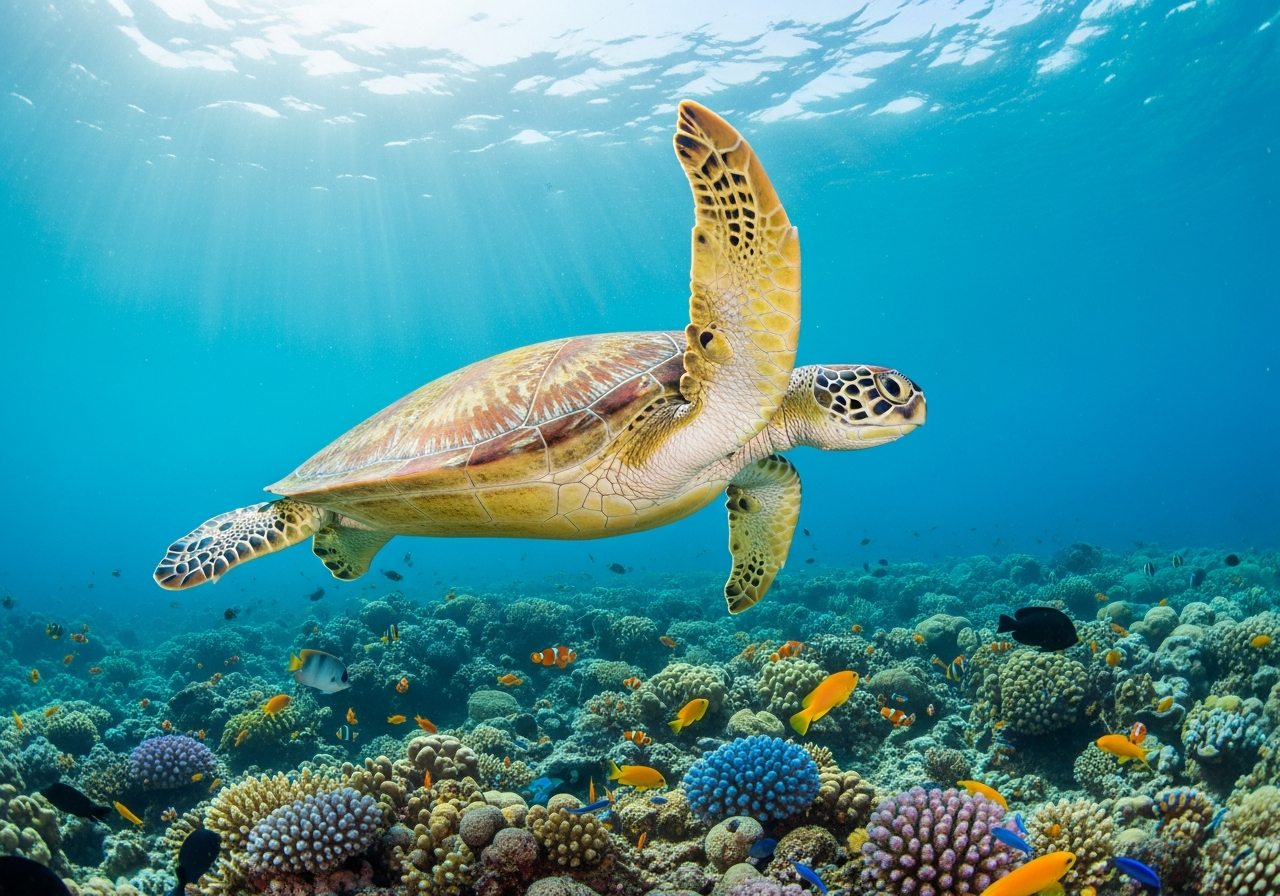
The green sea turtle (Chelonia mydas) is a reptile of the family Cheloniidae, in the order Testudines.
Quick answer
The green sea turtle is a large marine reptile found in warm oceans worldwide, named for the greenish color of its body fat rather than its shell. Adults are unusual among sea turtles in being mostly herbivorous, grazing on seagrass and algae. They migrate long distances between feeding grounds and the beaches where they hatched, and can live 70 to 80 years or more.
Top questions about the Green Sea Turtle
Green Sea Turtle facts at a glance
- Weight 160 kg
- Length 1.5 m
- Top speed 35 km/h
- Lifespan 80 years
| Scientific name | Chelonia mydas |
|---|---|
| Diet | Herbivore as adults (seagrass, algae) |
| Habitat | Tropical and subtropical coastal seas |
| Lifespan | 70–80+ years |
| Weight | Up to 160 kg (350 lb) |
| Top speed | ~35 km/h (22 mph) in short bursts |
| Conservation status | Least Concern (IUCN, global assessment 2025) |
| Kingdom | Animalia |
|---|---|
| Phylum | Chordata |
| Class | Reptilia |
| Order | Testudines |
| Family | Cheloniidae |
| Genus | Chelonia |
Where it lives
The green sea turtle (Chelonia mydas) is native to Tropical and subtropical oceans worldwide, nesting on beaches in more than 80 countries. — recorded across Oceans in this guide’s range summary.
For occurrence records, see GBIF species search and sources below.
How big is a green sea turtle?
An adult green sea turtle measures 1.5 m long — about 87% of the height of an average adult person (1.73 m) — and weighs around 160 kg, about 2.3× an average adult’s body weight (70 kg).
Length vs an average adult’s height (to scale)
What is a group of green sea turtles called?
Group name (collective noun)
A group of Green Sea Turtles is called a bale. It is also known as a nest.
Baby name
A baby Green Sea Turtle is called a hatchling.
Explore more animal collective nouns and baby animal names .
Behavior and migration
Green sea turtles undertake some of the longest migrations of any reptile, traveling hundreds or thousands of kilometers between feeding areas and nesting beaches. Remarkably, females return to the very beach where they hatched to lay their own eggs, navigating using the Earth's magnetic field.
Diet
Hatchlings and juveniles eat a mix of animals and plants, but adults switch to a largely herbivorous diet of seagrass and algae. This grazing keeps seagrass meadows healthy, making green turtles important to coastal ecosystems.
Habitat and range
Green sea turtles live in tropical and subtropical waters around the world, favoring shallow coastal areas with seagrass beds and coral reefs. They come ashore only to nest, with females digging nests on sandy beaches at night.
Conservation
Green sea turtles are assessed as Least Concern globally in the 2025 IUCN assessment, following decades of conservation. Some regional populations remain threatened. They face threats from hunting, egg collection, accidental capture in fishing gear, plastic pollution, and the loss of nesting beaches to coastal development and rising seas. Protected nesting sites and fishing regulations are helping some populations recover.
One turtle, several habitats and life stages
Green turtles use different habitats as they grow and may travel long distances between feeding and nesting areas. Protecting a nesting beach alone cannot address every threat encountered at sea. Entanglement, vessel strikes and loss of suitable habitat can affect survival. Conservation labels also need context: a national legal listing, a regional population and a global Red List assessment are not interchangeable.
Dig deeper into the Green Sea Turtle
- Are Green Sea Turtles Endangered?
Green turtles are IUCN Endangered (2004). Bycatch, egg harvest and seagrass loss. Named for green fat, not the shell. Not hawksbills.
- Green Sea Turtle: Key Facts
The green sea turtle is a large marine reptile found in warm oceans worldwide, named for the greenish color of its body fat rather than its shell.
- How Long Do Green Sea Turtles Live?
Green turtles often live about 70–80 years or more; bycatch and egg harvest cut the average. IUCN Endangered.
- What Do Green Sea Turtles Eat?
Adult green turtles graze seagrass and algae; juveniles eat more animals. Not hawksbill sponges. Never feed them.
- Where Do Green Sea Turtles Live?
Green turtles live in tropical and subtropical coastal seas with seagrass, and nest on natal beaches. IUCN Endangered.
Explore the Green Sea Turtle
Close relatives
- Hawksbill Sea Turtle Same family
- Leatherback Sea Turtle Same order
- Alligator Snapping Turtle Same order
- Loggerhead Sea Turtle Same order
Collections
Range & geography
Did you know? Green Sea Turtle facts
- Adult green sea turtles are unusual among sea turtles in being largely herbivorous.
- Their diet of seagrass and algae is what gives their body fat a greenish tint.
- They can migrate thousands of kilometres between feeding and nesting beaches.
- Females return to the very beach where they hatched to lay their eggs.
- The temperature of the nest determines the hatchlings' sex.
- Green sea turtles are Least Concern globally (IUCN 2025); regional threats from bycatch, hunting and habitat loss remain.
Diet & feeding
Adult green sea turtles are mainly herbivorous, feeding on seagrasses and algae, while juveniles are more omnivorous, taking invertebrates as well.
Adaptations
- Finely serrated jaws are suited to cropping seagrass and algae.
- Streamlined shells and flipper-like limbs make them efficient long-distance swimmers.
- Salt glands near the eyes excrete excess salt from seawater.
- Natal homing guides females back to their birth beach to nest.
Behaviour & ecology
- Green turtles graze seagrass meadows and algae beds as adults.
- They undertake long migrations between feeding grounds and nesting beaches.
- Females come ashore to dig nests and lay clutches of eggs at night.
- Hatchlings rush to the sea and spend early years in the open ocean.
Communication
- Sea turtles rely mainly on vision and chemical cues rather than vocal signals.
- Hatchlings use light and slope cues to find the sea.
- Adults navigate using Earth's magnetic field on long migrations.
Habitat & range
Green sea turtles inhabit tropical and subtropical coastal waters worldwide, grazing in shallow seagrass and algae habitats and nesting on sandy beaches.
Ecological role
As grazers of seagrass, green turtles keep meadows healthy and productive, supporting fisheries and carbon storage, and they cycle nutrients between sea and beach.
Conservation status of the Green Sea Turtle
The green sea turtle (Chelonia mydas) is listed as Least Concern on the IUCN Red List. Least Concern (LC) is the IUCN's lowest-risk category, assigned to widespread, abundant species that have been evaluated and found not to be threatened. It does not mean a species faces no pressures — only that it is not currently at risk of extinction.
Main threats to the green sea turtle
- Fisheries bycatch
- Harvest of eggs and adults
- Coastal development
- Climate change
Green Sea Turtle (Chelonia mydas) was most recently assessed for the IUCN Red List in 2025. View the full IUCN assessment .
Frequently asked questions about the Green Sea Turtle
Why is it called a green sea turtle?
The green sea turtle is named for the greenish color of the fat under its shell, not the color of the shell itself, which is usually brown or olive.
What do green sea turtles eat?
Adult green sea turtles are mostly herbivores, grazing on seagrass and algae. Younger turtles also eat small animals such as jellyfish and crustaceans.
How long do green sea turtles live?
Green sea turtles are long-lived, commonly reaching 70 to 80 years and sometimes more. They take decades to reach breeding age.
Do sea turtles return to where they were born?
Yes. Female green sea turtles return to the same beach where they hatched to lay their eggs, navigating across open ocean using the Earth's magnetic field.
Are green sea turtles endangered?
Green sea turtles are globally Least Concern in the 2025 IUCN assessment. Some regional populations remain threatened, and national legal protections can differ from the global Red List category. Bycatch, harvest and habitat loss still require conservation action.
How fast can a sea turtle swim?
Green sea turtles usually cruise slowly but can burst to around 35 km/h (22 mph) when escaping danger.
Are all green turtles strictly herbivorous?
No. Diet changes with life stage and location. Many adults feed predominantly on seagrasses and algae, while younger turtles can have a more mixed diet. A simple “herbivore” label is useful as an introduction but does not describe every individual throughout its life.
What is a group of green sea turtles called?
A group of Green Sea Turtles is called a bale. It is also known as a nest.
What is a baby green sea turtle called?
A baby Green Sea Turtle is called a hatchling.
Sources & references
This guide is compiled and reviewed against established zoological and conservation references. Key sources for the Green Sea Turtle:
-
IUCN Red List of Threatened Species
Conservation status (Least Concern) reflects the IUCN Red List category for Chelonia mydas, most recently assessed in 2025.
-
iNaturalist — observations & photos
Search citizen-science observations and community IDs for Chelonia mydas. Useful for range checks and recent sightings — not a substitute for formal Red List status.
-
GBIF — occurrence data
Global Biodiversity Information Facility species search for Chelonia mydas. Explore published occurrence records used in range research.
- IUCN SSC Marine Turtle Specialist Group — Green turtle assessments (2025).
Global Least Concern status and distinct regional assessments; checked 19 September 2026.
- The Reptile Database (reptile-database.org).
Taxonomy and distribution.
- Animal Diversity Web — Chelonia mydas. University of Michigan Museum of Zoology.
Life history, morphology, and range.
-
Global Animal Guide editorial standards
How we research, source, review, and update every guide for accuracy.
Want to help directly? Learn how to symbolically adopt a green sea turtle and support its conservation.